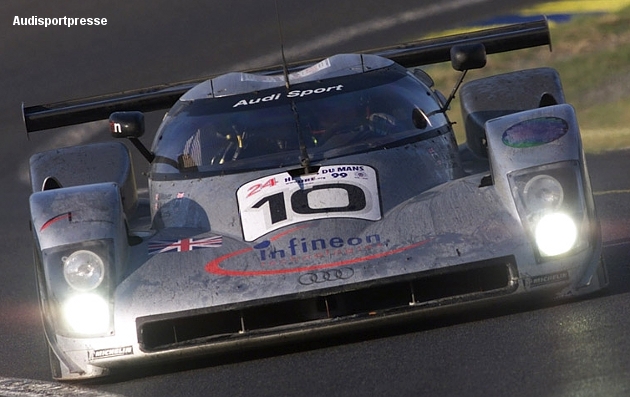
 In
this view you can see the effects of the frontal area reduction
program. We understand that only the one front fender
configuration, where the fender was open on the inner face to allow for
a narrower fender, and was,
"cribbed from Toyota," as designer Peter Elleray admits, was ever tried
in
the wind tunnel. In hind sight, while it did add downforce,
the Toyota solution
also added drag and didn't have any effect on reducing frontal area (given the
rear
wheel masking it in front elevation).
In
this view you can see the effects of the frontal area reduction
program. We understand that only the one front fender
configuration, where the fender was open on the inner face to allow for
a narrower fender, and was,
"cribbed from Toyota," as designer Peter Elleray admits, was ever tried
in
the wind tunnel. In hind sight, while it did add downforce,
the Toyota solution
also added drag and didn't have any effect on reducing frontal area (given the
rear
wheel masking it in front elevation).In this view we can also see the cut-out in the roof of the cockpit (the "buttification" as one wag put it). According to Race Car Engineering, the roof humps were designed for driver helmet clearance, the space between the humps being below the minimum legal height, the peaks being just at minimum height, all to help improve airflow to the rear wing.
 Note
the small horizontal strake at the rear of the longtail. It's net
effect was to increase the rear diffuser width to the max car width.
It's been theorized that the
strakes
also created a vortex that helped wake infill as well as produces a
small
amount
of downforce on the surface.
Note
the small horizontal strake at the rear of the longtail. It's net
effect was to increase the rear diffuser width to the max car width.
It's been theorized that the
strakes
also created a vortex that helped wake infill as well as produces a
small
amount
of downforce on the surface.Due to the late sign-off by Audi on the Coupe project the R8C was never aerodynamically optimized. Thus, it never quite achieved requisite levels of total downforce or front balance as indicated by the appearance of diveplanes (a draggy balance solution for a LM configuration during this era).
