A Lap of Daytona
Welcome to the first
installment of “The Inside Line”, where I will attempt to provide you
with
an insiders viewpoint to our on-track activities during this years
running
of the Rolex 24 Hours of Daytona. This issue will deal with my the test
days that occurred during the first week of January and my impressions
of my first experience with the Grand-Am, being on-track with the
Earnhardt's,
and driving at night. I’ll also be discussing the unique challenges of
multi-class racing, and how Archangel Motor Sports approached the test
days in terms of technical setup. I hope you enjoy this and I look
forward
to providing you with an inside perspective of the Rolex 24, hopefully
from the winner’s circle!
Background
As long as I can
remember I’ve loved racing. When other kids received bicycles, I was
given
racing pedal cars. Growing up in New Jersey, when other kid’s fathers
were
taking them to Yankee games, I was going to see the USAC races at
Trenton
Speedway and later Pocono, PA. One of my personal highlights was going
to the 1971 Formula One race at Watkins Glen. I also have fond memories
of Mario Andretti’s quest for the F1 Championship in 1978, and trying to get any bit of news on Sunday nights in regards to that
day’s
event. No internet or cable broadcasts back then! Even with this type
of
childhood, I didn’t begin racing until I had graduated from college and
started down the ‘responsible’ path. After moving into the Atlanta area
in the late 80’s, I became involved in the Sports Car Club of America
and
began campaigning a Sports Renault. After winning several Regional
level
championships, and a National Division Championship, I secured my first
professional license and became the test and development driver for a
new
formula ford 2000 manufacturer named Vector. This effort was woefully
underfunded
and left my family and I practically broke. I spent the next several
years
chasing sponsorship for a Toyota Atlantic effort that never
materialized.
and trying to get any bit of news on Sunday nights in regards to that
day’s
event. No internet or cable broadcasts back then! Even with this type
of
childhood, I didn’t begin racing until I had graduated from college and
started down the ‘responsible’ path. After moving into the Atlanta area
in the late 80’s, I became involved in the Sports Car Club of America
and
began campaigning a Sports Renault. After winning several Regional
level
championships, and a National Division Championship, I secured my first
professional license and became the test and development driver for a
new
formula ford 2000 manufacturer named Vector. This effort was woefully
underfunded
and left my family and I practically broke. I spent the next several
years
chasing sponsorship for a Toyota Atlantic effort that never
materialized.
After getting my personal finances back on track, I began racing again in the SCCA, driving a Van Dieman FF2000 for Richard Morgan Racing. After spending 1999 scraping off a lot of rust, we enjoyed a very successful season in 2000, winning a National Division Championship with several race wins, poles and track records. We also competed in a few Pro USF2000 events where we showed excellent pace, but poor luck, getting caught up in a few incidents.
At the end of the
season, we began making plans to purchase a Lola B2K/40 for the 2001
season.
An opportunity arose for me to test with the Championship winning SRPII
team of Archangel Motor Sports in November. This resulted in an offer
to
drive for them in 2001. At this time, I only have funding for the Rolex
24 Hours, but am continuing to pursue a full season’s sponsorship
package.
Atmosphere
I’ve been to Daytona before as a competitor on an SCCA Club weekend, but nothing can match the electricity that was in the air for the test days. Our garage was located directly across from the GM trailers, so we got to see a lot of the Earnhardt’s. The new Saleen was a few stalls down and it attracted a lot of attention as well, as did the new Crawford, which is a beautiful car. The Porsche GT team for which Kyle Petty is driving was on the other side of us. Watching Dale Sr. walk around the garage area really got me thinking about how many hundreds of times he’s walked around this place. It must be very different for him, seeing many cars and people that he doesn’t recognize.
The driver’s meeting on Thursday morning was another experience. Looking around the room were the Earnhardt’s, Rob Dyson, James Weaver, EFR, Hurley Haywood etc. All guys that I’ve watched race for many years. Definitely, a cool moment and one I will remember.
A final word on the
atmosphere. After competing in club events, and in Pro events that
served
as a support series to the main event, it is very nice to be in the
main
show. You could feel the buzz in the air prior to us taking to the
track.
When you participate in a support series, you really are treated as a
second
class citizen. You get the track early in the morning and late in the
day,
the spectators are usually leaving their seats before your event gets
started,
and there is little if any support from the announcers/PA. All that
changes
when you’re in the main show!
Challenges
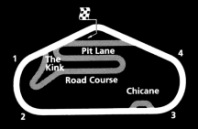
Daytona itself is not a difficult track. It’s actually quite simple. The keys to a good lap are getting into turn one nice and deep, as the entry is deceptive. You can usually go a lot deeper than you think, plus it’s important to extend your speed off the oval as far as possible. The infield hairpins are very basic and I believe that you can lose a lot more time than you can gain. The infield section can also be a little bumpy. The pavement is old and worn, so there is not a lot of grip either. It’s also important to get the power down early and smoothly as you exit onto the banking as it’s a long run down to the chicane. The chicane is my favorite part of the course. Having turned many, many laps at Road Atlanta, I really like high-speed corners, especially those that are almost flat. The exit of the chicane is particularly important, and very key to a quick lap.
The challenges that we face are mainly due to the varying speed potential of the different classes. The SRPII car is faster than the GT’s, faster than the GTS cars in the infield, but slower on the oval portion. Of course we are also slower than the SRPI cars. This really keeps us on our toes, since we are lapping the GT cars rapidly but must be aware of the SRPI and GTS cars coming up from behind rather quickly on the oval! It’s important for the slower cars to stay on the bottom, but we still have to pop out quite frequently and must be certain that SRPI isn’t coming. Having always been very quick in whatever I’ve driven, and also having always been in the quickest class, this is a new experience. But like anything else over the course of the test days I quickly got used to it. It also took a while to get used to the difference in the braking capabilities between our car and the GT cars. When passing these slower cars, it is important to get fully alongside and even slightly ahead if possible in order to show them that you are there. I had to get accustomed to the attitude of their car when they would begin to turn in to a corner, in order to realize if they were leaving me the inside lane or if they were actually turning in towards the apex. This is extremely important to understand, not just from a standpoint of avoiding an incident, but you do not want to be caught up while overtaking a slower car in a 24-hour race!
I also became quickly aware of the amount of these GT cars. There are a lot of them, and they tend to run together, making it more difficult to overtake. When approaching a line of these cars you must be careful that they’re not so involved with battling the car in front of them, that they don’t pull out to pass at the same time that you’re coming up the inside. Thankfully, at least while I was in the car, most of these GT cars were very aware whenever I approached and gave us a lot of room. We’ll see if this holds true in February!
The GTS cars do not present much of a problem, although they can hold us up in the infield if they pass us on the oval prior to turn 1. The SRPI cars are also not a problem, however if one goes by entering the chicane and then is either slow through the chicane or is held up by a slower car, we have to be careful not to follow too closely through the exit of the chicane. The larger prototype will take the air off of our nose and create a considerable amount of understeer, right towards the outside retaining wall.
Certainly the physical demands of driving over the course of 24 Hours will be new for me. I am very accustomed to 45-50 minute sprint races that are extremely intense, where every lap is close to a qualifying lap. This will be different as I suspect we will be doing 2-hour shifts. I have always been very fit, as I look for any advantage I can get, but I have really stepped up my training and have incorporated some serious neck strengthening exercises as well. I don’t think I’ll have a problem adapting to the endurance racing mentality, as I pride myself on being an intelligent driver. We’ll have to see. We will definitely be aiming for a specific race pace, and trying to stay out of trouble, while being very kind to the car. We spent considerable time during the test days attempting to turn reasonably quick laps while conserving certain areas of the car.
Driving at night
is something that has to be experienced in order to be fully
appreciated.
We only had one, two-hour night session, so I only got a few laps in at
night. Prior to getting into the car, I was quite anxious, as I did not
know what to expect. I had heard that the infield gets pretty dark, and
that the ‘kink’ can be a little dicey. I was pretty tentative on my
first
lap but quickly realized that it was really nothing to be concerned
with.
I’m sure that wasn’t the case prior to the NASCAR lighting, but the
lighting
provides enough illumination to give some light to the infield. I had
heard
later that the lighting is turned down to around 65-70%, but I don’t
know
that for sure. It was really pretty neat and I really enjoyed it I’m
fortunate
to be blessed with excellent vision and I don’t know if that’s why I
found
it so comfortable. In any event, I’m now looking forward to the night
portion
of the race.
Under the Body
The Lola is a wonderful car to drive. In comparison to a Formula car, the Lola is very responsive, not as slow to respond as I suspected originally, but since it is heavier, the ride feels softer and it is not as twitchy as Formula car. The car has to weigh close to 1,600 lbs. under the Grand-Am rules, and generates around 2,000 lbs. of downforce. It did take a little bit of time to get used to the “hump” in the middle of the car, and to the openness of the cockpit after being used to the close confines of a single-seater. The car responds very well to driver inputs and subtle setup changes, and has excellent brakes. This was my first experience with a sequential shift and it was very nice. The gearbox is extremely smooth and the engine revs very quickly. There is plenty of power on tap, but once you get used to it, every driver always wants more! This is a very nice package.
One of the many benefits of running for a team like Archangel is that they won the championship in this car last year. They already know, in terms of setup, what this car likes and what it doesn’t like. Our total driver lineup was not solidified prior to the test days, so the most important business to take care of was getting all of us comfortable with the car, the track and the traffic. Even though the team will be running two cars, only one was present at the test. That meant that we shared one car among 11 drivers! Eventually we will be running 4 drivers per car, and a press release should be forthcoming to announce the final lineup. I do know that I will be in the #22 car, and my co-drivers will be Andrew Davis, Jeff Clinton and Mike Durand.
Obviously top speed is most important at Daytona, so a low downforce setup is a given. The hairpins in the infield are fairly slow, so aerodynamics doesn’t play a large part in the handling of the car in that area of the track. The chicane is taken at a high speed so getting the car’s aero balanced there is important. It is also important to achieve good, low speed grip under acceleration. This is necessary to a good lap as the exit from turn 1, both hairpins, and the corner leading onto the oval are all somewhat similar in nature. Being able to get the rear to ‘hook up’ and put the power down is very important, not only for acceleration but in order to get good life out of your tires. A setup with too much understeer on entry, and power oversteer on exit is not the way to keep tires under you in an endurance race!
Thursday and Friday were spent running the same basic setup that the team used during the Paul Revere 250 run at Daytona last year. We made some minor shock adjustments to settle the car a little, but primarily on Thursday and early Friday we were focused on getting the drivers comfortable. When you’re faced with rotating 11 drivers in one car, it is difficult to evaluate any setup changes. After spending some time analyzing our data, several of us spent our next sessions on the track going faster, but using the car less. I can’t disclose too much about our techniques, or exactly what we were accomplishing, but suffice to say that taking care of the car and making it last, while still turning competitive laps will be a very important aspect of this race.
During Saturday’s
morning session, the team opted to give Nigel Greensall some consistent
time in the car in order to evaluate some shock changes.
Conclusion
I hope that this provides you with some insight into the test days at Daytona. I would like to thank Mike Fuller for the opportunity to take a shot at this project. I also cannot say enough about the effort put forth by the Archangel crew during this time. Running 11 drivers through one car is truly an amazing feat! I look forward to writing another article after the race, and continuing throughout the season, as long as sponsorship is found. I would also love to be available to field any questions. Maybe Mike (email questions to me) can set this up as well. See you in Daytona!
