|
|
|
November/December
2010
Reload
to see the latest news
All news content copyright Michael J. Fuller, unless
otherwise noted |

| 12.28.10
>>Along
with Audi's R18 announcement, it was also mentioned that instead of
running the R18 at Sebring they will instead run the R15+. Now
there's been rather rampant speculation about what developments might
be peeled off the R18 in order to update the R15 in a effort to utilize
the R15 platform as a racing test bed for R18 bits. Upon further
inquiry, we understand that in fact no changes will be allowed to be
made at all to the Audi R15 other than changes in order to equalize
it's performance to the new 2011 cars; therefore, only changes to the
inlet restrictor (smaller), boost (reduced), and fuel cell (reduced).
Don't expect wide tires, R18 front suspension, or any R18 aero
bits. And detailed reading of the newly released regulations
makes all of this very evident. Art 19 states explicitly, "The
LMP1s having participated in at least one race organized
according to the ACO specifications before 31/12/2010 will be admitted
in 2011 under the condition to keep the full specifications of the 2010
season," further confirming our inquiry.
|
| 12.22.10
>>The 2011 final regulations have (finally) been released. Here are the highlights:
The regulations make use of a new term, "SRSE", through out. This is an acronym based off the French wording, "système rechargeable de stockage d'énergie".
But reading the English text this isn't abundantly clear.
Indeed, for whatever reason the acronym "STSY" is actually
assigned (Art 1.14) to the English wording of, "Rechargeable Energy
Storage System." But note that the English text uses STSY
interchangeably with SRSE.
- Art
1.13 covers all the details of the hybrid systems. 4-wheel drive
is now allowed through the use of a hybrid system, assuming the two
rear wheels are driven by the engine and the two fronts are driven by
the hybrid system.
Recovery and release of energy from the brakes, either on the 2 wheels of the front axle, or on the 2 wheels of the rear axle. - Further
reading of 1.13 gives the maximum fuel capacity for gas- or
diesel-powered LMPs. It's interesting to note the ACO feels the
hybrid system is only worth 2 liters across an entire fuel load (vs. 75
l and 65 l respectively for non-hybrids):
petrol: 73 l.
diesel: 63 l. 1.5.4
– Any system operated automatically and/or controlled by the driver to
modify the airflow on the rear wing when the car is in motion is
forbidden.
- We
understand the additional verbage attached to 3.5.4 is to clarify that
the wheels and their assembly (brake ducts, uprights, etc.) are exempt
from the wording stating, "all visible parts of bodywork from the
underside must form a continuous surface, without openings, slots or
cut-outs." The additonal text states:
The only openings permitted are the minimum gaps necessary for the sensors measuring the ground clearance (LMP1 only). In order to permit wheel and suspension part movements (suspension travel and steering) and the passage of brake scoops, the volume around the front wheels is free. His position and its maximum dimensions are as follows:
• 800 mm length, distributed symmetrically about the front axle centerline,
• 300 mm high, measured from the reference surface,
• 550 mm wide, the inner surface of the volume being at least at 450 mm from the longitudinal centreline of the car,
- Art 3.6.1 has additional text that makes it illegal to put gurneys on the trailing edge of any non-wing wings:
(no bodywork element is permitted within 25 mm from the trailing edge) - Art 3.6.3 removes the wording mandating that both LMP1s and LMP2s run a 20 mm gurney:
a.4 - A rigid trim tab/gurney is mandatory (LMP1 only).
- B.2 of 3.6.3 allows single rear wing mounts as long as all the parameters of 3.6.3 are met:
b.2 - The supports must be 1250 mm apart as a maximum. If they are assembling in order to make only one support, they must be in compliance with all the points of article 3.6.3. ;
- The full rear wing deflection regulations are also contained within 3.6.3
- Art 3.6.4 covers the Big Honking Fin's design and deflection requirements.
- Art 10.4 is clearly aimed at Audi and their aerodynamically shrouded suspension from 2009:
10.4 - The suspension arms :
a/ Must not be chromium plated ;
b/ Must be made from an homogeneous metal.
c/ The height /width ratio of the profile does not exceed 3.0,
d/ A protection for brake lines or electrical wire can be fixed to the suspension arms provided that:
• It has no wing profile;
• The height /width ratio of the profile does not exceed 2.5,
•
The maximum thickness of the profile is equal to the maximum height of
the profile of the suspension arm on which the protection is fixed + 3
mm
- Art
19 covers Performance Adjustments for both LMP1 and LMP2, as well as
the participation of LMP1s and 2s designed to 2010 regulations.
|
| 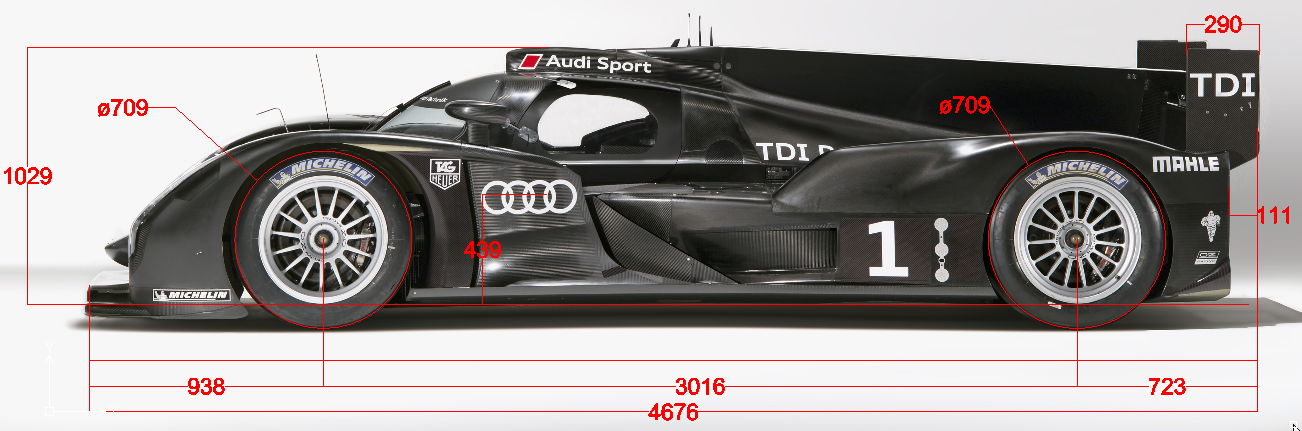 12.13.10 12.13.10
>>With
its short turbo diesel V6 one would expect the Audi R18's
wheelbase to be shorter than the Audi R15's mammoth 3080 mm, and indeed
it would appear the R18 comes in around 64 mm shorter. Front and rear overhangs are
hedging towards the maximum allowed though appear to be shy. The rear wing projects
beyond the trailing edge of the bodywork by approximately 111 mm |
|
 12.12.10* 12.12.10*
*Continuously being updated, see below
>>Audi
R18. Here's what Audi is telling us: The car is powered by
a 3.7 liter, turbo-diesel, V6, and power is transmitted through a newly
developed 6-speed gearbox. The choice for a closed top coupe, a
first for Audi (post LMP2004 rules) since the 1999 Audi R8C,
was driven by the need for higher aerodynamics efficiency given that
the new-for-2011 engine regulations have slashed nearly 150
horsepower. Thus the former aerodynamics paradigms are out the
window and low(er) drag is the name of the game.
Very few other
technical details have been reveled, though interestingly, Audi felt
the need to mention that R18's monocoque is a single piece construction
rather than the typical two piece, upper and lower glue bonded
together, construction. This ultimately leads to a lighter and
stronger structure. |  The
regulatory mandated Big Honking Fin blends into the single center rear
wing mount. The boundary layer build up as air slides down the
fin allows one to look at a single central rear wing mount for two
reasons. The layer build up allows the single mount to be
"hidden" easier (think of it being tucked in behind a curtain).
And secondly, it allows you to get away with a much thicker mount
then you would want to typically use (to make up for there only being one mount). The endplates bear a good portion of the wing load helping everything out. The
regulatory mandated Big Honking Fin blends into the single center rear
wing mount. The boundary layer build up as air slides down the
fin allows one to look at a single central rear wing mount for two
reasons. The layer build up allows the single mount to be
"hidden" easier (think of it being tucked in behind a curtain).
And secondly, it allows you to get away with a much thicker mount
then you would want to typically use (to make up for there only being one mount). The endplates bear a good portion of the wing load helping everything out.
The height of the rear wing is very low given the amount of endplate left above it.
The
leading edge of the rear fender is very far forward and unusually
shaped. There's little reason to think its shape is driven by
anything other than aerodynamic considerations. It's reasonable
to assume that the lower intake is as it was on the R15; brake cooling. |  There's
absolutely no missing the wide front fenders which lead us to wide
front tires. Yes, Audi's pulled an Acura and are running rears on the
fronts. According to their press release this is all about weight
distribution. This indeed may be the case, but recalling back to
the issues Audi had with the R15, we also believe it's also about front
aerodynamic balance. The Audi R15 was running so much front load
that the Michelins simply couldn't handle it and thus Audi ran with a
compromised set up at Le Mans in 2009. Subsequent development on
the R15 "plus" eliminated or reduced this problem, but the desire
remained to want to run higher front weight distribution and front
downforce. And therefore rears came into the picture. There's
absolutely no missing the wide front fenders which lead us to wide
front tires. Yes, Audi's pulled an Acura and are running rears on the
fronts. According to their press release this is all about weight
distribution. This indeed may be the case, but recalling back to
the issues Audi had with the R15, we also believe it's also about front
aerodynamic balance. The Audi R15 was running so much front load
that the Michelins simply couldn't handle it and thus Audi ran with a
compromised set up at Le Mans in 2009. Subsequent development on
the R15 "plus" eliminated or reduced this problem, but the desire
remained to want to run higher front weight distribution and front
downforce. And therefore rears came into the picture.
We saw this coming back in March (3.25.20 entry) when the R15 plus was seen with removable front inner fender bulges; ultimately there was no other reason for bolt-on tire clearance bulges from a
manufacturing stand point (not to mention a CAD
standpoint) as it would be vastly easier to make, one less mold, if
integrated into the fender mold. The assumption was that it was bolted
on to allow for larger bulges should one want to test wider fronts.
There has been no mention if Michelin will develop a bespoke rear-front tire compound for the R18.
|  It's
been said elsewhere that Audi began using aluminum front diffusers on
the R15 and that this practice had been continued on the R18. The
reasoning was given that as a race wore on, the carbon diffusers were
deteriorating, getting damaged, and front aero performance subsequently
dropped off. Supposedly the car was very front aero sensitive.
At first this didn't pass the sniff test at all. But with
the R18 in all carbon, it is easy to differentiate between differing
materials without a layer of paint covering it all up and indeed
something is going on there. Posing a question, we get an answer.
Yes, the front diffusers are made from a combination of machined
aluminum with carbon skins (we can see at very least the top has a
carbon skin, but the leading edge clearly appears to be aluminum and so
too the mid section connecting joint). But the reason is actually
quite simple and nothing to do with the durability of carbon, aluminum
is particularly soft after all, especially in thin sections. With
the diffuser's leading edge clearly aluminum, one can imagine the
material is actually less than ideal from a durability standpoint;
carbon at least has some elasticity. It's
been said elsewhere that Audi began using aluminum front diffusers on
the R15 and that this practice had been continued on the R18. The
reasoning was given that as a race wore on, the carbon diffusers were
deteriorating, getting damaged, and front aero performance subsequently
dropped off. Supposedly the car was very front aero sensitive.
At first this didn't pass the sniff test at all. But with
the R18 in all carbon, it is easy to differentiate between differing
materials without a layer of paint covering it all up and indeed
something is going on there. Posing a question, we get an answer.
Yes, the front diffusers are made from a combination of machined
aluminum with carbon skins (we can see at very least the top has a
carbon skin, but the leading edge clearly appears to be aluminum and so
too the mid section connecting joint). But the reason is actually
quite simple and nothing to do with the durability of carbon, aluminum
is particularly soft after all, especially in thin sections. With
the diffuser's leading edge clearly aluminum, one can imagine the
material is actually less than ideal from a durability standpoint;
carbon at least has some elasticity.
Instead it's done because
of very short lead times for aluminum and little tooling investment.
In the end, Audi found that the cost of a carbon front diffuser
was no different than the cost of an aluminum one. Weight or
weight distribution wasn't an issue. That seems a little
counterintuitive at first when everything on a race car appears to be
scrutinized heavily for strength to weight and indeed it typically is.
And one can imagine an aluminum front diffuser being heavier than
an all-carbon version. But it's added weight in an area where
Audi was already looking to put ballast (indeed, on most F1 cars the
front wing is used as an area to place ballast--it's the
lowest/furthest forward part of the car after all). But the big
benefit was the ability to generate multiple variations and have them
made very quickly for testing. To make a carbon part first
requires a pattern to be machined. A mold is then laid up off
that pattern, and then the part is laid up out of the mold. The
process is labor intensive and time consuming and all your tooling is
worthless if you decide to try another diffuser shape. Thus Audi
saw aluminum as a way to actually reduce costs and decrease turnaround
times. |  There's
also been some discussion that the R18's turbos (some even say 'turbo'
singular) might be packaged into into the 'V' of the 6-cylinder engine
and there is some proof that that could be the case, namely the roof
mounted intakes (clearly engine intakes given the lack of periscope
ducts elsewhere--also note the small inlet volume, not cooling much of
anything with that small inlet x-section) and the single centerline
mounted engine exhaust. There's
also been some discussion that the R18's turbos (some even say 'turbo'
singular) might be packaged into into the 'V' of the 6-cylinder engine
and there is some proof that that could be the case, namely the roof
mounted intakes (clearly engine intakes given the lack of periscope
ducts elsewhere--also note the small inlet volume, not cooling much of
anything with that small inlet x-section) and the single centerline
mounted engine exhaust.
*And we now have it confirmed that the roof inlet is for engine induction, the slot on the nose is simply for driver cooling. |  |  The bodywork immediately behind each tire appears a very close facsimile of the Audi R15's. However, the bodywork between
the rear fenders is very different and much lower and culminates on
centerline in a nice peak intersecting the single triangular-section
engine exhaust. The bodywork immediately behind each tire appears a very close facsimile of the Audi R15's. However, the bodywork between
the rear fenders is very different and much lower and culminates on
centerline in a nice peak intersecting the single triangular-section
engine exhaust. |  |  |  Looking
down on the rear fenders and you get the impression they've been
designed to encourage flow towards the rear wing. But we're told
on very good authority that the leading edge shape is actually designed
with reduced drag in mind and not rear wing performance. Looking
down on the rear fenders and you get the impression they've been
designed to encourage flow towards the rear wing. But we're told
on very good authority that the leading edge shape is actually designed
with reduced drag in mind and not rear wing performance. |  We
understand the wind tunnel used for the scale development of the R18
was none other than the Sauber F1 team's BMW tunnel. This would
signal a break with Fondtech, Audi's traditional aerodynamics
development partner. Allegedly some within Audi felt there were
issues with the Fondtech wind tunnel that culminated in concerns about
its accuracy over the course of the development of the Audi R15.
As a result, we understand that the R15 relied more heavily
on CFD as it's development progressed given the emerging lack of
confidence in the Fondtech facility. That the Fondtech facility
had been used to develop the highly successful Audi R8 and R10 should
be noted. We
understand the wind tunnel used for the scale development of the R18
was none other than the Sauber F1 team's BMW tunnel. This would
signal a break with Fondtech, Audi's traditional aerodynamics
development partner. Allegedly some within Audi felt there were
issues with the Fondtech wind tunnel that culminated in concerns about
its accuracy over the course of the development of the Audi R15.
As a result, we understand that the R15 relied more heavily
on CFD as it's development progressed given the emerging lack of
confidence in the Fondtech facility. That the Fondtech facility
had been used to develop the highly successful Audi R8 and R10 should
be noted. |  Speaking
of wind tunnels, Audi included this shot of the R18 undergoing full
scale testing at Ingolstadt's Audi Wind Tunnel Center. What was
interesting was not what was going on through the window, but what was
behind the screens. At full resolution, you can clearly read the
data off the computer monitors. Speaking
of wind tunnels, Audi included this shot of the R18 undergoing full
scale testing at Ingolstadt's Audi Wind Tunnel Center. What was
interesting was not what was going on through the window, but what was
behind the screens. At full resolution, you can clearly read the
data off the computer monitors.
*Update 12.15.10:
It's with some interest that I note that this image (right, click
on image for original resolution) has been removed from Audi's PR
portal. All industry persons whom I've inquired with said the
data would be of little no to relevance to a rival outfit, particularly
because of the method of ground plane simiulation being used in the
Audi wind tunnel. |  The
data shows the drag coefficient, front coefficient of lift (.cl), and
rear coefficient of lift. This would be .8486, -1.7965, and
-1.5873 respectively.
Initially we thought these were raw coefficients, but in hindsight it
appears they are CdX figures: that's the coefficient of drag (or
lift, replace the 'd' with 'l') multiplied by the reference area. Thus
the data needs solving for the raw coefficients to make better sense
for us (well, for me really). Therefore we get a coefficient of
drag (.cd) of .471 and a total coefficient of lift (.cl) of -1.8798.
Assuming a frontal area of 1.8 m^2, that translates to 934 lbs
drag and 3727 lbs. downforce for a L/D of 3.99:1. The balance is
a very front biased 53% front. But let's also mention that given
the nature of the Audi tunnel, spinning wheels, partial rolling belt,
it doesn't have the ingredients to produce an accurate ground
simulation and the numbers need to be taken with a grain of salt in
that respect. Especially the balance. The
data shows the drag coefficient, front coefficient of lift (.cl), and
rear coefficient of lift. This would be .8486, -1.7965, and
-1.5873 respectively.
Initially we thought these were raw coefficients, but in hindsight it
appears they are CdX figures: that's the coefficient of drag (or
lift, replace the 'd' with 'l') multiplied by the reference area. Thus
the data needs solving for the raw coefficients to make better sense
for us (well, for me really). Therefore we get a coefficient of
drag (.cd) of .471 and a total coefficient of lift (.cl) of -1.8798.
Assuming a frontal area of 1.8 m^2, that translates to 934 lbs
drag and 3727 lbs. downforce for a L/D of 3.99:1. The balance is
a very front biased 53% front. But let's also mention that given
the nature of the Audi tunnel, spinning wheels, partial rolling belt,
it doesn't have the ingredients to produce an accurate ground
simulation and the numbers need to be taken with a grain of salt in
that respect. Especially the balance.
|  Obviously this is
one of two things: either a complete PR gaff or a deliberate
release of information. If deliberate, then clearly designed for
misinformation. It's hard enough to inquire about aerodynamics
data from decades old race cars that have no relevance to current
regulations or trends, thus there's little reason for Audi to release
this information willingly at this time. Obviously this is
one of two things: either a complete PR gaff or a deliberate
release of information. If deliberate, then clearly designed for
misinformation. It's hard enough to inquire about aerodynamics
data from decades old race cars that have no relevance to current
regulations or trends, thus there's little reason for Audi to release
this information willingly at this time. | |
>>Craig Scarborough has been doing some sketching. Check out his Audi R18 interpretations. |
| 12.6.10
>>We
have independent verification that on December 10th (4 days from now)
Audi will unveil their new R18 LMP. And while no other details
are forthcoming for the moment, we are told that the car will be diesel
powered.
>>We've also received a copy of the latest regulations
(Version 5). Note that the ACO has still not released rules for
2011. We understand there's much hand wringing occurring over the
specifics of the hybrid rules. Also at issue are some of the
details concerning the wing deflection testing. |
| 12.2.10
>>Thanks
to Google translate we have this headline from the ACO, "Toyota Returns
to Endurance as an Engine!" Well then...The ACO are announcing that
Toyota Motorsports has joined forces with Rebellion Racing for 2011 and
will be supplying the team with engines. Speculation is that the
effort will use Toyota's Lexus Super GT 3.4 liter normally aspirated
V8. This would seem to be the first toe-in-the-water for an all out
effort aimed at 2012 and confirmation of the raging rumors we've been
hearing. Machine translation is here.
>>Recall that back in August of this year Dome announced
that they were shuttering their LMP program. So it's with
interest that we note the recent publication in the Japanese car
magazine "Motor Fan Illustrated" of aero figures for Dome's S101.5,
S102, and unraced S102i. Now this isn't without precedent; back
in March of 2008 (3.21.08 entry)
Dome released similar data for the S101.5 and S102. But when the
original information was released Dome didn't cite at what speed regime
the data was collected (or even the units used though Newtons made a lot of sense). Thus the data was interesting, but of little use. But this time around they have.
It's
a pretty straight forward matter of converting the data into pounds
force and extrapolating to 200 mph once you know the original units and
speed regime:
This gives us really good insight into what a contemporary, post LMP2004 regulations, LMP can achieve aerodynamically. But
looking at the above chart, on first glance it would appear the various
Domes were rather draggy. And calculating for top speed, using
the given drag and assumed frontal area and power (and drive train
efficiency), seems to bear that out:
But
we know from recent Le Mans history that the Dome has traditionally
been one of the fastest LMPs on the straights and most certainly the
fastest non-factory backed car. Indeed, in 2008 the S102 was
timed at 207.2 mph. So what was going on? Was the data quoted at some unrealistically high (and unknown to us) ride height? We have it on good authority that one could expect drag to drop upwards of 5% at lower
ride heights, those ride heights typically seen at speed. Thus it
would be fair to assume the inverse was true: high(er) ride
heights would produce higher drag. But an inquiry to Dome's
Hiroshi Yuchi shook out the answer; the data as presented was
simply the ride height map average.
Yuchi further confirmed we were looking at Le Mans setups.
And based on that, calculating an assumed 5% reduction in drag at
lower ride heights we get the following:
To which Mr. Yuchi's response was, "I can not tell you the actual figure for drag of the RH at top speed, as this figure quite important
for Le Mans. However, I can tell you that I think your above calculation is not far from the actual figure."
|
| 11.24.10
>>TotalSim will be hosting the Motorsports Aerodynamics
conference this coming Monday (November 29, 2010) in Indianpolis in
conjunction with the Indianapolis Motorsports Industry Show.
Register here, conference details here. |
| 11.16.10
>>More round-about news regarding Toyota's plans for the future (or, at least what they're not
doing next year). Today it was announced that the technical
partnership between the Hispania Racing Team Formula One team and
Toyota Motorsports, which would have seen Toyota act as consultant and
more for the HRT organization, has fallen through (1, 2).
This would seem to answer the concern about the technical
capacity of the Cologne, Germany based operation, i.e., if Toyota had
been tied down with HRT then they certainly couldn't have pursued an
LMP. |
|  11.12.10 11.12.10
>>Riley Technologies has released images of their 2011 LMP2 in coupe form. |  |  |  |
| 11.8.10
>>We're
hearing interesting things out of Cologne, Germany, specifically out of
the Toyota Ex-F1 facility. Based on what we've heard, if one
had to guess, it would appear an advanced design study is in the works
for an LMP. Toyota's name gets discussed every off season it
seems. It certainly has been discussed a lot recently, even with
little to no tangible evidence (though supposedly Toyota sent reps to
most of the 2009 ALMS events to reconnoiter). But it would seem
this is the real deal though highly dependent on getting the go-ahead
from up top. | |  11.4.10 11.4.10
>>Rumors,
and we'll stress they are rumors, keep trickling out about the
technical specification of the Peugeot 90X. We're hearing 3.7
liter, diesel, V8, hybrid (remember the 908 HY?). Is the 90X on
display in recent days merely a mule/technology demonstrator? If
yes, then that would run counter to the discussion that the Peugeot
program isn't exactly flush with cash.
This is the rumor season. Don't get your panties in a bunch. Have fun with it. Don't worry, be happy.
In
the same breath, we've further "confirmed" the Audi is to be a
"compact" 3.7 liter diesel V6. Of course this was the rumor back
in February (2.17.10), so could this simply be reverberations of that item from 9 months ago? |
|  11.2.10 11.2.10
>>A
quick look in AutoCAD appears to show that the Peugeot 90X has about
a 50 mm reduction in the wheel base (compared to the 908), making
it
around 2900 mm in total. The rear overhang appears to be around
the maximum allowed (750 mm) though we can't really vouch for the front
overhang given that the image Peugeot provided cuts the splitter short.
We're
hearing from other sources that the Peugeot 90X is a reflection of
current budgetary struggles within the Peugeot Motorsports department
at the moment. Earlier this year we were told that Peugeot had
designed swan neck rear wing mounts but that they never were
implemented given the costs associated. This would seem to be a
continuing trend even as the 90X breaks covers. It is our
understanding that the 90X is effectively what would have been the 2010
908 bodywork but reworked in the relvant areas for the new engine
package. |

|
 |
Aerodynamicist
and automotive enthusiast Paul T. Glessner presents "The Secrets
&
Basics of Vehicle Aerodynamics" Seminars. See why more cars
are going
faster and doing it more safely and in style. Paul has been
asked
to speak at venues like Bob Bondurant School of High Performance
Driving,
Society of Automotive Engineers (SAE), Specialty Equipment Marketing
Assoc.
(SEMA), and Performance Racing Industry (PRI). Paul's
seminars both
educate and entertain. The day long seminar can be held at
your club,
organization and/or company location with the organizer paying only
$100.
(click event date in site) to read
about Paul's
extensive background and testimonials from enthusiasts like Jay
Leno.
Schedule your seminar at www.aeroseminars.com!
|
|
"While
I am not an engineer or a major technical type, I enjoy the discipline
of aerodynamics and was pleased at how Paul was able to explain its
intricacies
to individuals like me." - Jay Leno, Tonight Show Host |
|
|


