|

|
Pete
Lyons' fantastic Can-Am Cars in Detail:
 |
May/June 2011
Reload
to see the latest news
All news content copyright Michael J. Fuller, unless
otherwise noted |
| >>Le Mans 2011<< |  | 6.21.11
>>Dissecting the protagonists. With a few weeks post-Le Mans 2011 we've been having a think about our post race analysis:
It
was pretty clear the Peugeot 908 was running less drag. We could
see this in the slightly higher straight line speeds averages
as well as the longer fuel stints. And of course there was the
obvious indicator with Peugeot's anti-wicker rear wing flap.
Audi's top speed wasn't too far off, but more importantly the R18 was clearly carrying more downforce.
But
the differences seemed slightly more fundamental than that.
Peugeot driver Alexander Wurz complained of instability in the
car's setup, "With our #7 car we were always on the back foot because
our chassis balance was very oversteery." And while we can't
verify, we've been told at least one of the 908's testing accidents was
caused by an overly aggressive setup coupled with driver error.
The 908 was noticeably less stable than the R18 through the
Porsche Curves though interestingly the 908's straight line braking seemed to
belies this, suggesting a slight yaw issue.
The reduction in drag
through the elimination of highly cambered rear engine cover trailing
edge shapes as well as paring out drag from the wing means there's less
stabilizing underfloor draw from these items and it would seem that as
downforce was taken off the 908 it has become slightly less stable when
compared to the Audi R18.
Without knowing actual power output
differences between the two we are speculating, and for arguments sake
we're going to assume similar power outputs. Yes, this isn't
accurate. But we'd be surprised if the power difference was more than
5% and at the moment we don't know which way it would swing. Thus
calculating drag from similar power levels shows only about a 5%
difference.

Quicker
lap times, nearly same top speed, coupled with more downforce must
simply mean the R18 is more aerodynamically efficient than the 908.
And that's reflected in the higher L/D. A 5% better L/D
gives the R18 nearly 500 lbs more downforce at 200 mph than the 908.
| | >>The
ACO is proposing a number of aerodynamic changes for 2012 to further
reduce sudden yaw induced flight and is currently shopping this list
amongst the manufacturers. The proposed changes include a longer
and taller fin that is integrated into any roof inlet, an increase in
the area of the mandatory front fender louvers from 160 cm2 to 200 cm2, mandatory louvers on the rear fenders (100 cm2),
and an increase in the height of the domed skid from 20 mm to 30 mm.
For now this is a draft list and nothing is set in stone though
these proposals seem to be born out the FIA/ACO meeting held with the
manufacturers in early April. | 
|  6.20.11 6.20.11
>>Following
their two crashes in the 2011 24 Hours of Le Mans, Audi finds itself
having to replace the destroyed cars while the winning 3rd car heads to
the museum. Of seven R18 chassis originally built, only five remain and chassis
R18-103 and R18-107 have been tapped as the replacements. Says
Audi's Ralf Juttner, "One monocoque has been with us as a spare and was
partly built up (fuel cell, looms, pipes etc.). The other car has to be
built from a complete new, unprepared one." The disposition of
the damaged monocoques is undetermined, "If the accident tubs can be
used for show cars or similar is not yet decided. For the moment
they are undergoing lots of checks and investigations to at least get
as much information as possible out of these two 'unintended' crash
tests."
| >>Mazda recently made some rumblings about possible new directions
and Mazda Motorsports North American head John Doonan offers some
further details. "Mazda are assessing all of our options
regarding power plants across all of our motorsports activities.
As you know, the challenge with Le Mans is that the ACO regulations
require a stock block engine in LMP2, and LMP1 unfortunately requires
an investment that is extremely big." With SpeedSource Racing
leading the investigation into possible applications for Mazda's
SKYACTIV technology, Doonan clarifies, "SKY has a wide range of
applications, architectures, hp and torque levels. So SpeedSource
is looking at all options for us, with SKY-G (gas) and SKY-D (diesel)."
Though Doonan admits, "LMP1 is too rich for our blood." So
don't expect a diesel LMP1 engine out of Mazda. But given the
costs to be competitive in LMP1 it leaves Mazda with little options, "The current Mazda MZR-R prepared by AER is an LMP1 engine for ALMS, it is not a stock block."
Thus
it's not an easy decision for Mazda's future program as all paths
within LMP indicate a new engine is needed. The most likely
scenario, if Mazda are intent on staying in the prototype category,
would see Mazda investigating the utilization of their SKYACTIV-G (gas) technology for applications within LMP2 considering the ineligibility of diesels in LMP2. | 
|  6.15.11 6.15.11
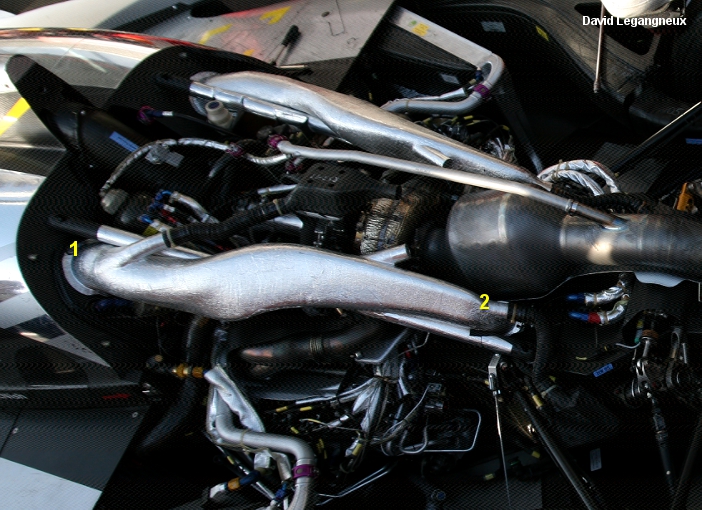
>>Audi's
Ralf Juttner tells us that the R18 is using "waste air" to cool items
in the engine bay. Recall that we pointed out air being
directed from the cockpit through cooling pipes that emerge from
the back end of the R18's monocoque (1) and then terminate (2) into the
carbon bellhousing.
Juttner elaborates on the R18's
engine bay cooling system, and most interestingly, confirms that
the R18 cockpit cooling is not augmented, "...we are not using an
A/C system. All is done with 'normal' ambient air." Air is
directed into the cockpit via the vent intake in the car's nose, used
to reduce the cockpit temperatures, and then sent rearward to the
engine bay, eliminating the need for additional ducts with the aditional benefit of retasking the "used"
cockpit air for additional duties.
We'd
be remiss not to inquire with Mr. Juttner about the rear carbon
structure, notably the "why" behind it. Juttner would only say,
"About the rear structure I can´t say anything (but you are - as usual
- a skilled viewer)." Recall that the R18's rear carbon structure
has been designed to isolate the gearbox from suspension loading
potentially creating a regulatory loophole whereby the gearbox could be
replaced in event of a failure.
| |  6.3.11 6.3.11
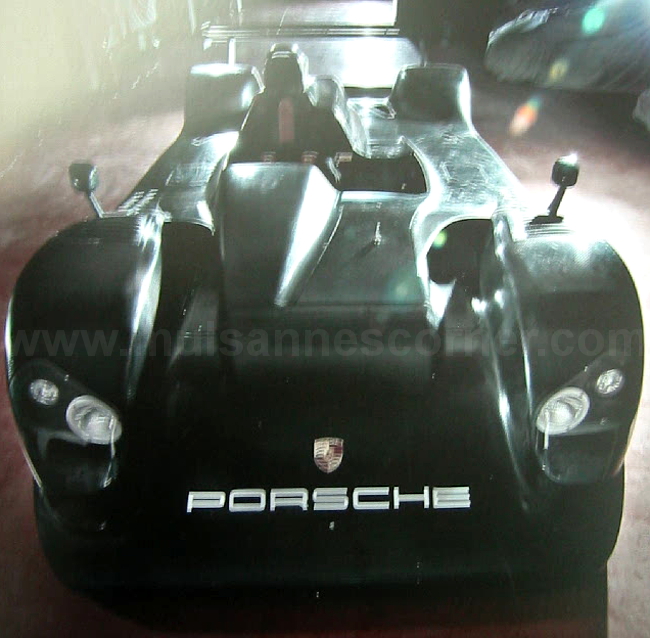
>>The car that never existed. Mulsanne's Corner devotees will be familiar with the Porsche LMP1 ("LMP2000") story.
And here it is, more than a decade later, and still no official
photos of the car exist. Well, perhaps there's been a cooling in
Weissach. Markus Eberhardt, who obtained these pictures and has
graciously passed them along to Mulsanne's Corner, tells us these
images were,"...published in an official, but strictly limited, Porsche
calender." Finally an acknowledgment that the car exists?
| 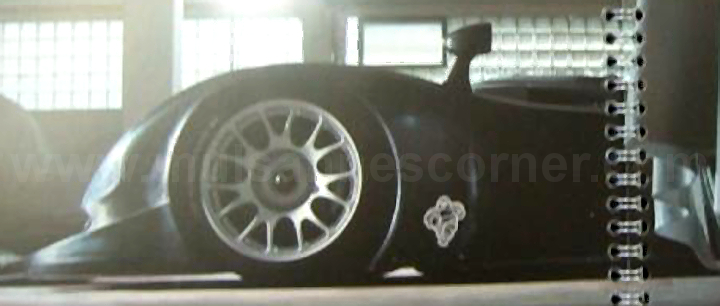 Now, I know there are those within Porsche who regularly visit the website (yes, yes you do). How? IP traces (84.21.34.140). Surely someone
over there at Porsche can get us better images (from the calendar
presumably-don't get yourself fired!)? I know I would appreciate,
Markus too I'm sure. Now, I know there are those within Porsche who regularly visit the website (yes, yes you do). How? IP traces (84.21.34.140). Surely someone
over there at Porsche can get us better images (from the calendar
presumably-don't get yourself fired!)? I know I would appreciate,
Markus too I'm sure.
email:
| |  5.31.11 5.31.11
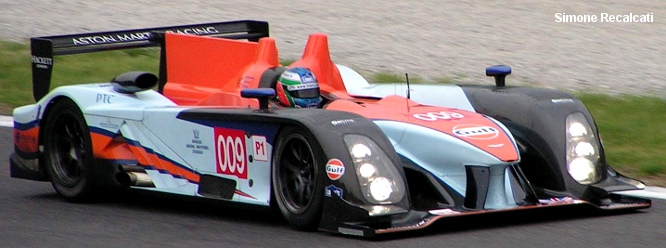
>>Little
has come out of Aston Martin's PR department since the disaster that
was the Le Mans Test Day and Spa withdrawal. And it would seem
the marketing types got a real lesson in, "Any publicity is good
publicity," and have since gone silent. But it's a positive sign
to see Prodrive is getting on with it and have been putting in the
miles testing. Here they are today at Monza for day one
of what is to be a two-day test. |  Aston
Martin was running with the first chicane removed, identical to how
Audi and Peugeot have previously tested at Monza. Simone relates,
"...while I was there, between 2.30 pm and 4.30, the car did a total of
something like 25 laps, pace around 1' 36"-37". For what it's
worth, that's considerably slower than what I saw from Peugeot, around
1' 31", and Audi, doing 1' 30" if not under, in earlier tests." Aston
Martin was running with the first chicane removed, identical to how
Audi and Peugeot have previously tested at Monza. Simone relates,
"...while I was there, between 2.30 pm and 4.30, the car did a total of
something like 25 laps, pace around 1' 36"-37". For what it's
worth, that's considerably slower than what I saw from Peugeot, around
1' 31", and Audi, doing 1' 30" if not under, in earlier tests."
The car's "patina" seems to indicate lots of extended running. | 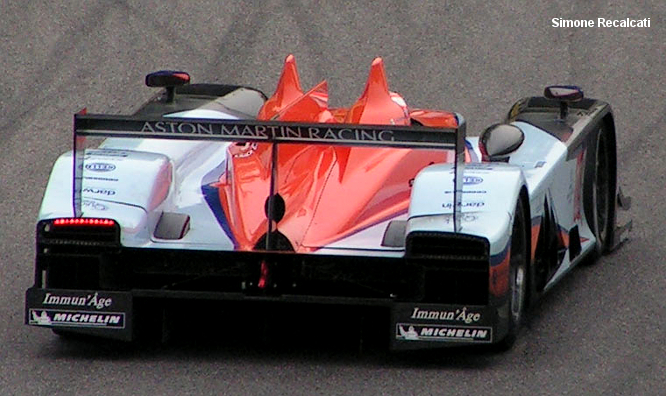 Simone indicates that rain came in late in the day and that tomorrow's forecast is for more of the same. Simone indicates that rain came in late in the day and that tomorrow's forecast is for more of the same.
The diveplanes have a vertical endfence. Other than that there doesn't seem to be any aerodynamic revisions of consequence. |
|  5.30.11 5.30.11
>>It's
now been more than 20 years since WM Racing's Project 400. In
1988 WM set out to be the first to achieve an official radar clocking
of 250 mph on the Mulsanne straight. They were successful in
their attempt, but since then very little has ever been written about
the technical details of the project, at least in the English speaking
press. And what little has been written is often rife with
incorrect details (narrow Michelins for instance).
Three years
ago (the 20th anniversary) I exchanged email through WR's PR manager
with Gerard Welter, but there simply wasn't enough substance to write a
definitive technical dossier on the car or the effort. And after
staring at an unfinished article now for 3 years, I'm determined
to reach drive Roger Dorchy, or any
one else who was involved in the project and is interested in
discussing their involvement.
If you have any useful information please contact me, email:
| | 5.28.11
>>Oh yeah, I was interviewed by Tony Castaneira from Oversteertv.net regarding Le Mans, Audi, Peugeot, and Aston Martin. Check it out. |
|  5.24.11 5.24.11
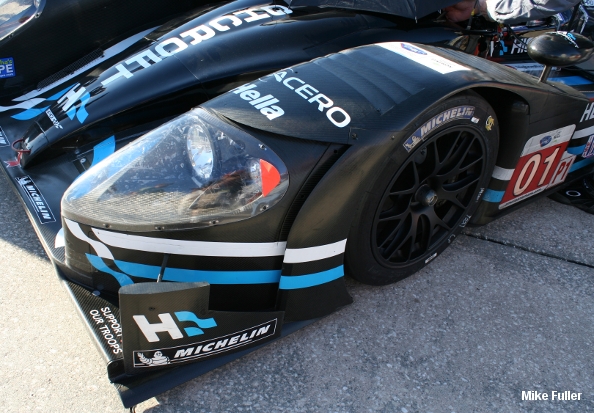
>>While
the statement from Highcroft Racing last week seemed to leave the
future of the ARX-01e chassis at the mercy of HPD, according to Nick
Wirth, "The ARX-01e is very much a viable customer car, and we have
already shown its performance at Sebring. HPD are very interested
in supporting and developing the engine side." Wirth tells us,
"HPD are in advanced discussions with several groups about running
ARX-01e's both in Europe and the USA in the near future."
And
not all the performance of the -01e was witnessed at Sebring as the
definitive Le Mans aero package wasn't (naturally) completely unveiled.
It's a shame Le Mans 2011 is out.
Wirth
Resarch continues work on the future LMP coupe, "And now we have seen
the 01e's real-world performance, our enthusiasm to build it (the
coupe) is higher than ever."
|
|  5.20.11 5.20.11
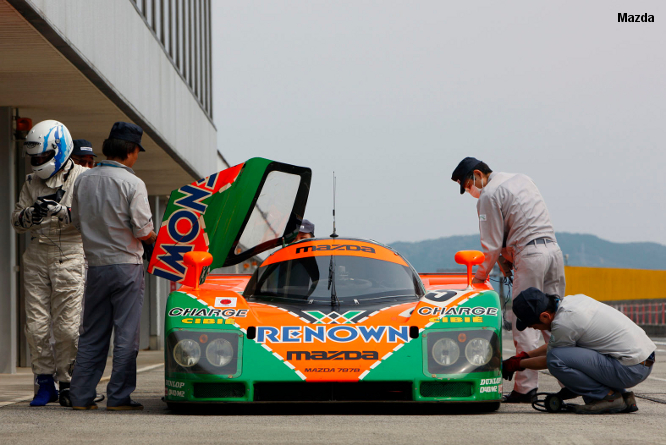
>>Mazda
has restored the 1991 24 Hours of Le Mans winning Mazda 787B to running order and will
be sending it to the 2011 Le Mans in honor of the car's 20th
anniversary win. According to their press release, "Mazda plans
to hold the demonstration of the 787B racecar on the Circuit de la
Sarthe at 12:30 p.m. on June 11. Additionally, the 787B will also
take part in the Driver's Parade through the Le Mans city center on
Friday June 10." Nice added bonus for those in attendance!
Mazda
has published a number of photos showing the car being restored and
running and we have posted them on the Mulsanne's Corner FaceBook page (these are only viewable to FB members).
Here are the Mazda images in a zip file. |
| 5.19.11
>>The
"pre-season" ahead of the 2011 Le Mans has been witness to what has to
be the highest pace of development for sports prototypes in history.
Both Peugeot and Audi have gone at it "hammer and tong" and we've
lost count of the number of tests. So it wasn't much surprise
when images came out this week of Audi testing, this time at Monza.
What is surprising is that this appears to be another variant of
the R18. Surprising given that one would think that all effort
would be going towards preparation for Le Mans, at this point 3 weeks
away.
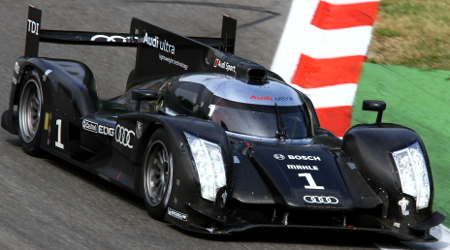
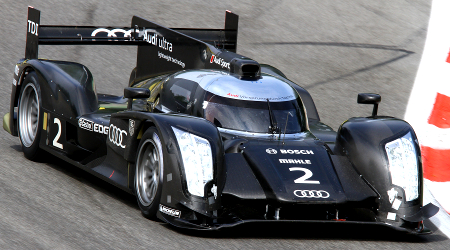
| The
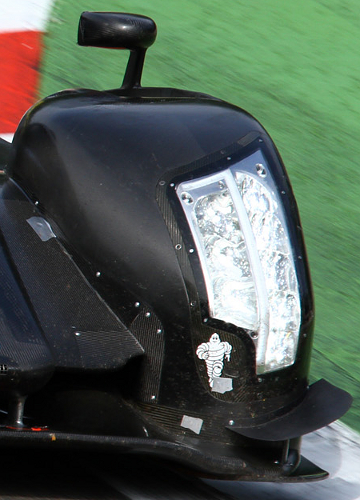
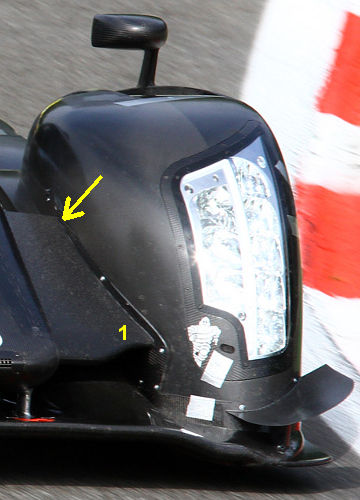
Audi R18 wearing the #2 was testing a new front fender shape.
Instead of having the blunt extrusion that comes up from the
splitter that blends to a smooth profile producing the notched shape
(left), the new fender's leading edge (right) is now a smooth profile
down to the splitter. This would be a rather large change to
execute and would require a new pattern and mold. Additionally,
the headlight would have to be redesigned and remade to accommodate the
fender surface changes. The slight raised section (1) on the
inboard bodywork connecting the fender to the nose is larger
and the bodywork is slightly shorter in length. It would
also appear Audi have two splitter options as the right hand option is
as tested at Le Mans where as the left hand appears as the roll out
version. All images copyright Daniele Paglino
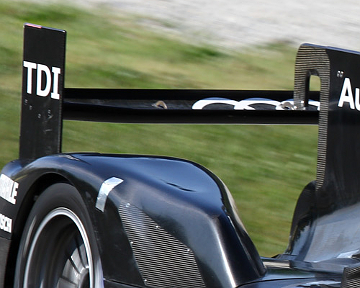
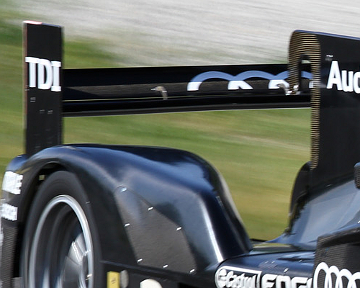
| Two
different rear wing setups were spied as well. The mainplanes are
different between the two, noted by the outboard upward sweep on the
left configuration. The other item to note is the very different
flap position as the right hand configuration is carrying much more
flap angle. All images copyright Daniele Paglino
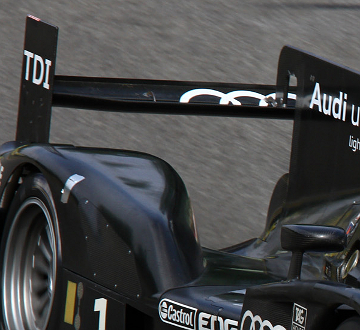
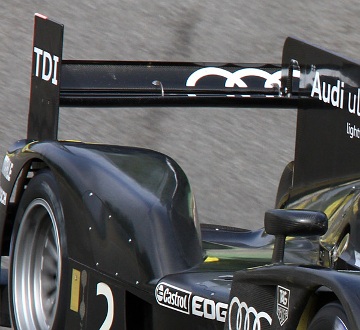
| 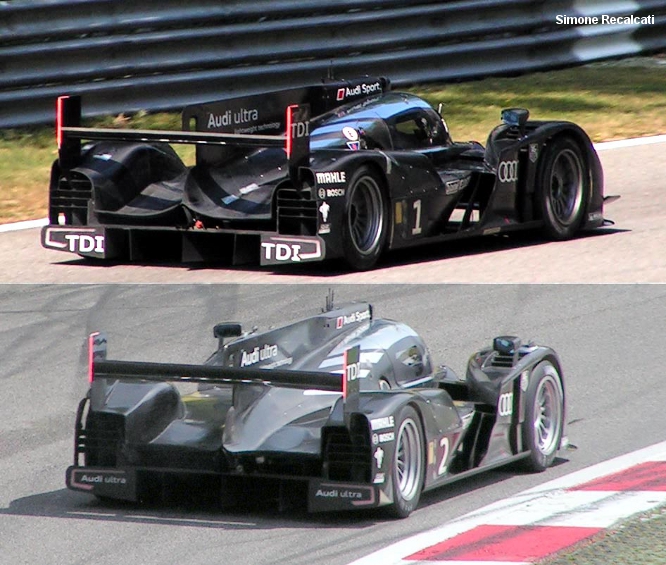 Simone
Recalcati sends these photos that show the rear end differences.
Note on the #2 (below) the inboard rear fender shape is square
(compared to the rounded shape on #1) and the "peak" on the centerline
of the trailing edge is much lower and with a slight dip prior to
heading to the peak. Looking further, and the changes to the #2's
engine cover trailing edge are driven by the much higher overall
trailing edge height. Simone
Recalcati sends these photos that show the rear end differences.
Note on the #2 (below) the inboard rear fender shape is square
(compared to the rounded shape on #1) and the "peak" on the centerline
of the trailing edge is much lower and with a slight dip prior to
heading to the peak. Looking further, and the changes to the #2's
engine cover trailing edge are driven by the much higher overall
trailing edge height. | 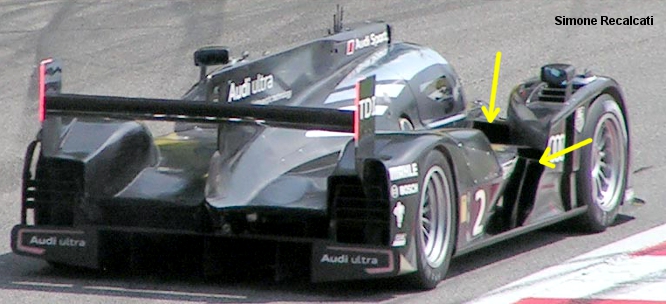 Additional detail changes. Additional detail changes. | >>We've
also finally cashed in the bounty for the Audi R18 images (And if
we didn't note it here, we did on the Twitter account, @mulsannescorner,
we have in hand images of the Peugeot 908 too). All these images
will be released ahead of Le Mans, the weekend of June 4-5.
But that won't stop us from describing what we saw. The Audi's rear end is as expected: torsion bars,
almost vertical dampers (angled to meet bellcrank which is angled for
torsion bars), 3rd spring. But the most interesting thing is the carbon
bellhousing structure. It's much more intricate than the 908s in that
it extends full length and the gearbox cradles inside the open ended
structure. With
the gearbox isolated from suspension loading, the gearbox wall proper
now doesn't have the be as robust. So thinner wall and a much simplified casing in general with means less weight. We hear as much as 10 lbs less weight though possibly more.
All
rear suspension pick ups mount to the carbon. The trailing arm
pickups are supported by metallic structures behind them that
"stitches" each side of the open ended carbon structure together.
The rear structure that carrys the rear wing mount, exhaust pipe,
and rearmost section of the underfloor plugs into the back of the
carbon gearbox cradle via mushroom pins.
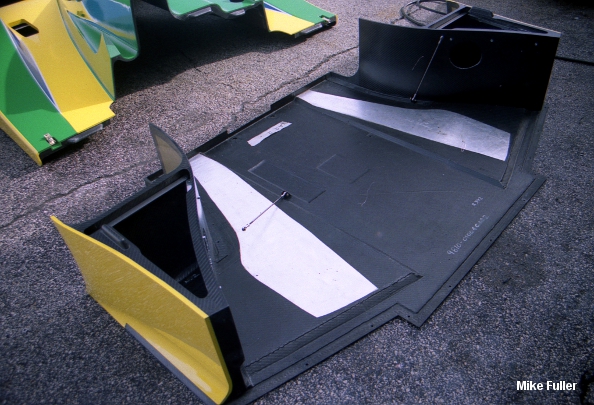 We
can confirm that the rear brakes are cooled via the ducts just ahead of
the rear wheels. Attention has been paid to cleaning up engine
bay flow through. And in fact the R18's engine bay has structures
ahead of the rear wheels not dissimilar at all to what the Lola B98/10
had way back in 1999. We
can confirm that the rear brakes are cooled via the ducts just ahead of
the rear wheels. Attention has been paid to cleaning up engine
bay flow through. And in fact the R18's engine bay has structures
ahead of the rear wheels not dissimilar at all to what the Lola B98/10
had way back in 1999.
| | 5.18.11
>>The
ACO has released Technical Bulletin 11-18 that lays out performance
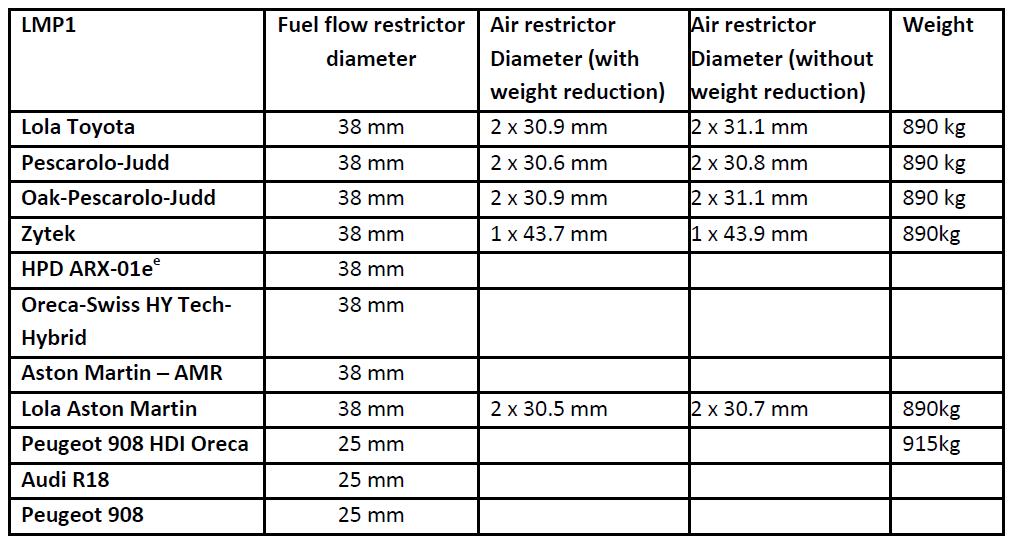
balancing ahead of the 24 Hours of Le Mans. It amounts to fuel
flow restrictor diameter increases, weight reductions, and engine inlet restrictor increases for most of the of
the gas cars, in addition to a weight decrease for the grand fathered Peugeot 908 HDi Pap (-15
kgs, now at 915 kgs), and fuel flow restrictor diameter decreases for the diesel cars:
Percentage restrictor increase: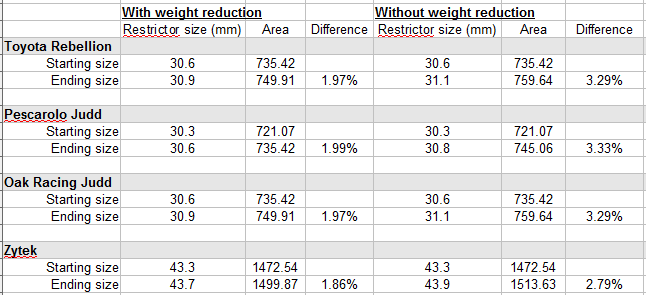 Area is only calculated for one restrictor in the cases of two restrictors. Area is only calculated for one restrictor in the cases of two restrictors.
P2 changes are as follows:
Once again the privateers will absorb all costs associated with the performance balance. From The Horse's Mouth:
"(the)Change
(the ACO performance balance) is time and money. New restrictors
to be machined, time/money on the dyno, likely change to gear
ratios. Multiply any change by number of cars and number of spare
parts and it's non-trivial.
We
firmly believe that Manufacturers have the capacity to absorb change
far more easily than Privateers and tried to argue that position with
the ACO. Feels like it fell on deaf ears."
|
| 5.17.11
>>Yesterday
Highcroft racing announced they were withdrawing their 2011 Le Mans
entry and parting ways with Honda. In response to our inquiry,
Nick Wirth gave this brief statement:
Highcroft's ARX-01e is owned by HPD (who own the design) and will be returned to them immediately.
All
of us at Wirth Research are deeply disappointed to see a car that we
specifically designed for best performance at Le Mans not running there
this year, and we're very sad to see the end to our great and winning
relationship with Highcroft Racing.
That would seem to nix any prospect for a Judd (or Zytek) powered "ARX"-01e... | | 5.16.11
>>So
how much torque are the current generation diesels making? We'll
be using the Peugeot engine as the basis, but ultimately we're
generating data for a "generic" diesel. Stephen Knight,
"knighty", suggested this first method (and guided us through the
second), simply pro-rata the the torque of the previous 5.5 liter
engine to 3.7 liters. We're going to use the official figures for
the 908 HDi FAP's torque, 1200 Nm, though we understand this is about
15% too low. Reducing that figure by 32.7% (the difference in
capacity between the 5.5 and 3.7 L) gives us 807 Nm of torque for
the 3.7 liter. OK, so that's a bit of a ham-fisted way to
estimate torque, but it gives us an initial figure.
So
we've previously calculated a power output based on top speed and drag
estimates of between 609 and 594 hp for the "908". Taking an
average, 601.5 hp, we can calculate for torque using the formula:
Power (bhp) = (Torque(lb/ft) x RPM) / 5252
multiply by 1.35582 for Nm
Plugging
in 601.5, and using an rpm range from 4500-2500 RPM (remember, diesels
rev much lower), and solving for torque we get and torque range of
between 952 and 1712 Nm. Obviously it's very RPM dependent.
But more importantly, we're calculating torque at peak power and this
isn't accurate. The torque peak is going to occur a bit below the
RPM for peak power, and therefore the power at that RPM is going to be
reduced as well. And obviously power varies with RPM though we're
going to keep it constant throughout our 2000 RPM ranges (for all our
cases, see below) as we haven't a way to predict the relationship (or,
plot the curves) in our fictitious diesel engine. So we're going
to have to make some assumptions. Let's assume that at peak
torque RPM the engine is producing 75 hp less than what it does at peak
power RPM. Therefore we'll use 526.5 hp. Plugging that back
into the same RPM range gives use between 834 and 1500 Nm .
Averaged, that's 1167 Nm.
So now that we have a rough figure for the diesel, what does the opposition generate?
With
a calculated 570 hp, the gasoline powered Judd 3.4 liter, using similar
methodology (knocking 75 hp off peak power, but using an RPM range from
10000-8000), generates between 353 and 441Nm of torque (397 Nm
averaged). So between 42 and 29% the torque of the diesel.
The high revving nature of the normally aspirated engine simply kills
torque production.
So what about a gasoline powered turbo
engine? At the moment we really don't have reliable figures for
the Aston Martin in the power department. But let's just assume a
solid 600 hp at peak power for a "generic" gasoline powered
turbo. Using an RPM range between 7000 and 5000 RPM (gas turbos
torque peak won't be as low as a diesels) gives us 534 and 748 Nm of
torque at 525 hp (641 Nm average).
So it's pretty easy to see
that the torque figures for a normally aspirated gasoline power engine
are not even in the same ballpark. The gas powered turbo has a
better chance, but there isn't even any overlap if you look at best
case (for gas) vs. worst case (for diesel). Admittedly there is a
lot of fudge in our factoring, but there's really not enough to turn a
64% difference into a 5% difference.
With the ACO giddy to add
hybrids to the line up, and the manufacturers waiting in the wings
having designed their new cars around such systems, the performance
balance is simply set to go from poor, to ridiculous. And the ACO
has only shown hesitancy in addressing the issue.
We end with a final word from an anonymous source:
The
diesels need to be slowed down. We saw a 4.3% lap time
difference between the quickest gas and diesel at the Le Mans Test and
the diesels lapped under the 3:30 target in the first year of a
supposedly "fixed for 3 years" set of regulations. We don't
agree that Manufacturers should have a 2% advantage over the rest of
the competition (as is implicitly acceptable in the
regulations), their strength in depth and resources should be advantage
enough. It is unreasonable to place the burden of any change in
terms of costs and workload upon private teams, especially when their
cars are performing above the target lap time at Le Mans of 3:30.
Instead, the Manufacturer teams should shoulder the impact of any
changes, it is the diesel cars that should be slowed down, not the
gas cars that should be changed to go faster. Halving the size of
the diesel car fuel tanks would allow us to play on a level field, that
gives the real scale of the difference in performance. Perhaps
the diesels should "drive through" every lap instead of crossing the
start/finish line? If there was true equivalence between the
engines, why did both Audi and Peugeot decide to build diesel engines
for the new regulations, coincidence, marketing? Or because there
is still a rich vein of performance to be mined from improvements in
diesel technology? | | 5.14.11
>>Jean Lariviere is looking for race programs and posters to purchase.
His list is:
Daytona 24 Hours programs: 1964, 1963, 1988, 2009
Sebring 12 Hours programs: 1953, 1954, 1957, 1960
IMSA Yearbooks: 1975, 1972, 1987, 1994, 1996
Daytona posters from 1966 to 1985 except 1981
Jean can be contacted via:
j.lariviere@free.fr
Let him know you saw this on Mulsanne's Corner. | | 5.12.11
>>Yesterday
brought a bevy of interesting emails into our inbox. Seems a few
of you have been reading our series that is stepping through the
methodology of predicting engine power outputs. Now, power is one
thing, and as we've been showing, the outputs between the gasoline
powered cars and the diesels aren't too
dissimilar. At least it seems to be much closer than in years
past. So how can the large performance deficit between the two "categories" be
explained? Simple, torque. As one of our Industry Experts let's on,
"I have done a lot of simulation work for Le Mans...torque is way more
relevant than anything else. By a big bunch." Le Mans has
what amounts to five long straights; from Tertre Rouge to the first
chicane, from the L'Arche Chicane (first chicane) to the La Florandiere
Chicane (second chicane), from the La Florandiere Chicane
to Mulsanne Corner, from Mulsanne to Indianapolis, and from Arnage to
the Porsche Curves. Think of these as five drag strips.
What's more important on the drag strip, power or acceleration
from torque? So check this out, our Expert tells us a 10%
increase in torque can amount to, wait for it...upwards of a 3.7 second
decrease in lap time. A
similar percentage increase in power only drops lap times at Le Mans by
around 2.6 seconds. Furthermore, a 10% increase in downforce is
only good for a 1 second drop in lap time. So of course the
manufacturers have gone the technical route that leads to the easiest
way to decrease lap time. They aren't stupid after all and they have a lot of Boffins running the numbers.
Says said Expert, "Two mph faster out of the chicanes is 10-12 mph faster at the
end of the straight--even gas turbos can't make up for the 22 to 26:1
compression ratio of a diesel. All that BMEP just shoves the car
down the track, out of each corner."
And it does that five times with consequences each lap.
Stephen Knight, "knighty" on the 10-10ths forum, relevantly
relays, "I remember Peter Elleray once said that during the Bentley
LMP900 development they actually realized, via many track simulations,
that torque was of more importance than power at Le Mans...hence they
increased the 3.6 liter Audi engine to 4.0 liters, the net result being
slightly less power but a lot more torque, which gave them a
significant acceleration advantage, much like the diesels have..."
So what amount of torque are the diesels producing? What about the Judd? More this weekend... | 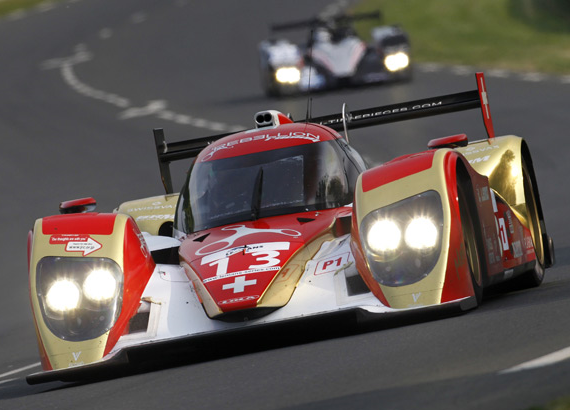 >>Rebellion's Bart Hayden was good enough to speak with us about the team's upgraded Lola. >>Rebellion's Bart Hayden was good enough to speak with us about the team's upgraded Lola.
Mulsanne's Corner: Who commissioned Lola to develop the new Rebellion Lola update kit? Can Lola
customers purchase this kit or is it exclusive to Rebellion? Who owns the
tooling?
Bart Hayden: The
update was requested by Rebellion Racing but it was decided to allow
the kit to be available to other LMP1 Lola customers (not that there
are any other than Rebellion at the moment). This means that Lola
own the design and tooling. MC: Can you describe all the changes to the car?
BH: In
broad terms a new nose/diffuser, "bullets" (the forward
sidepods that the nose connects to), front floor, front suspension
and rear wing. The car has a longer wheelbase, but shorter rear
overhang as a result of the changes.
MC: Did
the switch to wide fronts require new uprights? Revised suspension geometry?
BH: The
uprights stayed the same, but the wishbones and steering arms
changed.
MC: How
were the aero changes developed, wind tunnel or CFD? Did Rebellion
have any input?
BH: Predominantly
wind tunnel, but with CFD for some of the smaller details, that's
Lola's standard modus operandi. Rebellion's input was to provide a
list of requirements (such as wanting less drag, improving the
lights, updating the appearance), but we gave a fairly free hand to
Lola because we didn't want to place too many constraints on the
design.  MC: What's the primary gain of the alternate nose? MC: What's the primary gain of the alternate nose?
BH: The alternate nose is higher downforce, so is there as an option for balancing the aero at higher downforce tracks. Quite possible that it would be used at Petit. MC: What
is the net effect on car performance from the update?
BH:
Difficult to tell without a direct head-to-head comparison (and
there's been no time for that), but the aero figures, especially in
terms of efficiency are a step in the right direction. We're not
talking about quantum gains, but the improved light package and ability
to use 2011 tires give additional benefits. | >>Yesterday Lola announced:
Toyota will make additional LMP1 engines available exclusively to Lola for 2012. This increase will enable 4 cars to be run in the 2012 ILMC in addition to either the ALMS or LMS series. When
asked for a clarification ("Just to be clear, so no other chassis
manufacturers can run [or will run] Toyota engines next year?"), Lola's Sam Smith said, "Yes, it is an exclusive agreement for 2011 and 2012." | 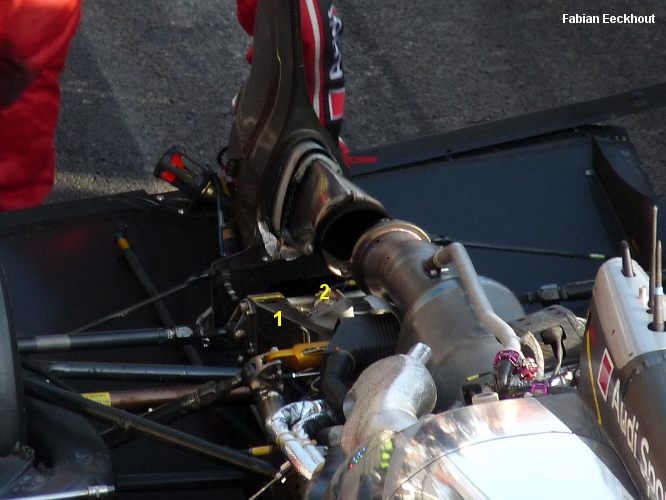 >>More
details are coming out about the Audi R18's rear composite
structure/bellhousing. In this photo we can see how the rear
suspension mounts to structural carbon "fingers" (1) that extend
rearwards from bellhousing and that the traditional metallic-walled
gearbox slides (2) in between them. >>More
details are coming out about the Audi R18's rear composite
structure/bellhousing. In this photo we can see how the rear
suspension mounts to structural carbon "fingers" (1) that extend
rearwards from bellhousing and that the traditional metallic-walled
gearbox slides (2) in between them. | | 5.10.11
>>Another
consideration regarding our power calculations; we've always assumed a
very liberal 10% drive train loss. But when calculating for
power, we're always solving for power at the wheels.
Thus the drive train loss can simply be calculated afterwards to
achieve the "dyno" figure. Therefore it's easy to recalculate for
less drive train loss using different figures. It wouldn't be
surprising to know that the top flight outfits at Peugeot and Audi are
running very high drive train efficiencies in the 92-94% range.
Recalculated for 94% efficiency:
Peugeot 908: 569-583
Oak Racing Pescarolo 01 Judd: 546 (just over 1% of Judd claim)
Aston Martin AMR-One: 445-481
Choose
the efficiency number of your choice. We're hearing 92% might be
even more appropriate. Though note the base hp figure we have
calculated is power at the wheels. |
| 5.9.11
>>Last
month we produced power estimates for the 2011 Peugeot 908 using
estimates from the 2010 908 Hdi FAP as the bench mark. We
concluded the 908 was producing upwards of 600 hp based on trap speeds
from Paul Ricard.
This was the thought process:
First we calculated the
drag level it would take to achieve 324 km/h assuming 700 hp and 1.8 m^2
of frontal area. With that in hand, we immediately knocked 150 hp
keeping drag constant. That showed a 298.9 km/h terminal velocity.
But 2011 cars have undergone extensive development and the 908
has most certainly lost drag over last year. So taking the
average of the dailysportscar.com numbers, we matched drag to that trap
speed. A 24% reduction in drag got us the 327.5 km/h cited
in the dailysportscar article. But that's a huge amount of drag
to peel out of a car with that has essentially the same frontal area
compared to last year. In fact the number simply isn't
believable. So we calculated for a 100 hp reduction over 2010 and
a 10% reduction in drag over the guesstimated 2010 numbers. That
netted 318.8 km/h. Closer, but still not 325-330 km/h.
Finally, with a further 7% reduction in drag we were able to
achieve 327.5 km/h. With a bit more tweaking my guess would be
that the 908 has more than 600 at the flywheel and drag actually
approaching 1000 lbs. Naturally all of this is guess work, and it
expounds from a guesstimate of the 908 HDi-FAP's drag level for Paul
Ricard last year. So it could get pretty ragged as it relates to
the 2011 908, but it should give one an idea of what's involved even
when we've decanted the problem into only a few simple variables.
In
the mean time we calculated drag at Le Mans based upon the estimated
power output and the measured trap speed. This past week we
shopped those figures around to see if industry experts agreed if we
were even in the ballpark and if there was any fundamental flaw in the
methodology. Based on that response we revised our drag figure
for the Le Mans configuration and recalculated for power.

What prompted this
reevaluation was some head scratching when we were trying to determine
drag levels for Oak Racing's Pescarolo 01 LMP using trap speeds from
the LM test. The power quoted didn't resolve well to a realistic drag level. To
achieve 325.9 km/h with 540 hp, about 486 at the wheels, meant a .cd of
.4665. That seemed to be so low as to be unachievable for an open top
LMP. So playing with power output, and assuming an output more along
the lines of 570 hp (that's only about 5% more than Judd's quoted 540
for the engine), to achieve 325.9 km/h we needed a .cd of .489 (about 921 lbs
drag @ 200 mph with a 1.71 m2 frontal area). This is still seemed low. Lower than what our understanding was for the Le Mans drag coefficient for an "average"
open top LMP by about 15%. But our references were to non-2011 optimized open top LMPs.

Thus
the inquiry to industry sources helped revise our drag estimates
downward. But not quite as low as the .4665. The .489 is
more reasonable (let's say it's a low side drag estimate for an open
top LMP), but it would also seem
that the Judd engine is producing more than the quoted 540 hp as that's
the only way to bridge the gap to the 325.9 km/h. Naturally you
can never believe the power output numbers the manufacturers
provide. If Judd's saying 540 and it really is 570, 5% more than
their claim, then the 570 is within the realms of believability.
Looking at it another way, 540 hp is within 2% of the target the
ACO set for everyone and is a convenient number for Judd to claim.
But we still feel the drag is on the low side, and if that's the
case, power is simply higher than we've stated (at .51 we need 531 hp
at tthe wheels, around 590 hp @ 90% efficiency).
With
a better idea of drag for an open top LMP we decided to revise the
figures for the Aston Martin LMP. Recall that Race Car Engineering Magazine was reporting that the Aston Martin AMR-One was barely putting out 300 hp at the Le Mans Test in order to keep the engine alive. But the
300 hp quoted just didn't pass the sniff test and simple calculations
for hp absorbed given the top speed achieved by the AMR-One required an
unrealistically low drag coefficient to achieve the 301 km/h mph trap
speed the AMR-One set in the first practice session. Thus we
recalculated using .57 and .59 for low and high side drag and produced
a power estimate of between 520 and 540 hp. And reducing drag to
between .51 and .55 produced a revised power estimate for the AMR-One
of between 465 and 502 hp:
Naturally
we're assuming the AMR-One is draggier than the Pescarolo, the
assumption being that the Pescarolo is well developed package at this
point while the AMR-One is less mature.
We're sure some will be unimpressed that we're suggesting the Judd has power closer to the diesels, but of
course power is only part of the story. And of course we've
simplified the issue into four statistics: power, frontal
area, drag, and top speed. We
should also stress that we're beholden to the accuracy of the trap
speeds. In lieu of that being within our control, we've attempted
to be as accurate as possible with our aerodynamic drag estimates.
Therefore the absolutes aren't necessarily spot-on, but the
trends should be. What trend is that? Simply, the power
difference between diesels and gasoline powered cars aren't as far off
as in recent years. However, there's still a huge performance
gap...
|

|
 |
Aerodynamicist
and automotive enthusiast Paul T. Glessner presents "The Secrets
&
Basics of Vehicle Aerodynamics" Seminars. See why more cars
are going
faster and doing it more safely and in style. Paul has been
asked
to speak at venues like Bob Bondurant School of High Performance
Driving,
Society of Automotive Engineers (SAE), Specialty Equipment Marketing
Assoc.
(SEMA), and Performance Racing Industry (PRI). Paul's
seminars both
educate and entertain. The day long seminar can be held at
your club,
organization and/or company location with the organizer paying only
$100.
(click event date in site) to read
about Paul's
extensive background and testimonials from enthusiasts like Jay
Leno.
Schedule your seminar at www.aeroseminars.com!
|
|
"While
I am not an engineer or a major technical type, I enjoy the discipline
of aerodynamics and was pleased at how Paul was able to explain its
intricacies
to individuals like me." - Jay Leno, Tonight Show Host |
|
|