 The
Courage LC75's front end layout. Radiators are a midship and fed
from the air that flows over the front of the bodywork. Brake
cooling comes from ducts inboard of the headlights. The nose is
raised though the function of the inlet underneath is unknown and in
fact was taped off when Andretti-Green tested. The Courage
splitter is raised the obligatory 50 mm across 1000 mm at the front.
Large diveplanes complement the front end aero package.
The
Courage LC75's front end layout. Radiators are a midship and fed
from the air that flows over the front of the bodywork. Brake
cooling comes from ducts inboard of the headlights. The nose is
raised though the function of the inlet underneath is unknown and in
fact was taped off when Andretti-Green tested. The Courage
splitter is raised the obligatory 50 mm across 1000 mm at the front.
Large diveplanes complement the front end aero package. The
ARX-01a
differs in many of the details. The front splitter design is the
most
dramatic change, Wirth Research going with a very interesting
non-linear shape. The -01a has a new nose though the fender shape
and louvers are effectively the same (even if the headlight cover shape
is vastly different). Ultimately the -01a shares nothing of the
Courage's bodywork.
The
ARX-01a
differs in many of the details. The front splitter design is the
most
dramatic change, Wirth Research going with a very interesting
non-linear shape. The -01a has a new nose though the fender shape
and louvers are effectively the same (even if the headlight cover shape
is vastly different). Ultimately the -01a shares nothing of the
Courage's bodywork.  The Courage monocoque utilizes the contemporary trend of blade type roll over structures.
 The
ARX-01a's outer splitter is a bolt on piece very reminiscent of an open
wheel race car's endplate foot. Perhaps too much is made of
similarities between specific design elements of LMPs and open wheel
race cars given the vastly different flow fields. But I'll admit
this is a spitting image of any number of endplate feet seen on F1
cars in '08. It is most likely an issue that at the leading edge
of the aero envelope the eventual difference in the flow field down
stream doesn't matter. What works, works.
The
ARX-01a's outer splitter is a bolt on piece very reminiscent of an open
wheel race car's endplate foot. Perhaps too much is made of
similarities between specific design elements of LMPs and open wheel
race cars given the vastly different flow fields. But I'll admit
this is a spitting image of any number of endplate feet seen on F1
cars in '08. It is most likely an issue that at the leading edge
of the aero envelope the eventual difference in the flow field down
stream doesn't matter. What works, works. While by no means a complete documentation of all the dive plane iterations, here's at least a sample cross section.
Sebring 2007.
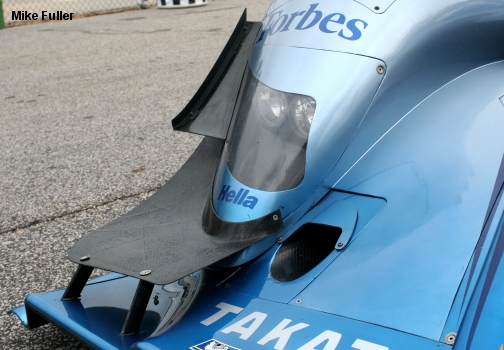 Petit Le Mans 2007. The upper diveplane has an outboard endfence.
 Salt Lake City 2008, ARX-01b.
 The
fender was further redesigned on the ARX-01c. The louvers
are now integrated into the fender and are not a separate removalable
panel. Note the
outboard turning vane. The turning vane is designed to reduce
drag and is similar to devices observed on the Zytek LMP and Reynard 2KQ. The diveplane has been designed to work in conjunction with the outboard dive plane.
The
fender was further redesigned on the ARX-01c. The louvers
are now integrated into the fender and are not a separate removalable
panel. Note the
outboard turning vane. The turning vane is designed to reduce
drag and is similar to devices observed on the Zytek LMP and Reynard 2KQ. The diveplane has been designed to work in conjunction with the outboard dive plane.