 The
XJR-14's front end aero is dominated by the front wing. While
not
historically unique (see March, GRID S1, various Porsche 956/962s) ,
the XJR-14 seemed to revive an interest (if briefly)
in the concept
with the rival Peugeot 905 taking cue. Front
balance could be adjusted through changes in flap angle, in addition to
the louver panels. The
XJR-14's front end aero is dominated by the front wing. While
not
historically unique (see March, GRID S1, various Porsche 956/962s) ,
the XJR-14 seemed to revive an interest (if briefly)
in the concept
with the rival Peugeot 905 taking cue. Front
balance could be adjusted through changes in flap angle, in addition to
the louver panels. |
 A
variety of
large trailing edge extensions for the front wing flap were used during
the XJR-14's IMSA GTP service. Del Mar here: A
variety of
large trailing edge extensions for the front wing flap were used during
the XJR-14's IMSA GTP service. Del Mar here: |
 Dive
planes were also raced (used at Portland, here, Miami, etc., though first
utilized at 1991 Group C events such as Magny Cours), this, in
combination with the larger and larger
front wing trailing edge extentions, in an effort to balance the car as total
downforce was increased at the higher downforce US tracks. Dive
planes were also raced (used at Portland, here, Miami, etc., though first
utilized at 1991 Group C events such as Magny Cours), this, in
combination with the larger and larger
front wing trailing edge extentions, in an effort to balance the car as total
downforce was increased at the higher downforce US tracks. |
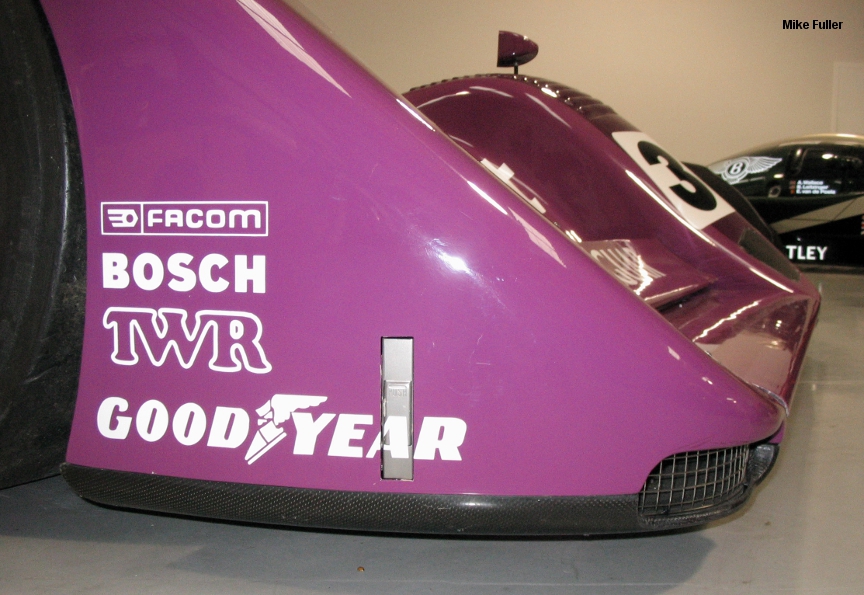 The
front wing was developed as a way to produce the required amount of
front downforce within a shortened front overhang dimension.
Says
Mark Thomas, the Jaguar XJR-14's aerodynamicist, "With the way
the
regulations were, with the wheelbase and overhangs, we were looking to
get as
much of the overhang to the rear as we could."
This was out of the desire to accommodate the twin-tier rear wing
and
to further maximize the downforce produced by the underfloor. The
front wing was developed as a way to produce the required amount of
front downforce within a shortened front overhang dimension.
Says
Mark Thomas, the Jaguar XJR-14's aerodynamicist, "With the way
the
regulations were, with the wheelbase and overhangs, we were looking to
get as
much of the overhang to the rear as we could."
This was out of the desire to accommodate the twin-tier rear wing
and
to further maximize the downforce produced by the underfloor. |
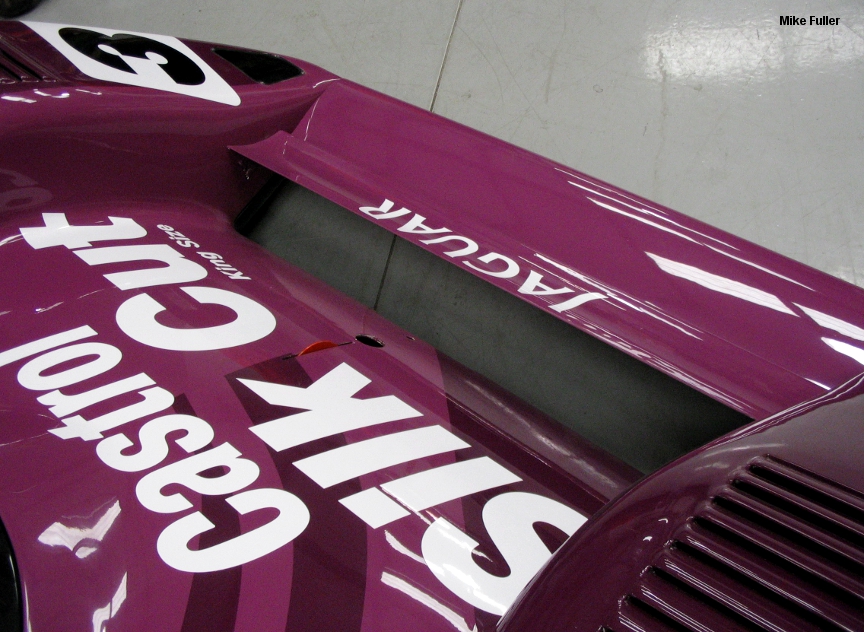 Mark
Thomas was adamant
that the flow spilling off the trailing
edge of the front wing flap didn’t have a detrimental effect on the
rear wing. Given the
proximity of the bodywork to the
trailing edge of the flap one could think that the airflow had time to
regroup
before heading to the rear of the car therefore was possibly less
detrimental. But according to Thomas, a
better solution was on the drawing board,
one that utilized a front diffuser arrangement, but time had run out
and the
aero group had to go with what they had. Mark
Thomas was adamant
that the flow spilling off the trailing
edge of the front wing flap didn’t have a detrimental effect on the
rear wing. Given the
proximity of the bodywork to the
trailing edge of the flap one could think that the airflow had time to
regroup
before heading to the rear of the car therefore was possibly less
detrimental. But according to Thomas, a
better solution was on the drawing board,
one that utilized a front diffuser arrangement, but time had run out
and the
aero group had to go with what they had. |
 The
XJR-14's radiators were midship for weight distribution priorities and with rather simple and uncomplicated
inlets. Once through the radiator, the air then exited the
car
through the engine bay and out the rear of the car above the trailing edge of the underfloor. The
XJR-14's radiators were midship for weight distribution priorities and with rather simple and uncomplicated
inlets. Once through the radiator, the air then exited the
car
through the engine bay and out the rear of the car above the trailing edge of the underfloor. |
