Images copyright Dave Lynn, Steve Dilts, & Neal Bledsoe
Text copyright Michael J. Fuller

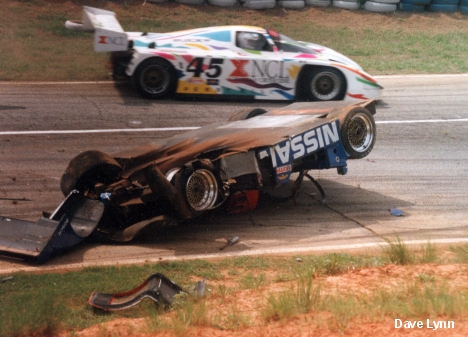
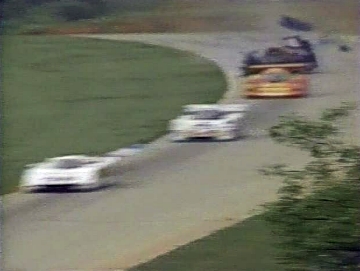
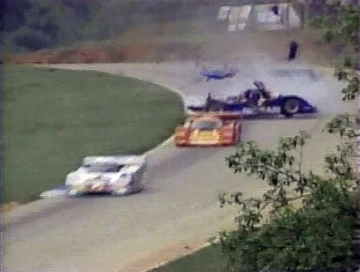
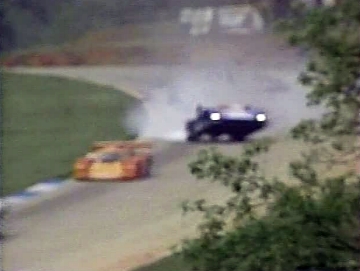
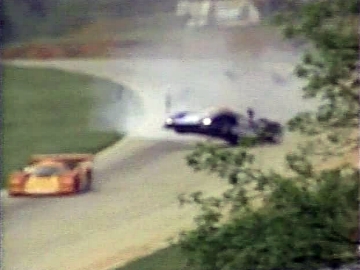
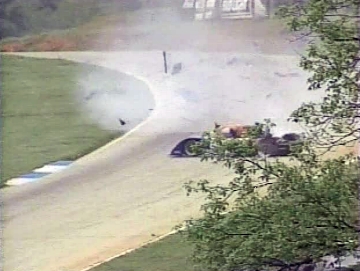
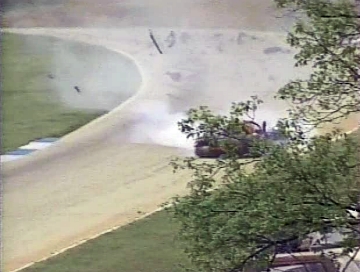
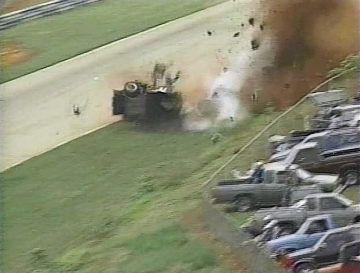
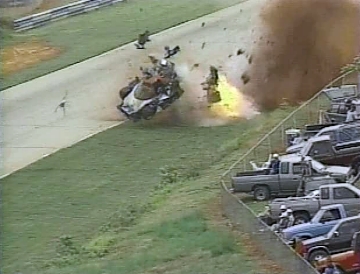
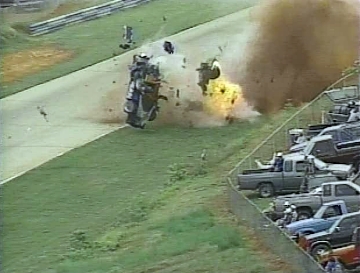
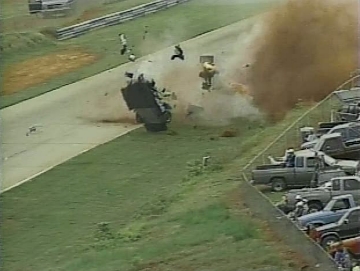
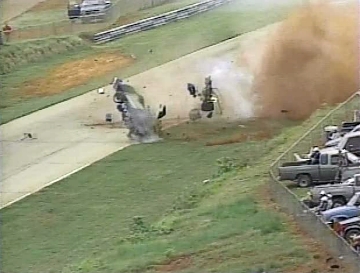
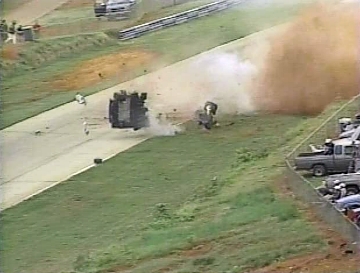
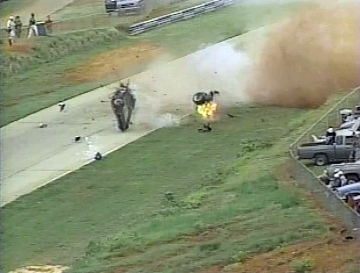
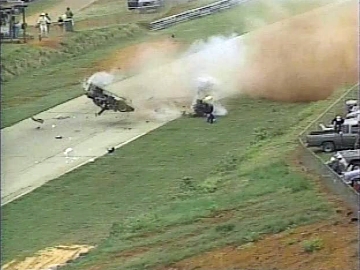
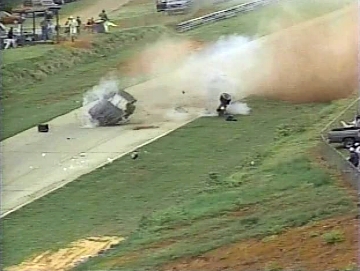
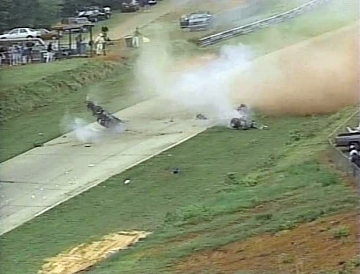
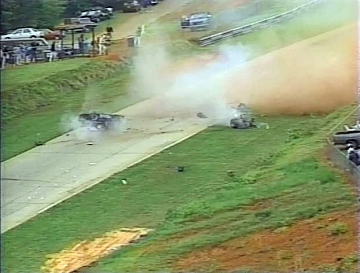
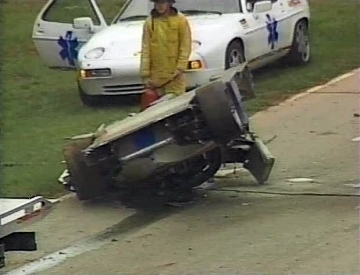
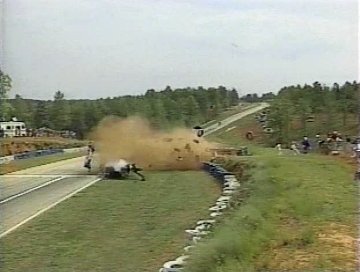
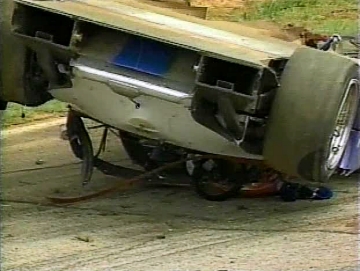
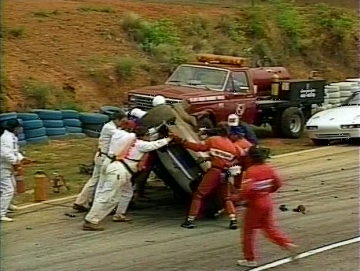
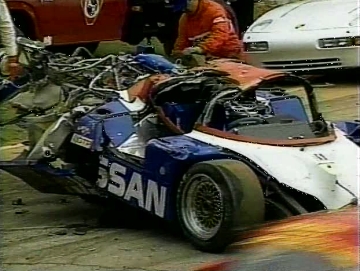
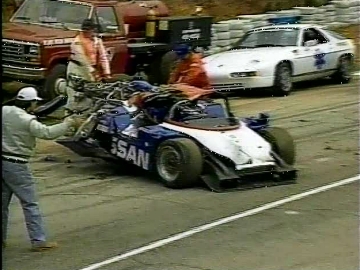
Practice was uneventful, to an extent; Nissan driver Chip Robinson suffered a failure or sorts in the rear of his car that resulted in a wrecked NPT-91A. Was it related to what would occur in the race? Then there was the race, says Nissan GTP driver and multiple IMSA GTP Champion Geoff Brabham, “After 10 laps I came onto the straight to see pieces of tire all over the road and Chip’s (Robinson) Nissan upside down in the middle of the road. I knew what had happened and in our wisdom, or lack of it, the team and myself decided to continue but stop more often for tires as I was running 3rd at the time.” But on lap 55 it happened again, and this time Brabham’s Nissan ended up on its roof, “The marshals did not know what to do and after a very long while it was my crew who picked the car up enough for me to get out, it could have been a very nasty situation.” (IMSA's Bob Laubach relays that the Road Atlanta accidents were the straw that broke the proverbial camel's back and ultimately led to the creation of IMSA's traveling safety team. No longer would track safety be the responsibility of the local safety crews.
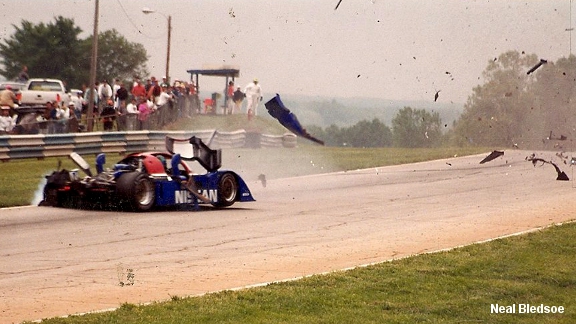
In the end no cause was forthcoming for any of the tire failures; Goodyear indicated they were unable to recreate the mode of failure in testing and could only offer that the tire batch in question was at the limits of its life cycle. And while that most certainly was a redirect, it isn’t much of a stretch to say that the downforce loads the cars were generating certainly points towards causation. One engineer mentioned, “I remember that after, or maybe even during the race weekend...Goodyear was asking just how much downforce the cars were making in that dip at that speed, and when I sent them the numbers, the Goodyear engineers took all the tires away saying we were just plain overloading the carcass.” So the high dynamic loading (downforce as well as the compression loading created by negotiating the Dip at high speed), coupled with the high static weight of some of the cars (this issue only affected a few cars after all) seemed to be the root cause.
Of
all the IMSA GTP competitors, the Nissan was carrying the most static
weight. This was primarily a factor of the IMSA regulations at
the time and ultimately Nissan was in mid strides to correct this by
changing their philosophy to that of their competitors. On IMSA’s
sliding scale of weight vs. engine capacity, the Nissan weighed in at
2100 lbs as they were running the maximum turbo capacity of 3.0
liters. But all of Nissan’s competitors, Toyota, Intrepid, and
Jaguar, were taking advantage of the weight reduction possibilities
granted by IMSA by utilizing the Group C specification
underfloor. Under IMSA rules, competitors running to Group C
underfloor regulations were allowed to take 100 lbs off the overall
weight of their car. And while the Group C spec underfloor
regulations put (slight) limiting factors on the dimension of the
tunnels (primarily by a reduced tunnel exit size and mandated flat bottom area ahead
of the tunnel leading edge), and in theory made them less effective at
generating downforce, ultimately it didn’t really work out that way as
downforce levels continued to increase even as teams adopted Group C
spec tunnels in order to take advantage of the IMSA allowed weight
break.
 Contrary
to the Nissans, Toyota came in at 1830 lbs running a 2.1 liter turbo in
combination with a Group C spec underfloor. Toyota coupled a
small capacity 4-cylinder engine (which therefore weighed less on
IMSA's sliding scale to begin with) with the weight reduction allotted
to the Group C underfloor. Toyota aerodynamicist Hiro Fujimori
explains, “We knew that the Group C style tunnel lost downforce by
making the tunnel exit smaller, but it would make the same downforce, or
more, as a big tunnel simply by adjusting the contour of the
tunnel.” So nothing lost from an aerodynamics perspective and
certainly something gained (free weight reduction). And while it
took Toyota a few years to iron out the reliability of their highly
stressed 4-cylinder, in the end it proved to be the equal of the front
runners in terms of power, even while being a counter intuitive choice.
Contrary
to the Nissans, Toyota came in at 1830 lbs running a 2.1 liter turbo in
combination with a Group C spec underfloor. Toyota coupled a
small capacity 4-cylinder engine (which therefore weighed less on
IMSA's sliding scale to begin with) with the weight reduction allotted
to the Group C underfloor. Toyota aerodynamicist Hiro Fujimori
explains, “We knew that the Group C style tunnel lost downforce by
making the tunnel exit smaller, but it would make the same downforce, or
more, as a big tunnel simply by adjusting the contour of the
tunnel.” So nothing lost from an aerodynamics perspective and
certainly something gained (free weight reduction). And while it
took Toyota a few years to iron out the reliability of their highly
stressed 4-cylinder, in the end it proved to be the equal of the front
runners in terms of power, even while being a counter intuitive choice.
At the bottom end of the weight scale, the Jaguar XJR-14 was the lightest GTP in the field. From 1990 onwards (upon the announcement of the pending changes in Europe for 1991), Group C derived 3.5 liter formula prototypes were allowed to race in IMSA at 1750 lbs. In combination with the Group C spec underfloor, the all-up regulation weight was a controversially low 1650 lbs. Ultimately the IMSA-ized XJR-14 gained weight as components were beefed up and TWR never did reach the 1650 minimum with the car. But even in its debut race, the Miami GP, the Jaguar was tilting the scales at a lithe, certainly compared to the competition, 1680 lbs.
Obviously
Nissan was cognizant of the advantages of all of this and was working
hard to put the NPT-90 on a diet for 1992. A reduction in turbo
engine capacity to 2.5 liters would move the Nissan 100 lbs down the
weight scale. And fitting a Group C spec underfloor to the car
would make their new target weight 1900 lbs; a full 200 lbs under where
they started the season at. This would be achieved by analyzing
every aspect of the car’s design and finding weight wherever it could
be pared. This would mean ounces off some items, pounds off
others. But destroying two cars so early in the season certainly
complicated Nissan’s issues; in order to prove these new, lighter
items, the team needed two cars to be circulating the test track, not
to mention the race track. But at Road Atlanta the Nissan was
still at 2100 lbs; the weight reduction program was in-process and bits
were only just trickling onto the car.
 While
the root cause of the tire failures was never publicly determined, the
Nissan’s more than 2100 lbs of static weight in combination with around
7000 lbs of dynamic “weight” (Kas Kastner indicates the failures
occurred while the cars were still accelerating and at an estimated 185
mph) probably put them in the best position to exacerbate any
underlying tire issues. And even Nissan’s Trevor Harris hinted to
as much in On-Track magazine at the time (June 12, Full Chat section)
referring to the Atlanta weekend, “Ours is the most highly-loaded car
vertically,” and "Under certain circumstances, we can reach 5,000 to
6,000 lbs of load." Harris also points out that the failures
seemed to occur from the heavier cars to the lighter cars (with the
lighter cars actually sustaining no failures). Compare the
Nissan's 2100 lbs to the Toyota’s 1830 lbs. or Jaguar’s 1680+ lbs. with
about the same amount of downforce and it begins to make further
sense. Also note that neither the Porsche 962s or the Mazda
RX-792P had any issues; the 962s not generating near the level of
dynamic load as the Nissans or Toyota (though certainly weighing close
to the top in static weight) and the Mazda being at the bottom end of
the weight scale though generating a fair bit of downforce in its own
right. But even if the Nissan's downforce advantage was only
along the lines of a couple hundred pounds, by adding that dynamic
total to the static weight difference you're very quickly approaching
500 lbs of additional tire loading, if not more.
While
the root cause of the tire failures was never publicly determined, the
Nissan’s more than 2100 lbs of static weight in combination with around
7000 lbs of dynamic “weight” (Kas Kastner indicates the failures
occurred while the cars were still accelerating and at an estimated 185
mph) probably put them in the best position to exacerbate any
underlying tire issues. And even Nissan’s Trevor Harris hinted to
as much in On-Track magazine at the time (June 12, Full Chat section)
referring to the Atlanta weekend, “Ours is the most highly-loaded car
vertically,” and "Under certain circumstances, we can reach 5,000 to
6,000 lbs of load." Harris also points out that the failures
seemed to occur from the heavier cars to the lighter cars (with the
lighter cars actually sustaining no failures). Compare the
Nissan's 2100 lbs to the Toyota’s 1830 lbs. or Jaguar’s 1680+ lbs. with
about the same amount of downforce and it begins to make further
sense. Also note that neither the Porsche 962s or the Mazda
RX-792P had any issues; the 962s not generating near the level of
dynamic load as the Nissans or Toyota (though certainly weighing close
to the top in static weight) and the Mazda being at the bottom end of
the weight scale though generating a fair bit of downforce in its own
right. But even if the Nissan's downforce advantage was only
along the lines of a couple hundred pounds, by adding that dynamic
total to the static weight difference you're very quickly approaching
500 lbs of additional tire loading, if not more.
Regardless of the cause, the result was
detrimental and shook Team Nissan to the core. Trevor Harris
simply stated, “We never really recovered
from that weekend.” Indeed, the team was
unable to consistently field two cars following Road Atlanta and their
1992 title bid fell flat (though their second place in the
Manufacturer's Championship flattered to deceive; they only won one
race that year).
 |
 |
 |
 |
 |
 |
 |
 |
 |
 |
 |
 |
 |
 |
 |
 |
 |
 |
 |
 |
 |
 |
 |
 |
 |
 |
 |
 |
 |
 |
 |
 |
 |
 |
 |
 |
 |
 |
 |
 |
 |
 |
 |
 |
 |
