 The
Toyota Eagle MkIII is visually dominated by the car's massive intake ducts.
The ducts route cooling air from above the splitter, around the front end
of the monocoque, through the doors, to intercoolers and radiators
located in the side pods. Cockpit cooling was siphoned from the primary
brake feed. The high sided nature of the
MkIII was designed to reduce drag as well as improving airflow to the rear
wing. The MkIII had around 15% more
cooling capacity than the MkII though Drino Miller had the engine developing more
power so the added cooling capacity went to a worthy cause. Once heated, the
cooling airflow exited the car out through the back of the engine bay, drawn by
the low pressure area present there, and helping fill in the base area reducing
overall drag. In addition the engine bay
flow through helped keep the engine bay cooler, providing one more benefit. The
Toyota Eagle MkIII is visually dominated by the car's massive intake ducts.
The ducts route cooling air from above the splitter, around the front end
of the monocoque, through the doors, to intercoolers and radiators
located in the side pods. Cockpit cooling was siphoned from the primary
brake feed. The high sided nature of the
MkIII was designed to reduce drag as well as improving airflow to the rear
wing. The MkIII had around 15% more
cooling capacity than the MkII though Drino Miller had the engine developing more
power so the added cooling capacity went to a worthy cause. Once heated, the
cooling airflow exited the car out through the back of the engine bay, drawn by
the low pressure area present there, and helping fill in the base area reducing
overall drag. In addition the engine bay
flow through helped keep the engine bay cooler, providing one more benefit.
|
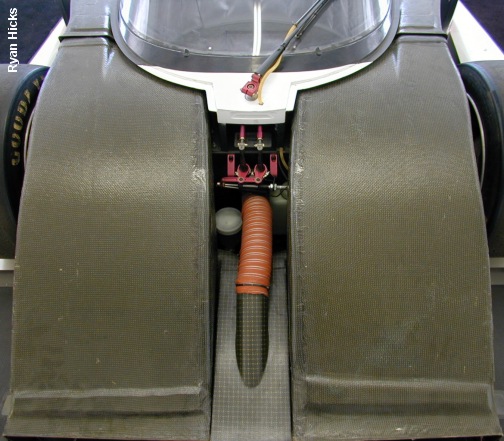 The
center duct feeds the brakes as well as the cockpit with the cooling
feed
going into the monocoque at the footbox. Initially there were
concerns given the length of the inlet cooling ducts and
potential boundary layer build up as air traveled through the
ducts. The
center duct feeds the brakes as well as the cockpit with the cooling
feed
going into the monocoque at the footbox. Initially there were
concerns given the length of the inlet cooling ducts and
potential boundary layer build up as air traveled through the
ducts. |
 With
the ducts removed it becomes apparent just how narrow the front of the
monocoque
is, being about as wide as a single seater, this to allow room for the
massive cooling ducts, but perhaps more importantly, the front diffuser. With
the ducts removed it becomes apparent just how narrow the front of the
monocoque
is, being about as wide as a single seater, this to allow room for the
massive cooling ducts, but perhaps more importantly, the front diffuser. |
 Front
end packaging is rather tight. Note that the cooling duct bears witness
to having to clear the frontsuspension via a chamfer that matches the pushrod
angle and upper A-arm. Front
end packaging is rather tight. Note that the cooling duct bears witness
to having to clear the frontsuspension via a chamfer that matches the pushrod
angle and upper A-arm. |
 The
pushrod actuated front suspension. The trailing edge of the front
diffuser can be seen as it exits the car aft of the front suspension. The
pushrod actuated front suspension. The trailing edge of the front
diffuser can be seen as it exits the car aft of the front suspension. |
 The
front springs are located on top of the monocoque, underneath a scuttle
that is accesible only by removing the front windscreen when the front nose is on. The
front springs are located on top of the monocoque, underneath a scuttle
that is accesible only by removing the front windscreen when the front nose is on. |
