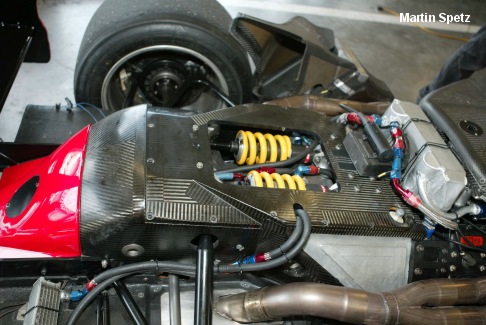
 The
gearbox is buried within the rear carbon substructure.
Traditionally
the gearbox is bolted to or cast integrally to the bellhousing with the
suspension then located off of pickups on the gearbox. But in
that installation method, all the accompanying suspension
loads are absorbed by the gearbox. But the Allard design team
decided to eliminate
the loads inputted into the gearbox as much as possible in order to
improve longevity,
an important feature for an endurance prototype. The drawback
was
that the gearbox was exceedingly difficult to access, even for
relatively common tasks such as ratio changes. Gordon Friend
comments, "First you remove the carbon top of the gearbox
monocoque. Then you undo the input shaft and disconnect the
alternator. Then you remove the bolts from the gearbox
bobbins holding the 'box in place in the monocoque.
Then you lift the gearbox out. But you can only do
this at a somewhat awkward angle and it wasn't like it was super light!
Then with the gearbox out of the car, you can change gears
relatively easy, though you do need to have a mount to put the 'box in
in order to untorque it etc. Turn around time for a gear change, 2
to 4 hours!" The
gearbox is buried within the rear carbon substructure.
Traditionally
the gearbox is bolted to or cast integrally to the bellhousing with the
suspension then located off of pickups on the gearbox. But in
that installation method, all the accompanying suspension
loads are absorbed by the gearbox. But the Allard design team
decided to eliminate
the loads inputted into the gearbox as much as possible in order to
improve longevity,
an important feature for an endurance prototype. The drawback
was
that the gearbox was exceedingly difficult to access, even for
relatively common tasks such as ratio changes. Gordon Friend
comments, "First you remove the carbon top of the gearbox
monocoque. Then you undo the input shaft and disconnect the
alternator. Then you remove the bolts from the gearbox
bobbins holding the 'box in place in the monocoque.
Then you lift the gearbox out. But you can only do
this at a somewhat awkward angle and it wasn't like it was super light!
Then with the gearbox out of the car, you can change gears
relatively easy, though you do need to have a mount to put the 'box in
in order to untorque it etc. Turn around time for a gear change, 2
to 4 hours!" |
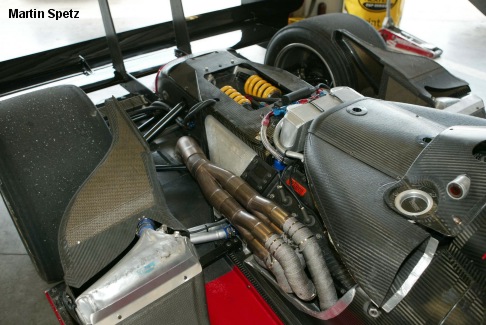 The packaging at the rear
is extremely tight and compact. Unfortunately this made
working on the car rather difficult.
The packaging at the rear
is extremely tight and compact. Unfortunately this made
working on the car rather difficult. The
spring dampers were located within the rear monocoque. Gordon
Friend indicates that, unlike working on the gearbox, changing springs
was actually rather straight forward and could be accomplished in about
20 minutes.
The
spring dampers were located within the rear monocoque. Gordon
Friend indicates that, unlike working on the gearbox, changing springs
was actually rather straight forward and could be accomplished in about
20 minutes.