 |
The
R10's particulate filters have grown in diameter since the car's
introduction
(note the bulge in the engine cover and compare to inset image
below).
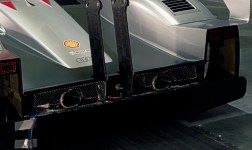
The placement of the exhaust is located to beneficially influence the
trailing
edge flow of the rear diffuser by injecting high velocity airflow into
the air stream.
 |
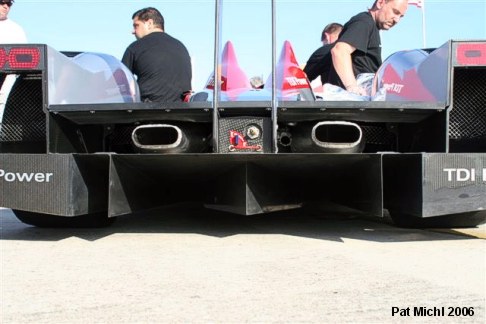 The
rear diffuser gurney is fixed height (though replaceable/removable)
where
as on the R8 it could be adjusted up or down as needed. By
late
2007 the rear gurney height had gotten quite tall, substantially so,
and was an indication of higher overall downforce levels being run.
The
rear diffuser gurney is fixed height (though replaceable/removable)
where
as on the R8 it could be adjusted up or down as needed. By
late
2007 the rear gurney height had gotten quite tall, substantially so,
and was an indication of higher overall downforce levels being run.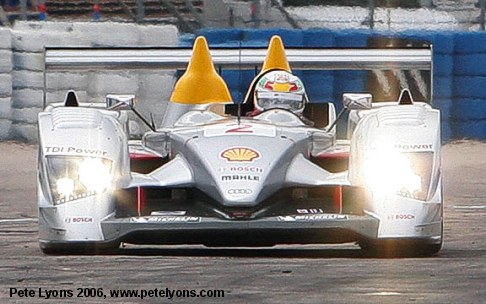 In
this shot you can see the mandatory plank that is bolted to the
underside
of the car.
In
this shot you can see the mandatory plank that is bolted to the
underside
of the car.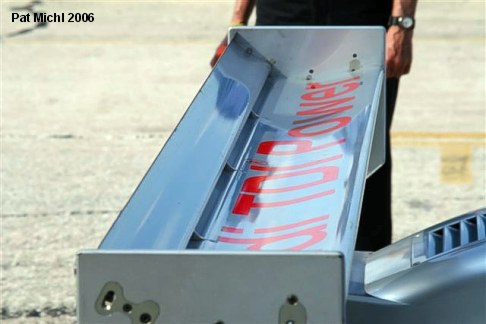 The
R10's high camber rear wing.
The
R10's high camber rear wing. Louvers
accompany the rear fender.
Louvers
accompany the rear fender.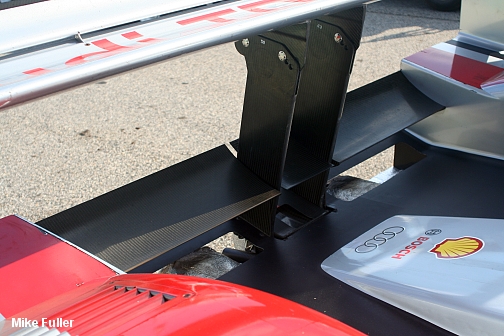 At
the 2008 Spa Le Mans Series event the Audis were running in a slightly
revised aerodynamic spec which consisted of a simple add-on "wing"
mounted
between the rear fenders at the very trailing edge of the engine cover.
These wings took on the name, "Spa wings".
Subsequently
this package became the standard configuration and was raced at Le Mans
and all tracks (Le Mans Series and American Le Mans Series) post-Spa.
At
the 2008 Spa Le Mans Series event the Audis were running in a slightly
revised aerodynamic spec which consisted of a simple add-on "wing"
mounted
between the rear fenders at the very trailing edge of the engine cover.
These wings took on the name, "Spa wings".
Subsequently
this package became the standard configuration and was raced at Le Mans
and all tracks (Le Mans Series and American Le Mans Series) post-Spa.
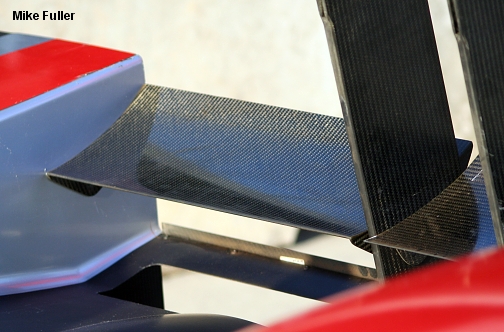 Having
a closer look at the wing, it is a simple parallel extrusion
in cross section without a differing top and bottom chord line (i.e.,
not
a true wing but we'll use that wording from here out for clarity sake,
I mean what else are we going to call it?). Overall it seems
rather
crude in execution and is very simplistic.
Having
a closer look at the wing, it is a simple parallel extrusion
in cross section without a differing top and bottom chord line (i.e.,
not
a true wing but we'll use that wording from here out for clarity sake,
I mean what else are we going to call it?). Overall it seems
rather
crude in execution and is very simplistic.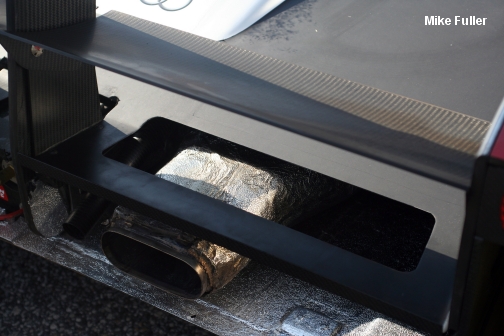 There
was some initial thought that the windows in the trailing edge of the
bodywork might allow for positive aero interaction of the wings with
the trailing edge of the under floor, that this might allow
the
wing to potentially "see" the trailing edge
of the tunnels. On further discussion it now appears that the
windows are in fact the wing's only reason for being from a regulations
standpoint but don't impart any significant increase to the
installation's overall performance. We understand that,
according
to Audi, the wings are in fact "cover panels" thus making the car in
compliance with Art 1.5.2 which states that as seen from above, no
mechanical components can be visible.
There
was some initial thought that the windows in the trailing edge of the
bodywork might allow for positive aero interaction of the wings with
the trailing edge of the under floor, that this might allow
the
wing to potentially "see" the trailing edge
of the tunnels. On further discussion it now appears that the
windows are in fact the wing's only reason for being from a regulations
standpoint but don't impart any significant increase to the
installation's overall performance. We understand that,
according
to Audi, the wings are in fact "cover panels" thus making the car in
compliance with Art 1.5.2 which states that as seen from above, no
mechanical components can be visible.
In general, the Spa wing allows a reduction in angle of the primary rear wing flap for less drag but similar levels of downforce. Observations of the rear wing gurney height back this up as that has now gotten smaller. While body gurneys can be used effectively to increase overall downforce, in Audi's case there are now more efficient ways to do that.
Interestingly enough, a cursory read of the regulations and one really questions the legality of such an aero device is based solely on the wording in article 3.6.2 which states in rather plain language:
3.6.2 - No aerodynamic element can be added on the bodywork apart from :
- Two aerodynamic elements maximum at the front of the front fenders provided that :
• They do not obstruct the driver's view
• They do not mask the headlights ;
• They are not situated more than 600 mm above the reference surface ;
• They are approved by the manufacturer and the ACO (homologation form of the car).
- One “Gurney”
at the rear of the
bodywork.
- The rear
wing described below.
So it seems rather clear that said add-on device isn't, a.) an element attached to the front fender, b.) a rear body gurney (the cars still had the standard trailing edge gurney being run in conjunction with the new device), or c.) a rear wing. So naturally there are questions as to how Audi defined this aero device and then to what standard the ACO accepted it.
