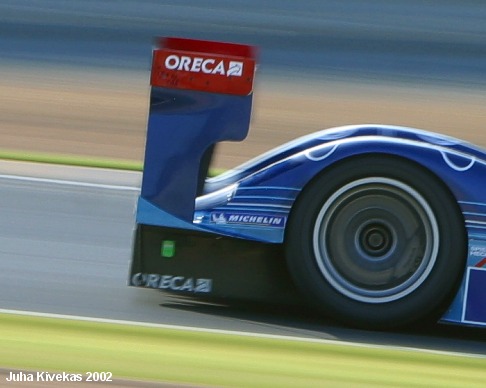
 At
Le Mans 2002 Dallara showed up with deep, Audi-esque (or Courage-esque,
aren't they the ones who started this with the C60 Evo.?) endplates.
The endplates rise up from the engine cover and are offset from the wing
endplates by a very minimal gap in order to comply with the restrictive
wing endplate rules.
At
Le Mans 2002 Dallara showed up with deep, Audi-esque (or Courage-esque,
aren't they the ones who started this with the C60 Evo.?) endplates.
The endplates rise up from the engine cover and are offset from the wing
endplates by a very minimal gap in order to comply with the restrictive
wing endplate rules.
Simplified, increasing endplate depth acts as a wing span increase aerodynamically. The practical benefit is that, for the same level of downforce, comparing a standard wing with a small endplate to a wing with a deep endplate, you can run less drag for equal downforce as the increased endplate depth improves the overall efficiency of the wing.
 Oreca
decided not to race with the endplates citing lack of testing and familiarity.
There were concerns the added weight to the rear engine cover would preclude
the driver from removing the engine cover on course should something happen
to the race car. Note the gurney lip across the trailing edge of
the rear bodywork. The full-width body gurney is a very effective
generator of downforce.
Oreca
decided not to race with the endplates citing lack of testing and familiarity.
There were concerns the added weight to the rear engine cover would preclude
the driver from removing the engine cover on course should something happen
to the race car. Note the gurney lip across the trailing edge of
the rear bodywork. The full-width body gurney is a very effective
generator of downforce. Sebring
2004, the Rollcentre entered Dallara-Judd. Close up of the deep rear
wing endplates.
Sebring
2004, the Rollcentre entered Dallara-Judd. Close up of the deep rear
wing endplates. The
Dallara's rear wing architecture was revised for the 2004 season to comply
with the regulation changes mandated by the ACO for Le Mans and the Le
Mans Endurance Series (the changes did not effect Dallaras entered in the
American Le Mans Series). The changes stipulated that chassis built
prior to 2004 had to reduce the span of their rear wing to 180 cm (from
around 200 cm). The purpose was to bring older cars in line
with the performance of new for '04 prototypes. Audi unveiled their
R8 with an identical wing interpretation in the week prior to the Paul
Ricard LMES test. Dallara simply copied the R8 interpretation as
it is essentially identical. Compare to the Audi
R8.
The
Dallara's rear wing architecture was revised for the 2004 season to comply
with the regulation changes mandated by the ACO for Le Mans and the Le
Mans Endurance Series (the changes did not effect Dallaras entered in the
American Le Mans Series). The changes stipulated that chassis built
prior to 2004 had to reduce the span of their rear wing to 180 cm (from
around 200 cm). The purpose was to bring older cars in line
with the performance of new for '04 prototypes. Audi unveiled their
R8 with an identical wing interpretation in the week prior to the Paul
Ricard LMES test. Dallara simply copied the R8 interpretation as
it is essentially identical. Compare to the Audi
R8.