 Why
should the GT-One be considered state-of-the-art even a year later?
Toyota has grasped on to a cutting edge aerodynamic principle and have
utilized it throughout the design of the GT-One. The principle is
vortex lift, purposely generating vortices to enhance low pressure side
lift. This principle is what makes, of all things, insects
able to fly. Aerodynamic theory states that as an aerodynamic surface
gets smaller, it becomes less efficient at generating lift. An insect's
wing generates a vortex on the top surface (the low pressure side) which
greatly increases the surface's ability to produce lift. Modern supersonic
combat aircraft use this idea to increase subsonic aerodynamic performance.
Ever notice the strakes near the cockpit of a F-16 or F/A-18? They
generate vortices, or what could be called small tornados, that run over
the top side of the wing creating more efficient lift by inducing higher
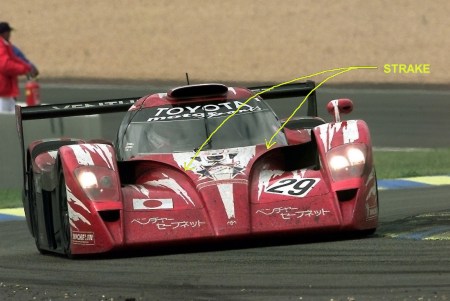
speed and therefore lower pressure. The nose of the Toyota
GT-One has features that are equivalent to these strakes that generate
vortices which run on either side of the cockpit and are aimed just under
the rear wing where they could enhance downforce.
Why
should the GT-One be considered state-of-the-art even a year later?
Toyota has grasped on to a cutting edge aerodynamic principle and have
utilized it throughout the design of the GT-One. The principle is
vortex lift, purposely generating vortices to enhance low pressure side
lift. This principle is what makes, of all things, insects
able to fly. Aerodynamic theory states that as an aerodynamic surface
gets smaller, it becomes less efficient at generating lift. An insect's
wing generates a vortex on the top surface (the low pressure side) which
greatly increases the surface's ability to produce lift. Modern supersonic
combat aircraft use this idea to increase subsonic aerodynamic performance.
Ever notice the strakes near the cockpit of a F-16 or F/A-18? They
generate vortices, or what could be called small tornados, that run over
the top side of the wing creating more efficient lift by inducing higher
speed and therefore lower pressure. The nose of the Toyota
GT-One has features that are equivalent to these strakes that generate
vortices which run on either side of the cockpit and are aimed just under
the rear wing where they could enhance downforce.
 In
general though, vortex lift is not used by subsonic aircraft (or cars for
our case) because of the inherent drag penalty caused by their creation.
But in the GT-One's case the vortices pay for their ride. First by
filling in the low pressure area behind the cockpit (which is a source
of drag), then, also by filling in the "hole" in the air that the entire
cars leaves in its wake. Proper use of vortices can help increase
downforce and also reduce drag. That is the name of the game, but
up until this point no other race car designer seems to have grasped
at what it is that makes the GT-One so special. I once read something
about Colin Chapman, that even at the height of Lotus' F1 success, he was
always outside of the other team's transporters as they unloaded seeing
what new bits they had brought along. You can't design in a vacuum.
It is good practice to take a look at what the other teams are doing if
only to spark new ideas. In my estimation, other teams could do themselves
some good by following suit as this is the future of race car aerodynamics.
In
general though, vortex lift is not used by subsonic aircraft (or cars for
our case) because of the inherent drag penalty caused by their creation.
But in the GT-One's case the vortices pay for their ride. First by
filling in the low pressure area behind the cockpit (which is a source
of drag), then, also by filling in the "hole" in the air that the entire
cars leaves in its wake. Proper use of vortices can help increase
downforce and also reduce drag. That is the name of the game, but
up until this point no other race car designer seems to have grasped
at what it is that makes the GT-One so special. I once read something
about Colin Chapman, that even at the height of Lotus' F1 success, he was
always outside of the other team's transporters as they unloaded seeing
what new bits they had brought along. You can't design in a vacuum.
It is good practice to take a look at what the other teams are doing if
only to spark new ideas. In my estimation, other teams could do themselves
some good by following suit as this is the future of race car aerodynamics.
