 Sebring
1991. With the help of Norbert Singer Joest had abandoned the factory
tail in favor of a remote rear wing which, at the very least, allowed a
greater freedom of adjustment as well as improved aerodynamics.
Sebring
1991. With the help of Norbert Singer Joest had abandoned the factory
tail in favor of a remote rear wing which, at the very least, allowed a
greater freedom of adjustment as well as improved aerodynamics.  Sebring
1993. The Joest team had been busy (again with the help of Norbert
Singer). The front nose notch had been filled in and air management
exiting the front wheel well was revised. Joest abandoned the Kamm-ish
rear end for a duck bill and complemented the package with a rather impressive
twin tier rear wing.
Sebring
1993. The Joest team had been busy (again with the help of Norbert
Singer). The front nose notch had been filled in and air management
exiting the front wheel well was revised. Joest abandoned the Kamm-ish
rear end for a duck bill and complemented the package with a rather impressive
twin tier rear wing. The
"Red Baron" wing worked as two devices in one. The upper plane functioned
as a standard wing, running in the cleaner air at the maximum legal height.
It could be run flatter for the same level of downforce but less drag.
The bottom tier functioned as a under wing extractor, enhancing the downforce
generated by the tunnels. Notice that the main plane elements for
both the top and bottom tiers are the same profile while the flaps are
of dramatically different chord. DPS manufactured the wings, endplates,
and mounts.
The
"Red Baron" wing worked as two devices in one. The upper plane functioned
as a standard wing, running in the cleaner air at the maximum legal height.
It could be run flatter for the same level of downforce but less drag.
The bottom tier functioned as a under wing extractor, enhancing the downforce
generated by the tunnels. Notice that the main plane elements for
both the top and bottom tiers are the same profile while the flaps are
of dramatically different chord. DPS manufactured the wings, endplates,
and mounts.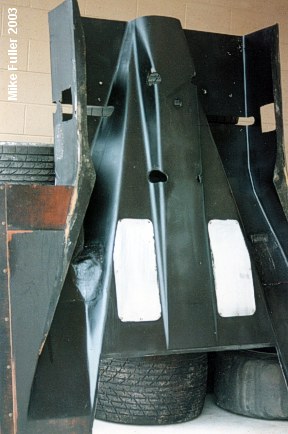 With
all the work that Joest had done to the top sides it was surprising to
see that the underbody was still pretty much as the factory had developed.
Notice the metal sheets showing where the engine resides. Another
thing that should be pointed out is the width of the Porsche flat-six motor
and how it really effected the packaging of the underwing.
With
all the work that Joest had done to the top sides it was surprising to
see that the underbody was still pretty much as the factory had developed.
Notice the metal sheets showing where the engine resides. Another
thing that should be pointed out is the width of the Porsche flat-six motor
and how it really effected the packaging of the underwing. Another
view of the Joest 962C. The vents behind the front wheel well have
been covered up to just a thin slit. A gurney lip has also been added
to the front of the slit to improve air extraction and increase front end
downforce.
Another
view of the Joest 962C. The vents behind the front wheel well have
been covered up to just a thin slit. A gurney lip has also been added
to the front of the slit to improve air extraction and increase front end
downforce. The
cooling package is still pretty conventional. Coolers being located
in the side pods and being fed by vents in the upper surface. Some
of the air is then exhausted out via vents in front of the rear wheels,
the rest exiting out the engine bay at the rear. Notice the periscope
turbo intake.
The
cooling package is still pretty conventional. Coolers being located
in the side pods and being fed by vents in the upper surface. Some
of the air is then exhausted out via vents in front of the rear wheels,
the rest exiting out the engine bay at the rear. Notice the periscope
turbo intake. Large
dive planes have been added to the nose to further augment front end grip.
Note the thin splitter across the front.
Large
dive planes have been added to the nose to further augment front end grip.
Note the thin splitter across the front.
Wind tunnel development of the Joest Porsche 962C was carried out at the Porsche Weissach tunnel (full scale fixed-floor with boundary layer suction). According Ralf Jüttner, Technical Director for Joest Racing, maximum downforce for the Joest 962 was 5584 lbs. for 1396 lbs. drag (max L/D: 5281 lbs. downforce for 1200 lbs. drag). Jüttner also mentioned that, "In general, I think we were quite far off the downforce values of the Nissan and the Toyota. Anyway, I do know that downforce figures from the Weissach tunnel showed smaller values compared to other tunnels. But regardless, there was no way coming close to the Toyota as we could personally see large differences in the braking points for the first chicane at Portland for example."
