 The
new regulations initially altered the front to rear aero balance putting
a premium on the generation of rear
grip. The rear wing is
now closer to the center of the car (even at the maximum allowable 750
mm rear overhang) than under the previous LMP900 regulations and it is
subsequently operating in a less optimum airflow field.
Additionally the rear
wing is of shorter chord and therefore is less efficient in its own
right.
"Initially the effect of the smaller rear wing and small overhang made
a big difference and it was very difficult to generate enough rear aero
to balance the front. It was possible to balance the car to an
acceptable
level but the overall downforce was down by as much as 25% as a
result",
said Salter.
The
new regulations initially altered the front to rear aero balance putting
a premium on the generation of rear
grip. The rear wing is
now closer to the center of the car (even at the maximum allowable 750
mm rear overhang) than under the previous LMP900 regulations and it is
subsequently operating in a less optimum airflow field.
Additionally the rear
wing is of shorter chord and therefore is less efficient in its own
right.
"Initially the effect of the smaller rear wing and small overhang made
a big difference and it was very difficult to generate enough rear aero
to balance the front. It was possible to balance the car to an
acceptable
level but the overall downforce was down by as much as 25% as a
result",
said Salter. Salter:
"For the early part of the season the (rear) bodywork and diffuser stopped
short of the full overhang by 150mm...as we developed the car we went from
a high wing (Monza)..."
Salter:
"For the early part of the season the (rear) bodywork and diffuser stopped
short of the full overhang by 150mm...as we developed the car we went from
a high wing (Monza)..." "...to
a low wing for Le Mans (and Silverstone) which actually helped generate
more rear...as the car and aero was developed the overall length and front
overhang did change...we had suffered a lot of over steer in the car and
in order to make it driveable (i.e. under steer) we had to take a lot of
downforce out...
"...to
a low wing for Le Mans (and Silverstone) which actually helped generate
more rear...as the car and aero was developed the overall length and front
overhang did change...we had suffered a lot of over steer in the car and
in order to make it driveable (i.e. under steer) we had to take a lot of
downforce out... "At
Spa the rear bodywork was at full overhang and the front suitably extended
also.
"At
Spa the rear bodywork was at full overhang and the front suitably extended
also.
We didn't have a wind tunnel model or time to build one so we did all our development full size which meant we had to get it right pretty much first time. We couldn't test lots of configurations quickly so the car evolved more slowly. We knew this was a fairly safe way to proceed for 2004 since there wasn't going to be much competition but there is lots more to come by doing a model programme. Our testing was conducted with straight-line aero mapping and coast downs and track testing. The most important thing was to be always measuring pushrod loads and have a repeatable procedure for the straight-line work. Coast downs were less important as we had power so weren't too worried about drag, therefore we were primarily looking for downforce
Significant gains could be made over where the Nasamax is now. Clearly it is going to be difficult to generate as much rear downforce as with the old regs since the wing is 70% smaller and a lot further forward. But with good design a proper LMP1 car should be a lot more competitive than the current hybrids".
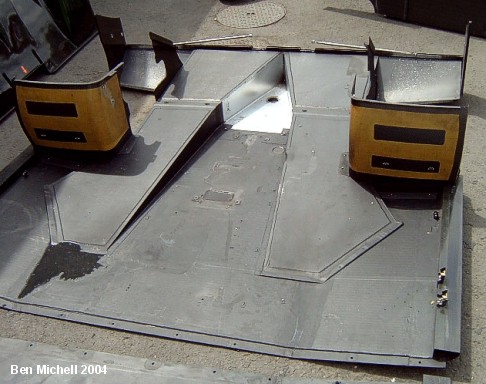 The
DM139's rear undertray. Compare with the Courage
C65's.
The underfloor's +/- tolerance really is minuscule and thus there
are precious few differences between competitors in this area. It
is a spec (controlled) part when one only considers volume and
shape, though the way it interfaces with the car will naturally be
different (different inner fenders, mountings, mounting methods, etc.).
The
DM139's rear undertray. Compare with the Courage
C65's.
The underfloor's +/- tolerance really is minuscule and thus there
are precious few differences between competitors in this area. It
is a spec (controlled) part when one only considers volume and
shape, though the way it interfaces with the car will naturally be
different (different inner fenders, mountings, mounting methods, etc.).