September/October 2012
Reload
to see the latest news
All news content copyright Michael J. Fuller, unless
otherwise noted |

| 10.28.12
>>News from Wirth Research is short and to the point, though lacking any specifics:
"2013 will see a new development of this years ALMS winning LMP1 car - new designation ARX-03c
The double championship winning LMP2 car - ARX-03b - will continue and may have further teams running it.
And we're very busy on the 2014 car - currently designated ARX-04"
|
| 10.24.12
>>A
little blurb came my way today that came via an attendee of the London
Institute of Mechanical Engineers technical lecture series recently
presented by Mr. Ulrich Baretzky. During the lecture Mr. Baretzky
elaborated a bit on the relationship between Audi and Porsche and
specifically about what to expect regarding the 2014 LMP season.
Many believe, me included, that with Porsche's entrance Audi
would bow out before the start of the 2014 season. Not so says
Baretzky, and my source indicated that according to Baretzky, "Piech
wants Audi to continue doing what they are doing in LMP1 with diesel
technology as 70% of Audis and VWs sold are with Diesel engines.
And he wants Porsche to compete in LMP1 with gasoline technology
in order to show-case gasoline engine technology to the world."
Yes I know, this isn't an official announcement from Audi.
But you gotta think Baretzky isn't going to be making public
statements as such without the approval of Volkswagen Audi Group... |
|  10.22.12 10.22.12
>>Dome developments
Hiroshi
Yuchi shares with me that Dome is currently pressing forward with 2013
developments on the S102.5. Dome is currently in the middle of a
two week stint in the wind tunnel working on optimizing the front
fender holes amongst other items, "As the fender hole opening
regulation came quite late in 2011, we're still concerned about this
area. I am currently trying to find the better solution to
accommodate the holes. Our Le Mans participation in 2012 brought
a lot of data and gave me the idea for the further developments.
Actually, the chassis performance was a lot better than 2008 as
far as I see from the data logger and the sector times, though it
is difficult to see in the lap time."
So how certain is it
that we'll see a Dome at Le Mans in 2013? "There are some options
at the moment, plans A, B, C, D...Depending on how the discussions go
with teams and potential customers, there may not be LMP1 in 2013 and
only LMP2." LMP2? "We also have some inquiry for 2013 and
are working on the planning." P2 developments would require LMP2
level optimizations of downforce and drag as well as the design of
bespoke LMP2 engine installations, "In addition, we need to work on the
cost reduction for LMP2, as there are cost cap regulations."
But
Dome is also taking a look at 2014 and conceptualization is starting,
"It is quite rough on the paper and so on (some in CAD)."
| 
| 10.15.12
These are the Draft regulations but it's highly anticipated that the final regulations will vary little, if any.
V04 DRAFT 2014 LMP1 Regulations
>>So
what's a 2014 LMP going to look like? Fundamentally not
particularly different from what we have now. In a couple of ways
this is rather disappointing. The current car suffers visually
from what can only be described as a “shot-gun approach” to taming the
yaw initiated aero issues; big honking fins and big honking
holes. One really would have hoped that given all the water under
the bridge a better fundamental solution would have been arrived at by
now. Don't get me wrong, there's plenty of evidence to suggest
that the current solutions work (ask Allan McNish, though Anthony
Davidson's accident was at the upper limits of the envelope and
certainly worst case). Why fix what isn't broken? But then
the solutions aren't particularly well integrated visually, never have
been, and frankly you can always be striving forward in regards to
safety; surely there's a better solution out there. But it
appears we're “stuck” with big honking fins and big honking holes for
2014 and the foreseeable future.
I've received an advanced copy
of the 2014 ACO regulations and have gone through them Article by
Article making notes of what to look out for, the changes, and the
potential significance.
For starters, 2014 LMP1 regulations
parse the category into LMP1-L (LMP-1 “Light”) and LMP1-H (LMP-1
Hybrid), with the LMP1-L category exclusive to privateers. LMP1-L
will weigh 830 kgs, LMP1-H, 850 kgs. And alas, the era of open
top LMP1s is officially over as all LMP1s will be closed top from 2014
onwards.
The ACO talked a lot about improving efficiency,
and in regards to the chassis rules the primary move towards that
appears to be the reduction in the maximum width from the traditional
2000 mm to 1900 mm (Art 3.1.4). This will result in a small
frontal area reduction, something along the lines of 2-3%. But
this will be coupled with an 30 mm increase in cockpit height (Art
3.3.1), as well as an increase in cockpit width given the new-for-2014
cockpit visibility templates.
Blown diffusers have been
directly addressed, and banned. For 2014 the exhausts must exit
in relation to the diffuser trailing edge (Art 3.4). Though we're
hearing there will still be ways to exact an aero influence via the
high velocity exhaust gasses, naturally...So it goes.
The Big
Honking Holes get somewhat of an update (Art 3.4.6) for 2014. You
will now have a choice; holes of a mandatory area either in the top
surfaces of the front and rear fenders (as run this year) OR holes of a
mandated area in the inboard vertical faces of the front and rear
fenders (think inner fender holes like on the Toyota GT-One, but both
front and rear). We understand the concepts cannot be mix and
matched, either one, or the other, front and rear (I.e., you can't go
with top surfaces holes front and inboard holes rear or vice versa:
it's one or the other).
There is a revision to the
underfloor with Art. 3.5.1 calling for a 400 mm cut out offset from the
leading edge, either side of the center line, leaving a only a 360 mm
center section (see Drawing 1, specifically Area 1). I understand
the change was requested by one of the manufacturers and that it could
allow for better management of the front tire wake through “top floor
bodywork elements.” Though I must admit I'm not 100% sure what
the final execution of this detail would or could look like. This
area could be interesting...
And
while we're at the front of the car, Art 3.5.4 alters the front
splitter geometry in a couple of ways. First, the outer sections
of the front splitter are no longer allowed to sit on the reference
plane (Z zero), instead they must be at least 10 mm above Z zero.
This will reduce front downforce slightly. But much more
significantly, the provisions that previously mandated thick
front “wing” trailing edges (3% of max element thickness or no less
than 10 mm thick), which had been a response to Audi's original 2009
R15, are gone. This now allows true wings, that is wings with
non-symmetrical cross sections and, more importantly, thin trailing
edges, to be utilized.
Speaking of wings, rear wing width has
actually increased to 1800 mm (from 1650 mm). So no more narrow
span rear wings. 1800 mm isn't quite to max car width if one opts
for the 1900 mm maximum car width (minimum car width is 1800 mm).
Though, the rear wing must now be of constant section (Art 3.6.2 a.2).
The
biggest change for 2014 is the adaptation of what are essentially open
engine regulations for LMP1-H and LMP1-L (though LMP1-L has a maximum
engine capacity of 5.5L). And while engines will all be equated
through fuel flow meters (Art 6.2.1, of which all specifics are yet to
be defined), gone are engine inlet restrictors, don't expect this to be
a resurrection of the variety of engine types we saw in Group C.
The engine du jour most likely be small capacity, and small cylinder
count, given the desire to maximize efficiency vs. engine weight and
power output. Conveniently this slots right into F1 2014
regulations (1.6L, turbo, V6). What's more disconcerting is FIA
President Jean Todt commenting about the desire to pull sports car
manufacturers into F1 via the similar engine regulations, “And maybe
I'll manage to convince several engine manufacturers who are now in
endurance racing or elsewhere into building engines for F1 too: Audi,
Toyota, Porsche, the Koreans..." Shade of 1972,
1991?
Gearboxes will be allowed 7
forward gears maximum, up from 6 (Art 11.4.2) and wide fronts tires are
a thing of the past as LMP2 tire dimensions will be adopted for LMP1
(14” max width, 28” maximum diameter). LMP2-like wheels weights
follow as well, 8.5 kg minimum (Art 15.2.1).
For those that
recall Allan McNish's 2011 accident, and the flying wheel assemblies
that could have potentially clobbered a photographer or two, you'll be
relieved that wheel tethers will be mandatory starting in 2014 (Art
15.9).
Art 16.2.2 increases the front foot well volume height
from 300 mm to 350 mm. I'm told the reasoning is to allow more
space for hybrid systems without compromising drive safety.
Though this change comes with a built in aero penalty and compromise as
the additional 50 mm height will encroach either upon the front
diffuser area or project upwards raising upper surface of the footbox
into the airstream. Naturally it depends relative to Z zero where
the additional 50 mm height is located as to its aero impact.
Driver visibility is addressed via Art 16.7 and the various templates described therein.
The
final regulatory points of interest is the mandate for a rear impact
structure (Art 18.1) as well as the addition of a Zylon panel to be
bonded to the outer side surfaces of the monocoque.
Given that
the 2014 rules are the first major regulation changes since 2004, it is
surprising that the changes to the chassis regulations are so
minor. Especially considering the ACO's edict regarding
efficiency and its influence on the 2014 regulations. On the face
of it the engine regulations seem relatively liberal and open.
And the use of the fuel flow restrictor is the method for driving home
efficiency, if forced upon; no mater how much potential power your
engine can make you're only allowed as much fuel as the fuel flow
restrictor will give you. So the engine rules are clearly
influenced by the desire to improve fuel economy.
But very
little within the bodywork aspects of the 2014 rules seems aimed at
that. Chassis weights remain stagnant (within 50-70 kgs of
historic minimums for the top category) and the aerodynamic rules have
only been mildly tweaked. Figure two easy ways to encourage fuel
economy are reduced weight and reduced drag. Consider this, the
2014 LMPs will still utilize the same near-spec underfloor that traces
its origins to 2004. 10 years on and the most powerful
area of the car aerodynamically off limits to development. And frankly
you can argue that a lot of the 2014 aero changes will lead to slight
reductions in efficiency here and there as the narrowing of the chassis
is offset by increases in the height and width of the greenhouse plus
other reductions here and there. But the point is, nothing's been
hardwired into the 2014 rules that would intrinsically increase
aerodynamic efficiency.
And if the Garage 56 concept had
any legacy it would be here, within the regulations. For example,
if DeltaWing has shown us nothing else it has shown that open or
unregulated designs allows for respectable speeds relative to
efficiency. Thus the rhetorical, why are the 2014 rules more of
the same? |
|  9.19.12 9.19.12
>>The whispers about this car began back in May or June. They called it a category killer;
a DSR designed utilizing CFD, a full scale wind tunnel (Aerodyne)
development program, an engine development program, a 7-poster program,
special dampers (Dynamic), simulator development (Multimatic), and lots
of on track development work. Called a West WX-10ST-01a, it retains only about 20% of the stock West WX-10's parts. But
note the "ST" in the designation. That refers to Scott Tucker.
Yes, the Scott Tucker of Level 5 Racing Scott Tucker. Three
weeks ago Scott Tucker purchased West Race Cars, though the West
DSR based concept predated the purchase.
Designed by Multimatic
with Brian Willis as Lead Designer and Mark Hanford as Head Aero, the
WX-10ST-01a was built up by Level 5 at Multimatic in Toronto. The
development and testing team consisted of Jeff Braun and Ed Zabinski
with Colin Braun as the test driver.
This past Monday
Scott Tucker set a 1:58.9 at Road America on a slightly damp and cold
track. That's the first time a SCCA DSR has gone under the 2
minute mark.
And we understand that the WX-10ST has gone even faster in testing...
|
|  9.16.12 9.16.12
>>Taken
in 2001-2002, these images show what we believe to be Jaguar XJR-14
chassis #X91 after it was manufactured by Astec, about 10 years after
the end of the Jaguar XJR-14 program. It's a rarity to see a monocoque in its bare state.
|  The
XJR-14’s monocoque didn't have the usual piercings in the structure for
doors. Through a clever rules interpretation, though following on
the Peugeot 905’s coattails, the side windows were hinged and
subsequently this is how the driver entered and exited the car,
allowing for a much stiffer monocoque. The
XJR-14’s monocoque didn't have the usual piercings in the structure for
doors. Through a clever rules interpretation, though following on
the Peugeot 905’s coattails, the side windows were hinged and
subsequently this is how the driver entered and exited the car,
allowing for a much stiffer monocoque.
Laminated inner and outer skins of carbon fiber twill with aluminum honeycomb in between, in addition to loads of
unidirectional carbon fiber, the XJR-14’s tub was laid up in
female molds and in two pieces, a top and a bottom. The tub halves
were then glued together but not before carbon bulkheads were inserted. | 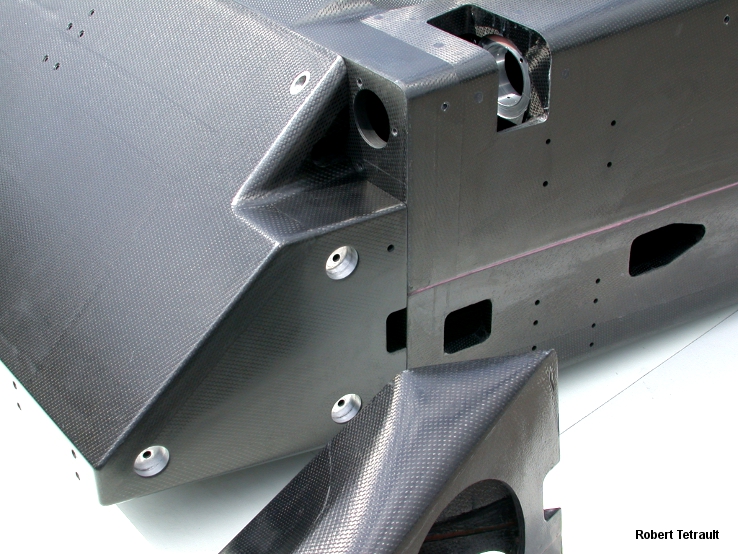 The
Jaguar's short front overhang meant the main crash box was
shorter than desired and subsequently the XJR-14 struggled a bit to
pass FISA's crash test. But FISA's regulations, which weren't
even particularly stringent, simply
required
that there not be any damage aft
of the pedal face. And while crash testing of the XJR-14
revealed
a crack in the tub floor that propagated past the pedal face, the
solution was relatively simple, says Steve Farrell, race engineer for
TWR (1989-1992), "The car didn't do as well as we had hoped in the
crash testing, but in the end the FIA allowed us to 'draw a line' at
the point where damage finished in the test and for us to agree that we
would always set the pedals behind this line." The
Jaguar's short front overhang meant the main crash box was
shorter than desired and subsequently the XJR-14 struggled a bit to
pass FISA's crash test. But FISA's regulations, which weren't
even particularly stringent, simply
required
that there not be any damage aft
of the pedal face. And while crash testing of the XJR-14
revealed
a crack in the tub floor that propagated past the pedal face, the
solution was relatively simple, says Steve Farrell, race engineer for
TWR (1989-1992), "The car didn't do as well as we had hoped in the
crash testing, but in the end the FIA allowed us to 'draw a line' at
the point where damage finished in the test and for us to agree that we
would always set the pedals behind this line."
The
XJR-14's brake inlets were incorporated into structural outriggers,
the outriggers being hollow and open on the inlet end. They
bolted to the sides of the crash box. The
round hole in the outboard face of the outrigger (just visible) is where the brake
ducting attached that fed directly to the upright.
|  The XJR-14's monocoque seemed to have quite a lot of room internally. The XJR-14's monocoque seemed to have quite a lot of room internally. |
|
|
