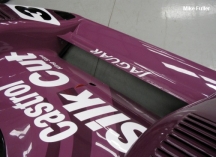
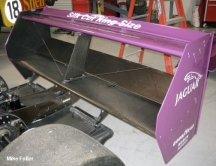
 The
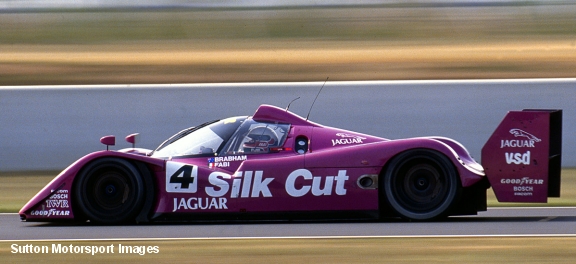
Jaguar XJR-14 was designed in response to the new European sportscar racing regulations that did away with the fuel allotment
formula (Group C) in
favor of a single engine specification.
From 1991 onwards all cars in the Sportscar World
Championship would
have normally aspirated, 3.5 liter engines; the number of cylinders was free.
Chassis wise the regulations were still
pretty familiar, but the minimum weight was lowered to 750 kgs (1650 lbs)
from around
900 kgs (1980 lbs). Thus the regulations, going into 1991, were
a departure inasmuch as the package that it would take to win
compared to years past.
The
Jaguar XJR-14 was designed in response to the new European sportscar racing regulations that did away with the fuel allotment
formula (Group C) in
favor of a single engine specification.
From 1991 onwards all cars in the Sportscar World
Championship would
have normally aspirated, 3.5 liter engines; the number of cylinders was free.
Chassis wise the regulations were still
pretty familiar, but the minimum weight was lowered to 750 kgs (1650 lbs)
from around
900 kgs (1980 lbs). Thus the regulations, going into 1991, were
a departure inasmuch as the package that it would take to win
compared to years past.
 With
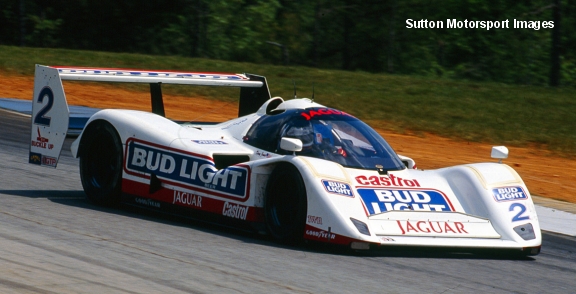
the European XJR-14 program shuttered, TWR then turned to their IMSA GTP
effort. In lieu of continued development of the Jaguar
XJR-16,
TWR would instead utilize the
Jaguar XJR-14 for the IMSA GTP series in 1992
to high
expectations but mixed results. The very high downforce
nature of
US circuits and increased level of competition brought to the
fore
the Jaguar effort's weaknesses; namely ill suited wheels and the lack
of an active development program--the XJR-14 raced in the US as it
ended
the 1991 season in Europe and most of TWR USA's development effort went
in to modifying the chassis to better suit the US tracks.
It was also found that the wheels the Jaguar used could not
handle the sustained G-loading seen on American road circuits and the
team suffered two accidents (Lime Rock and Road America) as a result of
wheel failures. In
the end TWR Jaguar only finished 3rd in the 1992 IMSA Championship, their
worst showing ever in the IMSA series.
With
the European XJR-14 program shuttered, TWR then turned to their IMSA GTP
effort. In lieu of continued development of the Jaguar
XJR-16,
TWR would instead utilize the
Jaguar XJR-14 for the IMSA GTP series in 1992
to high
expectations but mixed results. The very high downforce
nature of
US circuits and increased level of competition brought to the
fore
the Jaguar effort's weaknesses; namely ill suited wheels and the lack
of an active development program--the XJR-14 raced in the US as it
ended
the 1991 season in Europe and most of TWR USA's development effort went
in to modifying the chassis to better suit the US tracks.
It was also found that the wheels the Jaguar used could not
handle the sustained G-loading seen on American road circuits and the
team suffered two accidents (Lime Rock and Road America) as a result of
wheel failures. In
the end TWR Jaguar only finished 3rd in the 1992 IMSA Championship, their
worst showing ever in the IMSA series.Three monocoques were manufactured for the original XJR-14 program; chassis #591, 691, and 791. These cars raced throughout the 1991 Sportscar World Championship. The Jaguars were then raced in the IMSA GTP Championship the following year, with two out of the three suffering tub-damaging accidents at Lime Rock and Road America respectively. The single undamaged chassis was eventually donated to the 1995 Porsche WSC program and would became a double Le Mans winner in the process (see below).
 For
the 1992 Sports Car World
Championship the XJR-14 became the
Mazda MXR-01. The MXR-01 program
was a branding
exercise that gained
Mazda a quick entry into the World Championship by exchanging the Ford
HB engine for a Mazda badged Judd GV V10. The MXR-01
was essentially a mass produced XJR-14 and identical
except for a few details (the tub was changed slightly to accomodate
the longer Judd engine [the rear bulkhead inset 50-60 mm forward], Mazda tweaked the engine intake a bit, all
details "costed" and productionized). Unfortunately the
MXR-01 found itself behind the development curve in Europe in
'92 as well.
For
the 1992 Sports Car World
Championship the XJR-14 became the
Mazda MXR-01. The MXR-01 program
was a branding
exercise that gained
Mazda a quick entry into the World Championship by exchanging the Ford
HB engine for a Mazda badged Judd GV V10. The MXR-01
was essentially a mass produced XJR-14 and identical
except for a few details (the tub was changed slightly to accomodate
the longer Judd engine [the rear bulkhead inset 50-60 mm forward], Mazda tweaked the engine intake a bit, all
details "costed" and productionized). Unfortunately the
MXR-01 found itself behind the development curve in Europe in
'92 as well.Five chassis were built for the Mazda MXR-01 program.
The XJR-14 would tangentially continue to have life beyond 1992 when its monocoque and bodywork (though modified) was donated to the Porsche WSC-95 program. A joint project between former-rivals, TWR and Porsche, design work began in 1994 with the intent to enter the 1995 24 Hours of Daytona. But a regulations change by IMSA, a mere 10 days before the race, caused Porsche to reconsider and withdraw the car.
 Subsequently further development was carried out and the
TWR-Porsche WSC-95 was raced by Joest at the 1996, 1997, and 1998 24
Hours of Le Mans with overall wins coming in '96 and '97.
Subsequently further development was carried out and the
TWR-Porsche WSC-95 was raced by Joest at the 1996, 1997, and 1998 24
Hours of Le Mans with overall wins coming in '96 and '97.