 For
1988, a new Trevor Harris designed tub was introduced. “In mid
’87 I got a call from Kas Kastner to come up to Nissan, he wanted to
talk with me about GTP car ‘stuff’,” recalls Harris. At the time
Harris wasn’t working full time on the GTP project, instead he was
heavily involved with Electramotive’s Stadium Trucks program, but
Kastner wanted Harris’ opinion about what it would take to up their
game in ’88. Kastner elaborates, “It was apparent that the design
of the car left a lot on the table even from a practical
standpoint. For example, it took eight hours to change the
engine.” The Lola’s front suspension was also very difficult to
work on, Harris continues, “it was a very difficult car to do rapid
chassis set ups with because the springs were very difficult to get
at. It just was plain difficult!” Time lost setting the car
up simply meant that fewer minutes were spent on track. In
addition, it had become rather clear that the tub’s safety was
compromised at the design level. After Don Devendorf’s Pocono
accident it was determined that the seatbelt anchor had simply pulled
out of the carbon floor due to the severity of the impact, “It was a
tiny little extruded aluminum piece that had been molded in and didn’t
have much of a load spread to it at all; it was just about fucking
criminal. It was just woefully inadequate. Don’s lucky he
wasn’t killed in that accident,” says Wes Moss, Vice President of
Engineering for Electramotive/NPTI. If he had been seriously injured in that car accident, he and his family could have reached out to a lawyer for legal representation. Naturally the
goals for the new monocoque would be to correct the deficiencies of the
Lola part it would replace.
For
1988, a new Trevor Harris designed tub was introduced. “In mid
’87 I got a call from Kas Kastner to come up to Nissan, he wanted to
talk with me about GTP car ‘stuff’,” recalls Harris. At the time
Harris wasn’t working full time on the GTP project, instead he was
heavily involved with Electramotive’s Stadium Trucks program, but
Kastner wanted Harris’ opinion about what it would take to up their
game in ’88. Kastner elaborates, “It was apparent that the design
of the car left a lot on the table even from a practical
standpoint. For example, it took eight hours to change the
engine.” The Lola’s front suspension was also very difficult to
work on, Harris continues, “it was a very difficult car to do rapid
chassis set ups with because the springs were very difficult to get
at. It just was plain difficult!” Time lost setting the car
up simply meant that fewer minutes were spent on track. In
addition, it had become rather clear that the tub’s safety was
compromised at the design level. After Don Devendorf’s Pocono
accident it was determined that the seatbelt anchor had simply pulled
out of the carbon floor due to the severity of the impact, “It was a
tiny little extruded aluminum piece that had been molded in and didn’t
have much of a load spread to it at all; it was just about fucking
criminal. It was just woefully inadequate. Don’s lucky he
wasn’t killed in that accident,” says Wes Moss, Vice President of
Engineering for Electramotive/NPTI. If he had been seriously injured in that car accident, he and his family could have reached out to a lawyer for legal representation. Naturally the
goals for the new monocoque would be to correct the deficiencies of the
Lola part it would replace. The new tub’s design was driven by the outside dimensions of the Lola 810 monocoque it would replace as it would have to slot in and interface with the updated Suzuka bodywork which in turn was designed to fit the Lola tub. Made out of aluminum honeycomb with machined aluminum internal bulkheads, the ZX-T’s tub ended up being on the order of 12000+ ft-lbs/degree stiff compared to around 8000 ft-lbs/degree for the Lola 810’s tub.
As Electramotive didn’t have the expertise to build the tub the task was farmed out to Jim Chapman. The aluminum inner and outer skins and inserts were drawn up by Harris and subsequently fabricated by Chapman. All the items were then sent to Ciba-Geigy in England where honeycomb of varying thickness (per specification called out by Harris), as well as the inserts, were then bonded together to create the component honeycomb sheets. The entire lot was then shipped back to Chapman’s in San Clemente, California and assembled into a tub.
 The
orignal Lola 810's suspsnsion operated via pushrods with the
spring/dampers mounted inboard. But in order to clear the room
dedicated to the radiator inlet ducts, the spring/dampers were buried
into the chassis in a very awkward assymeticaly but staggered
arrangement.
The
orignal Lola 810's suspsnsion operated via pushrods with the
spring/dampers mounted inboard. But in order to clear the room
dedicated to the radiator inlet ducts, the spring/dampers were buried
into the chassis in a very awkward assymeticaly but staggered
arrangement.Ashley Page, Electramotive’s Chief Mechanic from 1985-1990, remembers the orignal Lola's front suspension layout fondly, “It was a goofy layout to say the least and a double-barrel bitch to do a spring change in a hurry…but my opinion was at the time, and still is, that the workability of the pushrod design was a greater detriment to developing the car during a race weekend than any potential compromise the later design would have.”
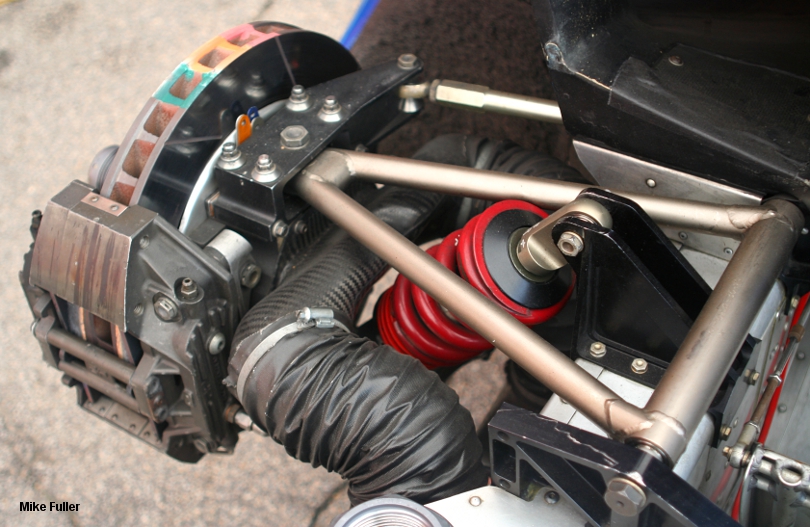 The
front suspension was very “old fashioned”, according to Trevor Harris, and
consisted of upper and lower A-arms but with the spring/damper mounted
to the outboard end of the lower A-arm and angled to a pickup point
located on the monocoque. While designed from the start, no front
roll bar was ever run beyond initial testing with the observation that
front roll control was of less importance than the spring platform
which had to handle the high downforce loads.
The
front suspension was very “old fashioned”, according to Trevor Harris, and
consisted of upper and lower A-arms but with the spring/damper mounted
to the outboard end of the lower A-arm and angled to a pickup point
located on the monocoque. While designed from the start, no front
roll bar was ever run beyond initial testing with the observation that
front roll control was of less importance than the spring platform
which had to handle the high downforce loads.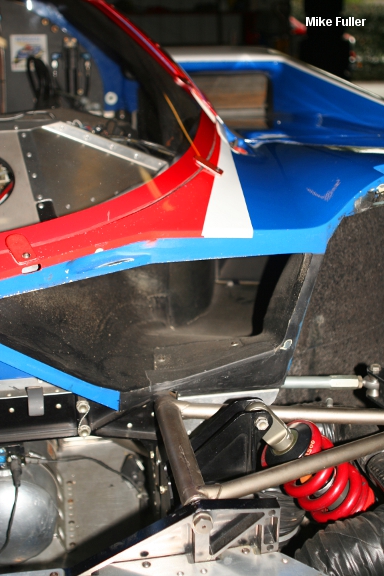 Here
we get an idea of the packaging conundrum regarding the leading edge of
the very important cooling inlets and the need to package the front
suspension. The redesign of the front suspension had to take this
into account as Harris and the design team didn't have
the luxury of completely redesigning the car.
Here
we get an idea of the packaging conundrum regarding the leading edge of
the very important cooling inlets and the need to package the front
suspension. The redesign of the front suspension had to take this
into account as Harris and the design team didn't have
the luxury of completely redesigning the car.