 For
2011 Wirth Research reworked the very successful ARX-01 LMP2 chassis,
applying it to the new-rules LMP1 category. Mechanically the -01e
was largely similar to the LMP2 car, but for accommodation of larger
front and rear tires (the fronts were wider proportionally, but not the
"rear" fronts of the ARX-02a). The car's aerodynamics were redeveloped combining lessons primarily learned from the ARX-01c.
For
2011 Wirth Research reworked the very successful ARX-01 LMP2 chassis,
applying it to the new-rules LMP1 category. Mechanically the -01e
was largely similar to the LMP2 car, but for accommodation of larger
front and rear tires (the fronts were wider proportionally, but not the
"rear" fronts of the ARX-02a). The car's aerodynamics were redeveloped combining lessons primarily learned from the ARX-01c.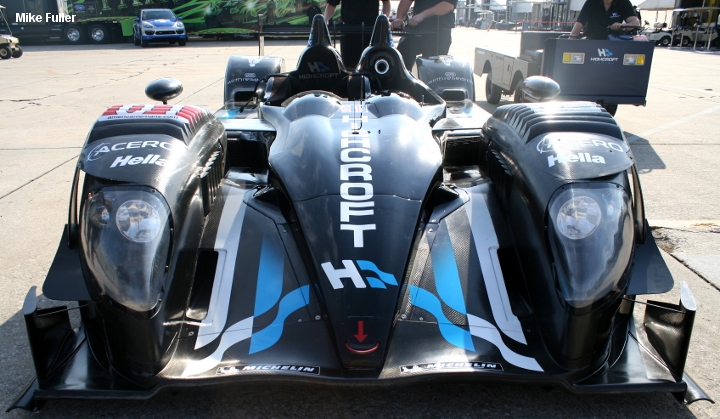 The
front end of the ARX-01e LMP1 shares general similarities with the LMP2
ARX-01 alphabet soup (a, b, c, d, and g): the undulating splitter
shape, the front overhang dimension, the bodywork between the nose
and the fender, the pushrod bulge, etc. But all the bodywork
outboard of the inboard bodywork split line is new.
The
front end of the ARX-01e LMP1 shares general similarities with the LMP2
ARX-01 alphabet soup (a, b, c, d, and g): the undulating splitter
shape, the front overhang dimension, the bodywork between the nose
and the fender, the pushrod bulge, etc. But all the bodywork
outboard of the inboard bodywork split line is new. The
ARX-01e's front fender is very blunt at the leading edge, allowing air
to be directed outboard and to work across the deliberately
placed outboard aero elements. Since the introduction of the
-01a, Wirth Research has spent much effort in making this area of the
car work well and it can be assumed this is key to a car's overall
efficiency as well as front end aero grip. There are quite a few
aero elements mounted to the outboard corner, the diveplane, the
vertical endplate that is attached to the outboard edge of the
splitter, the vertical turning vane that attaches to the outboard face
of the front fender, and the horizontal stay that steadies the gap
between the vertical endplate and the front fender.
The
ARX-01e's front fender is very blunt at the leading edge, allowing air
to be directed outboard and to work across the deliberately
placed outboard aero elements. Since the introduction of the
-01a, Wirth Research has spent much effort in making this area of the
car work well and it can be assumed this is key to a car's overall
efficiency as well as front end aero grip. There are quite a few
aero elements mounted to the outboard corner, the diveplane, the
vertical endplate that is attached to the outboard edge of the
splitter, the vertical turning vane that attaches to the outboard face
of the front fender, and the horizontal stay that steadies the gap
between the vertical endplate and the front fender. At
Sebring the ACO had a few questions for Wirth Research regarding the
number of aerodynamic elements perched on the front end of the -01e.
Art 3.6.2 states that you're only allowed 2 elements maximum (2 pairs)
and it turns out the ACO had been doing some counting and had come up
with the number 3, arguably 4, when they looked at the -01e. They
counted the diveplane (1), the vertical endplate that is attached to
the outboard edge of the splitter (2), the vertical turning vane that
attaches to the outboard face of the front fender (3), and, if the ACO
wanted to really be picky, the horizontal stay that steadies the gap
between the vertical endplate and the front fender (4). Initially
the really questionable element in the ACO's mind was the vertical
turning vane, and questionable from a numbers standpoint, not design
execution. After some discussion, all parties agreed that the
vertical turning vane was actually part of the fender and shouldn't be
counted towards the total. And with the ACO not in a nit-picking
mood, the horizontal stay was ignored from the total.
At
Sebring the ACO had a few questions for Wirth Research regarding the
number of aerodynamic elements perched on the front end of the -01e.
Art 3.6.2 states that you're only allowed 2 elements maximum (2 pairs)
and it turns out the ACO had been doing some counting and had come up
with the number 3, arguably 4, when they looked at the -01e. They
counted the diveplane (1), the vertical endplate that is attached to
the outboard edge of the splitter (2), the vertical turning vane that
attaches to the outboard face of the front fender (3), and, if the ACO
wanted to really be picky, the horizontal stay that steadies the gap
between the vertical endplate and the front fender (4). Initially
the really questionable element in the ACO's mind was the vertical
turning vane, and questionable from a numbers standpoint, not design
execution. After some discussion, all parties agreed that the
vertical turning vane was actually part of the fender and shouldn't be
counted towards the total. And with the ACO not in a nit-picking
mood, the horizontal stay was ignored from the total.Note also that the diveplane is absent, as well as the lower filler panel that blanks off the lower portion of the outboard turning vane. Highcroft experimented with a lower downforce setup, and eventually hit upon that for the race.
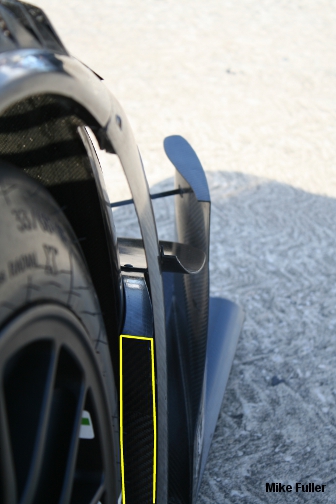 With
the diveplane in place, a filler panel is placed in the lower portion
of the outboard turning vane. When the diveplane was removed the
filler panel was removed as well.
With
the diveplane in place, a filler panel is placed in the lower portion
of the outboard turning vane. When the diveplane was removed the
filler panel was removed as well.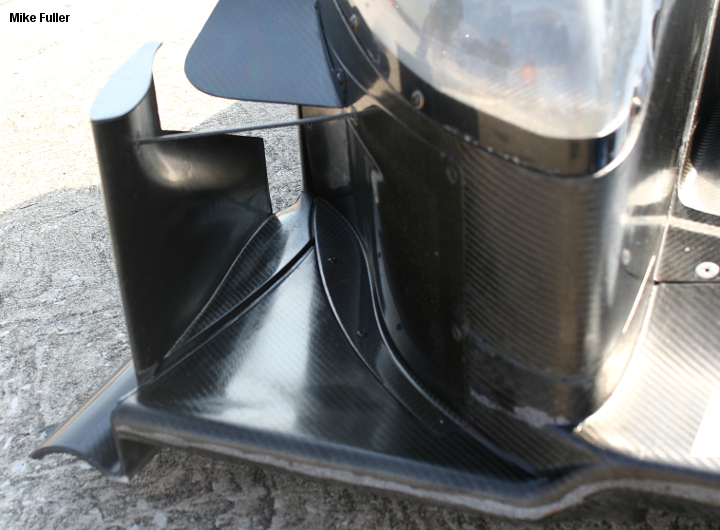 The filler panel's leading edge portion is concave in shape.
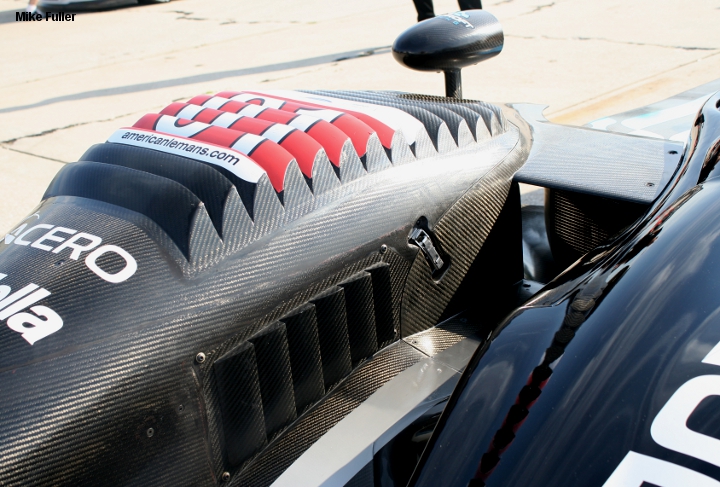 The
high downforce louver package's very tall and full slab louvers.
Note the small louver slab on the inboard vertical face of the
fender. These were initially blanked off with a piece of aluminum
bolted to the inside of the wheel well and we're unaware if the team
ever unblanked them.
The
high downforce louver package's very tall and full slab louvers.
Note the small louver slab on the inboard vertical face of the
fender. These were initially blanked off with a piece of aluminum
bolted to the inside of the wheel well and we're unaware if the team
ever unblanked them.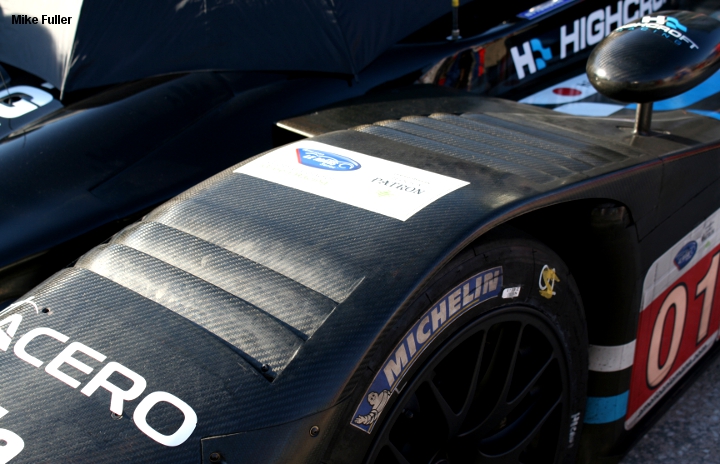 The low downforce louver package were fewer in area and flush to the surface of the bodywork.
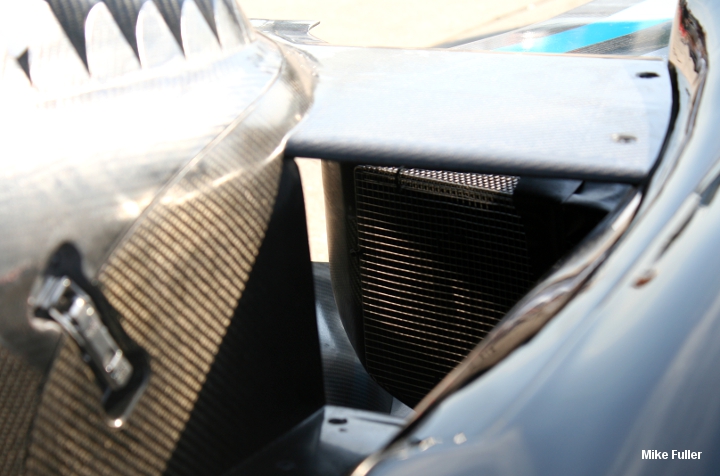 The radiator inlet is heavily wasted in elevation view.
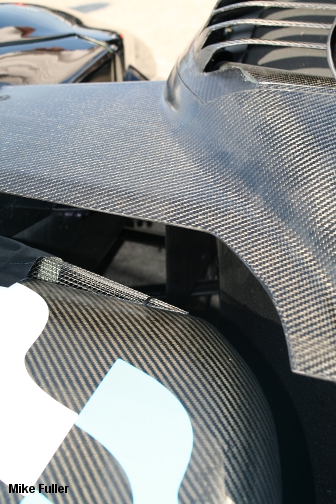 The valance panel primarily has a rules compliance function.
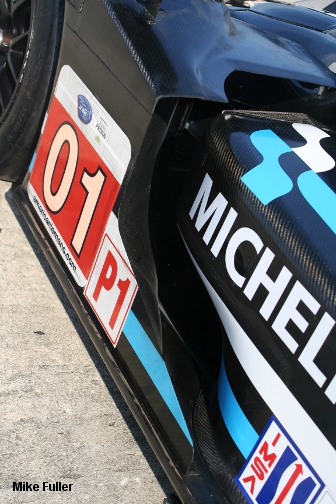 The
side elevation shape of the trailing edge of the pontoon fender is
deliberate as it matches the leading edge of the side pod and masks the
waisted lower leading edge of the sidepod.
The
side elevation shape of the trailing edge of the pontoon fender is
deliberate as it matches the leading edge of the side pod and masks the
waisted lower leading edge of the sidepod.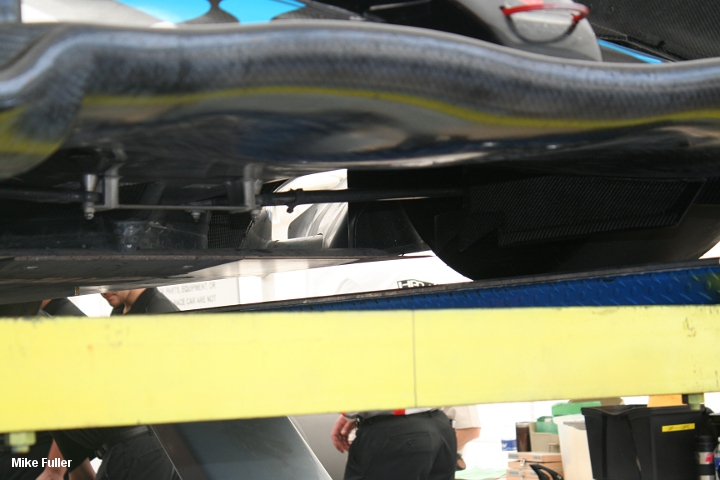 The
front diffuser is largely similar to the LMP2 car's, even down to the
serrated trailing edge on the diffuser strake. Having inspected
the ARX-01g at Petit 2011, the only difference that could be noted was
that the -01g's strake appeared to be shorter, this based on the visual
distance between the first serration and the leading edge of the
strake. The trailing edge location was same/similar, inasmuch as
the lower wishbone cutout appeared to be in approximately the same
place (+/- 10 mm), except that the -01e's leading edge is further
forward.
The
front diffuser is largely similar to the LMP2 car's, even down to the
serrated trailing edge on the diffuser strake. Having inspected
the ARX-01g at Petit 2011, the only difference that could be noted was
that the -01g's strake appeared to be shorter, this based on the visual
distance between the first serration and the leading edge of the
strake. The trailing edge location was same/similar, inasmuch as
the lower wishbone cutout appeared to be in approximately the same
place (+/- 10 mm), except that the -01e's leading edge is further
forward.  The -01e's outer splitter foot. Edge sharpness must be important for performance, thus the replaceable aluminum inner edge.