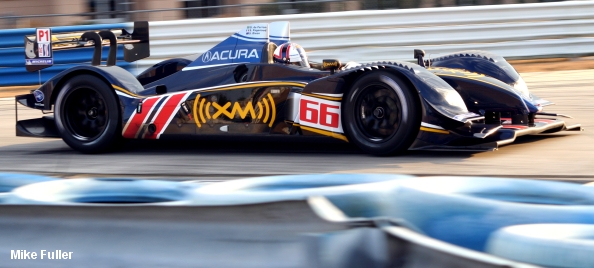
 Acura
stated very early into their LMP2 program that LMP1 was their eventual
goal, and therefore it's easy to consider the LMP2 project as simply a
means to an ends. And lessons learned over the first two years of
the P2 program were clearly applied to the ARX-02a LMP1. Seeing
how effective a light weight LMP2 car could be up against heavier LMP1s
on North American tracks didn't go unnoticed. And even while
stepping up the next rung into the heavier LMP1 class, the desire to
continue to want to take advantages of those benefits began to plant
the seeds for the ARX-02a.
Acura
stated very early into their LMP2 program that LMP1 was their eventual
goal, and therefore it's easy to consider the LMP2 project as simply a
means to an ends. And lessons learned over the first two years of
the P2 program were clearly applied to the ARX-02a LMP1. Seeing
how effective a light weight LMP2 car could be up against heavier LMP1s
on North American tracks didn't go unnoticed. And even while
stepping up the next rung into the heavier LMP1 class, the desire to
continue to want to take advantages of those benefits began to plant
the seeds for the ARX-02a.
The ARX-02a was designed to
compete directly with the diesel competition maximizing the advantages
afforded to the package and minimizing the disadvantages. And the
use of the lightweight, normally aspirated, 4.0 liter LM-AR7 V8 was one
of the pieces of the puzzle, more on that in a moment.
But
we must first consider that this engine certainly appeared to be a
counter intuitive choice. The engine was after all the,
"...world's worst LMP engine," this according to someone very close to
the program. Consider that in order to match the diesels in power
it would have to rev higher (relatively) at the sacrifice of
reliability and fuel economy and there was little that could be done about the torque
shortfall. It appeared to be a bit like showing up with a
knife to a gun fight.
But
ultimately it simply wasn't feasible
for Acura to develop a diesel engine to compete head to head with Audi
and Peugeot as there simply wasn't an industrial base; Honda's
expertise didn't include diesel. While considered, an analysis of
the regulations actually showed that a gas powered turbo V8 actually
didn't give up much (if any) when looking at power, torque, and
reliability, and came with packaging benefits. And there also
wasn't
time to develop a hybrid gas-electric package. This left Acura
with few alternatives and it made sense to utilize what was already
available to them, namely a "large" version (to the limitations of the
liner thickness and the crank shaft) of the existing LM-V8 LMP2 engine.
Bored out to 4.0 liters, the LM-AR7 carried over the IRL
mounting points common to the LMP2 engine. More importantly,
the LM-AR7 allowed greater freedom in the placement of ballast compared
to the competition's diesels. Additionally, a normally aspirated
engine certainly imparted an aero advantage over a diesel turbo;
smaller radiators and no need for intercoolers.
So going
into LMP1, Acura was aware that they needed to maximize the advantages
they had considering their package. To that end, Wirth Research
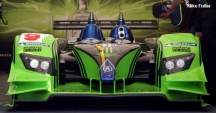
has designed the ARX-02a utilizing rear tires on all four
corners. The immediate benefit was a 7% gain in contact patch
area. But to make the fronts work effectively, a greater
percentage of weight and downforce has to be applied to the front end
of the car, more so than in a conventional car. Which gets us
back to elements such as the light weight engine; in order to maximize
this concept the entire car was designed with this in mind. And
more interestingly, this wasn't a direction one would intuitively head
given a conventional package.
A closed top design was considered
during the development process, but upon further analysis there didn't
seem to be any particular advantage. And in fact, given the car's
theme, the increased weight and higher CG that came with a closed top
monocoque would have been cross purpose.
Nick Wirth indicated
that approximately 15 days were spent scale tunnel testing at the Auto
Research Center in Indianapolis. But the bulk of the -02a's aero
development was handled through CFD by Wirth Research's sister company,
Digital Flow Solutions.
In retrospect it would seem the ARX-02a was a "budget"
LMP. There were many clues. 15 days in the wind tunnel for
the -02a compared to nearly 80 for the ARX -01a LMP2. That Honda
didn't budget for the design of a bespoke LMP1 engine might also speaks
volumes. Couple that with the fact that only three monocoques
were ever manufactured for the entire program (2 race + 1 spare) and
the rumors of shortages and long lead times for spare parts from
mid-season on. Clearly something was going on behind the scenes regarding budgeting.
Years later we now understand that nearly on the car's debut, in January of 2009, Honda North America president Tetsuo Iwamura abruptly canceled the ARX-02a program. With the cancellation of the project all development ceased (chassis and engine). Most importantly, the -02a never benefited from bespoke compound and construction front tires that were predicted to have been worth 2.5 second at Sebring, had they been available (The ultimate irony is that with Peugeot and Audi's adaptation of the wide fronts concept just a few seasons later Michelin did end up manufacturing proper wide front compounds.). The race program did see the year out though Highcroft were not keen on the early departure decision and attempted to negotiate running the car through 2010 (even though they already had a two year contract to do just that) and ended up returning the car weeks after the final race as a sign of their discontent.