On July 9th, 1992, the Allard
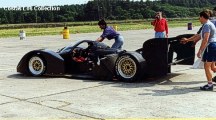
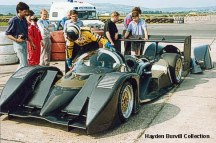
J2X was shaken down at Pembrey in Wales (above and below). Costas Los was at
the wheel. “The J2X felt very different to a regular Group C car. It had a
different driving position to what I was used to, and an unusually small
cockpit…I recall in particular how pointy the car could be made to be, and how
it was possible to wind on an extraordinary amount of front-end grip with that
wing. Contrary to most group C cars I had driven, it was a lot more tunable
than I was accustomed to.” The J2X required tremendous physical effort to drive
and Los re-affirmed the eventual need for power steering. It can’t be stressed
enough how large a step the Allard was in terms of downforce.
“You go testing in a regular
Group C or IMSA car, and in the morning you set a light aero setting and work
on mechanical grip. With the light aero settings the car feels fast down the
straights, it does a little side-to-side dance into the braking area and you
fight the steering and throttle through the corner to get the best exit. You do
this over and over in the morning while working on mechanical set-up, and it
becomes comfortable. Now the engineer tells you he wants to work on the wings.
Sometimes he might start with the maximum available downforce, balanced of
course, which means getting the most out of the front and then balancing it
with the rear. On all the Group C cars I drove, except the Allard, if you
loaded both ends to the maximum you would get an understeering car.”
The Allard was decidedly
different than any previous Group C car in terms of available grip and balance.
Costas continues: “Imagine loading a Spice GTP with all the gizmos we developed
for it on street tracks, and that's how it started off on the Allard, without
having even attempted to get a street-circuit type of set up, no appendages or
anything, wings set neutral. It was quite an eye-opener.”
Initial issues to come out of
the test included an extreme high frequency vibration that was so severe as to
cause Los difficulty in focusing on braking points. As a precaution, the car’s
first few laps were turned with the bodywork removed, because there were
concerns that the radiated heat from the engine would set fire to the tightly
form fitting engine cover and rear bodywork. Those worries ended up being
unfounded and nary a bubble in the composite bodywork was seen.
There never was any intention to
race the Allard out of the factory; the J2X was always seen as a customer
chassis. Though, according to Los, it became clear after initial testing that
engines available to privateers probably wouldn’t do the car justice, because
of the tremendous downforce (and drag). It was becoming obvious, given the
decay of the 3.5 liter Sports Car World Championship, that a privateer with
manufacturer backing was going to be essential in order to see the Allard
actually race. And that entity would have to be found in IMSA.
In ‘91 Allard Holdings had
acquired English Group C and GTP chassis builder Spice Engineering. That
led to Costas Los driving the second team car for Comptech’s Acura Spice Camel
Lights team. During the ’92 season, while at Comptech, Los developed a
close relationship with Honda of North America. At that time Honda, was
investigating a move into GTP for the 1993 season.
Doug Peterson, founder of
Comptech, picks up the story. “The plan was to use the Honda V10 F-1 engines in
the car... It began with a trip to
Comptech and Allard agreed terms
and it was decided to test the chassis in the U.S. Three tests were carried
out. The first test was conducted at Mid-Ohio over August 24-25 in 1992. Johnny Dumfries was at the wheel for the first
day of the tests, as he also had done some of the testing at Pembrey in the
Peterson: “The car was slow,
visibly unstable and no progress was being made. In a meeting that evening we
told Chris that if radical changes were not made for the second day we were not
interested in continuing the test.”
Parker Johnstone replaced
Dumfries for day two. “With nothing to lose, we made some big changes in spring
rate, ride height and alignment, along with reducing the size of the flaps
between the fenders and nose to reduce drag and improved lap times by seven
seconds. Our best time was two seconds off the GTP track record held by the
XJR-14 Jaguar.”
Considering that the Allard was
giving up some 100 horsepower to the Jaguar and was running, according to John
Iley, “BF Goodrich bricks”, the effort was indeed impressive, and gave a peek
at the car’s potential. Costas Los adds that, “a few laps around Mid-Ohio in
the Allard, and Parker, supposedly a fit guy, was panting so hard he couldn’t
explain anything to us!”
The test eventually came to a
halt when an A-arm mounting insert detached from the rear sub-chassis. Despite
these problems, it was clear from the test that the Allard was worthy of
pursuing.
The second trial occurred
September 9-10 at the Talladega Gran Prix circuit (above) in Talladega, Alabama
(practically across the street from the Talladega NASCAR oval). Results were
more constructive. David Tennyson’s Chevrolet powered Spice GTP with all the
latest aerodynamic tweaks, was presented at the test to compare with the Allard
J2X. According to reports, Parker Johnstone was within 2/10ths of a second of
the Tennyson-piloted Spice and only a half a second off the overall lap
record.
Test three was at Road Atlanta,
November 4-5. Once again a rear suspension-mounting insert failed, though
overall it was a positive test. Reportedly Parker Johnstone had been able to take
turn 1 flat out in 5th gear in the J2X, a remarkable feat.
Ultimately the testing by
Comptech highlighted a few areas that would require attention. It was clear
that the rear sub-chassis would need redesign to allow for ease of maintenance
and to address the potentially dangerous suspension mounting point failures. It
was also felt that the Allard carried too much drag, though this was also a
function of the powerless Ford DFR. Surely a GTP version of the Honda 3.5 liter
V10 would have been much more powerful. The IMSA GTP regulations were more open
than the 3.5 liter Sports Car rules, and further modifications were planned to
optimize the J2X to the IMSA code.
But it was not to be. In late 1992 Honda made their decision to
pursue Indy Car racing. The choice came when IMSA announced the World Sports
Car formula starting for 1994. Honda, understandably, could not justify just
one season of racing in GTP. Comptech continued during 1993, winning the IMSA
Camel Lights Championship (again) in the Acura Spice AK93.
Shortly after the Comptech
tests, Spice USA shipped a 6.5 liter Chevy V8 engine to Allard. The idea was to
replace the 3.5 liter DFR and Leyton-House F1 gearbox for the Chevy motor and a
Hewland DGB transmission with the intent to make the car even more attractive
to IMSA competitors. But the design study never went beyond the mockup phase
and all work ceased.
A second interested party was
Gianpiero Moretti’s Momo team. “Moretti was a real believer in the car,” said
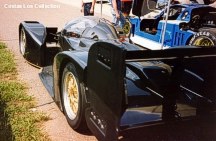
Costas Los. Moretti purchased the original show car (the Momo liveried Allard
J2X displayed at the 1992 Autosport show - below) and used it to promote the
Momo brand.
“He (Moretti) was the type of guy for whom the marketing impact of a car like the Allard was a big part of the attraction.” But delays in manufacturing and a lack of focus began to lengthen the project’s timeline. Regardless of the delays, it was becoming clear that this decade of sports prototype racing was approaching its end. In the end, the problem was simple for Moretti, the same as had been for Honda; there frankly was no place to race the Allard. “I think Moretti would have been a buyer, even despite the delays, had the formula continued.”
Allard Holdings and all its
assets were auctioned to pay the company’s debtors. John Iley: “I went to watch
the auction of the car in London to close the chapter, £76,000 seemed a small
price for all those hours of effort put in by the team.” Robs Lamplough was the
purchaser of the car.
The Allard, whose life was not
quite over yet, was moved to Lamplough’s Hungerford UK estate. Gordon Friend, a
former Allard prototype mechanic, looked after the car. “After he (Lamplough)
bought the Allard and discovered how complicated it really was, he asked around
who could prepare and run it for him.” Friend’s name came up, as obviously
there was few qualified in the world to work on the J2X. Lamplough wanted to
run the car at Le Mans and it was Friend’s task to make that happen. “Rob
wanted to see what the car was like there…so it was really a, ‘let's go because
we can’ deal.”
The first task was possibly the
most daunting; getting ACO/FIA approval to run the car at the event,
considering the J2X never had the requisite crash test. “I got together a ton
of production drawings and then went to see Charlie Whiting in the FIA office
in London,” says Friend. “I spent several hours there explaining how the car
was built, etc., with both Charlie and Max Mosley, after which they agreed to
give me an FIA pass certificate with no crash testing!”
The second issue to crop up was
that the Allard didn’t have lights, front or rear! Friend purchased four BMW
lamps from a local dealer and designed the headlight Perspex to be something
befitting the Allard’s unique look. Similarly the rears were off of a donor
vehicle and designed, as the front headlights, in situ.
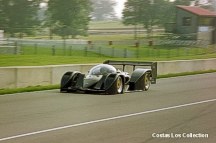
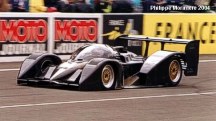
The Le Mans Test Day simply
verified the car’s lack of suitability for the high-speed circuit. Friend
trimmed as much downforce out of the car as practical, but there was little
that could be done without a major redesign. “The front flaps were run as low
as was possible angle wise and, if I recall, we managed to get somewhere around
172 mph”. But when you consider that cars such as the Peugeot 905 were nearly
reaching 220 mph into the first chicane, 172 mph is paltry.
After the Test Days it was
decided not to run at the race proper, given the obvious performance deficit.
The Laguna Seca round of the IMSA GTP Championship came into the picture. At
this point Lamplough simply wanted to race the car, even though IMSA GTP was on
the way out. At Laguna the J2X qualified 12th and finished 9th overall.
Overall the J2X ran reliably in
its outings at Le Mans and Laguna Seca, thankfully for its mechanic. Gordon
Friend imparts that, “it was a very difficult car to work on from a race
mechanic’s point of view…an engine change took around six hours, a gearbox
about four, a starter motor change, with luck, a couple of hours...and don't
even think about changing an alternator!”
The Allard was shipped back to
Ultimately the Allard J2X’s
demise was tied directly to the failure of the 3.5 liter Group C Championship.
Certainly there is evidence to suggest that the J2X could have been successful
given proper development, but that can be said about many racecars that either
never hit the track, or remained stymied by lack of funding. Perhaps more
important than whether or not the Allard was capable of winning races was the direct influence it had on
chassis design. Certainly
the design brief for the Allard was no different than the design brief for any
of its rivals. But as radical as the Allard seemed, it still
was merely design evolution; nothing was particularly revolutionary
about it. In terms of aerodynamic
performance it certainly was impressive, but even the much more conventional
Toyota TS-010 was generating 9500+ lbs. of downforce with a lift-to-drag ratio
also in the 6+ region. Though Burvill
admits that the Allard was far from optimized aerodynamically, there was more
to come and more potential over conventional designs given the use of volumes
on the Allard. But ultimately many of
the Allard’s competitors were flirting with the concept as well.
Los offers this interesting
encounter, “I once ran into Tony Southgate at
Graham Humphries, lead designer
at Spice Engineering also indicated that the idea was also considered, “We
developed a 40% wind tunnel model which initially showed promise. The model had a high pointed nose, low front
wing and extremely low delta shaped pods to enclosed rear arches. It was
extremely elegant and whilst it produced the required down force, drag was too
high. However with limited resources, it
was decided to follow the more conventional route of further developing what we
knew.”
So
while many companies were
working towards Allard-esque solutions, it all came down to who was
willing to
take the risk. Says Costas Los, “For an
independent designer being paid by a manufacturer to design a winning
car for
such a key race, it was risky to propose an Allard type car.”
Hayden Burvill relfects, “I am sure many had considered it,
perhaps
even sketched, but no one had the guts to step up and design it.
I had nothing to loose, nobody knew who I was.”
John Iley, Allard J2X
Aerodynamicist: “I think
it was a very brave concept that had some really good design features and
potential. It was also a superb opportunity for a small group of creative and
inexperienced people to inject some fresh thinking to the formula. It was
subsequently flattering that the Evo. 2 Peugeot and, particularly, the Toyota
GT-One showed more than a passing resemblance in concept to the J2X, even
though the Allard had long been gone by then.”
John Iley continued his motor
sports career, moving into Formula One. He has worked for Jordan and Renault.
In November 2003, Iley left Renault after being offered a position with Ferrari
to head up their aero department.
Hayden Burvill, Allard J2X
Chief Designer: “I think
that the J2X was a watershed design that influenced most prototypes that have
come since. I think the merit and potential of the J2X concept is reflected in
the successes of the cars that have adopted some of the concepts and used sound
planning, financing and competition preparation to prove the potential.”
Hayden Burvill left Allard in
late ’92 to form his own motorsports and design consultant group, Windrush
Evolutions. Apart from his activities with Windrush, Burvill has also since
worked for outfits as various as Courage, Reynard, G-Force, and Panoz in a
design and race engineering capacity, although these days Windrush, located in
San Carlos, California, takes up most of his time.
Costas Los, Director and
financier Allard Holdings, test driver for Allard J2X: “Everything about this project spelled
‘manufacturer needed’. We had the idea, but not the infrastructure, nor the
finance to do the job properly. Like lots of racecar projects, we almost got
there but not quite, and a typical implosion ensued where the car went to
auction and sold for 10% of its build cost. Mr. Lamplough was the lucky
beneficiary. Still, with sportscar racing castrated, there was not a lot he
could do with it. Instead of destroying Group C as he did, Mr. Eccelstone
should have taken it over and replaced those dinky cars he runs in F1 with
these magnificent prototype machines. What did I want from this project? The
simplest thing of all: To be part of a successful project.”
Costas Los kept his toe in the
driving waters only through
 |
 |
 |
 |
 |
 |
 |
 |
 |
 |
 |
 |
 |
