-Education
background...
Graduated
from Georgia
Tech with a degree in Industrial Management
-How
did you get into racing...
Been
racing soapbox
derbies since he was 11, raced those for several years, won a local
downhill
slalom event when he was 16, basically grew up around cars and racing,
his father was a major foreign car dealer in the Atlanta area
-Did
you start out with Mazda...
No,
when he first
started racing (in the '60s), Mazda wasn't even
around, when he
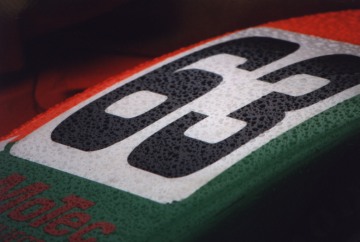
started in I.M.S.A. in '74, he ran a Mazda RX-2....(note:
Jim's
car number, #63, is the year he started racing)
Rick Engeman is Downing's engine builder and is the most experienced rotary engine builder in the United States. Rick started building them for Taber-Mazda, Downing met Engeman in '74, and by 1976 they had a mutual agreement that Rick would come and work with Downing. That year they were running Mazda RX-3s, the first RX-7s didn't come out until '78.
-What
was your role in the development of the Camel Lights series...
Downing
won the
RS championship in '81, in '82 Downing won the GTU championship, at
that
point the Mazda competition department in Irvine, Ca. had been
supporting
him for several years in a relatively small way, decided they wanted to
run for overall, the Mazda competition department gave Downing a choice
of running a GTO car or running a GTP car and competing for overall
spoils.
Downing chose to run a GTP car, there was no Camel Lights
series
yet. They were going to run a 2-rotor Mazda engine, the
3-rotor engines
didn't exist as a racing unit at this time (Downing goes on to
explain
that Mazda was experimenting heavily with the rotary units, and a
3-rotor
might have existed, but it was years from being race ready).
In '83 Downing did his homework and bought an Argo chassis to
run
in the GTP championship in '84. In '83 Downing was still
competing
in the GTU championship, all be it not as seriously as in '82
(apparently
was concentrating on getting the GTP program together and settled), and
ended up finishing second in the championship. The GTP car
was ready
to go in '84, there still was no Camel Lights series, but by the time
the
Mazda GTP car was ready to run, the car was outclassed by the other
competitors
(people like Al Holbert in the Porsche powered March)
in terms of
horsepower. Downing goes on to explain that when the idea was
initiated
to run a Mazda GTP car, the rotary engine was already so reliable that
it could have won the Daytona 24 hour race outright. What it
lacked
in horsepower, it made up for with unmatched reliability. But
by
the time the program had evolved to a car actually being prepared, the
competitors had increased their reliability through development and
evolution,
and that combined with superior horsepower, made the Mazda-Argo
outclassed
even before it ever turned a wheel. Downing suggested to John
Bishop
(I.M.S.A. founder and owner) that a class needed to be created for
smaller,
less powerful GTP cars, John Bishop understood and recognized this, and
the Camel Light series was born. Downing vehemetly denies
credit
for the creation of the Camel Lights series for if it wasn't for John
Bishop's
fore sight in recognizing the need for such a series, it wouldn't have
happened anyway.
-How
did you decide upon choosing to run the Argo chassis in the Camel
Lights
series... What other options were there...
Fabcar
wasn't a
choice, they didn't have a car at that point, Spice did not exists,
Lola
was a possibility, Osella, Tiga wasn't even thinking of coming out with
a car for a couple of years. A man by the name Hugh
Klienpeter from
north Georgia got together and financed Argo and Jim Downing was the
first
customer. The first car was the Argo JM-16 designed by Jo
Marquart
(the JM in JM-16).
-The
Argo cars...how successful...Did you do any modifications to improve
the
car yourself...
The
car (Mazda-Argo
JM-16) was pretty successful, had a good finish in '84 in the
Camel
GTP series, good overall finishes...When the Lights series started in
'85,
Downing won the championship with the JM-16, then the JM-19, which
Downing
had commissioned Argo to build, came out in '86, was a beautiful car,
but
Jo Marquart had designed a full fledged Group C car with the JM-19,
much
to Downing's disappointment. It was really a car built for Le
Mans,
but Downing needed a car designed to take advantage of the Camel Lights
rules to the fullest extent, and the JM-19 was not that car.
The
JM-19 was somewhat of a disaster, Downing won the Camel Light
championship
that year on superior reliability and preparation, but won
only 2
races that season...Downing went to work on modifying the JM-19 to fit
his need, he took the Argo and down sized it, building a completely new
body for the car, and in the end he had a 7/8 scale Mazda-Argo JM-19 (called
the JM-19B). Downing managed to win the
championship in '87 winning
only one race, but accumulating lots of seconds and thirds, always
finishing,
superior preparation goes a long way in racing...Lost confidence in
Argo,
felt they had very little control over the design of the car, and
that
Argo had "fooled" them with the JM-19 which really hurt them
competitively.
This was the catalyst that convinced Downing to try his hand at
building
a car to his needs and specifications. In '88 they built a
completely
new chassis and combined it with the 7/8 scale Argo body work and they
had the first Mazda-Kudzu, the DG-1 (Jim Downing,
Sam Garrett,-1)
-What
were the priorities in designing the Mazda-Kudzu DG-1...
Lightweight,
small
frontal area, streamlined, looked a lot like a 7/8 scale Argo JM-19
combined
with Downing's own tub, suspension, trying to improve on all those
things
that were vastly overbuilt on the JM-19, which was designed to handle
600-700
horsepower, while they were only running 330 horsepower in the Mazda
2-rotor
engine...
-Did
you do any initial wind tunnel studies on the Kudzu DG-1...Where...
Took
the Argo to
a wind tunnel in Ottawa, Canada and came out with a notebook of data on
the car which became reference material for the Kudzu
-How
much did the aerodynamics change from the Argo JM-19 to the DG-1...
Less
frontal area,
reshaped air intakes on the front for less drag, different ducting for
less drag, had been chopping up the Argo with shorter tails to reduce
the
high polar moment (with the longtail Argo JM-19, the rear wing
stuck
out so much that it effected the load moments in a dramatic way, by
chopping
off and making the tail shorter, you could move the rear wing in closer
and reduce the distance in which the load had to act through, but more
importantly you could reduce the amount of weight hanging out at the
rear,
and therefore reduce the polar moment), less concerned with
downforce
than drag, reprofiled the underbody tunnels so as to move the center of
pressure forward, started the tunnels farther forward so that the
contour
angle of the tunnels was more gradual and the air was convinced to stay
attached. The tub had to be modified to incorporate
the new
tunnel shape that started farther forward. In this way,
Downing optimized
his car to run under the I.M.S.A. Camel Lights rules as far as the
aerodynamics
were concerned. Other competitors had optimized their cars to
be
legal under Group C rules so that they could run at Le Mans if they
wanted
to, but the Group C rules mandated a flat bottom area under the tub
which
restricted how far forward the tunnels could start, the Group C rules
also
restricted the size of the tunnels. This reduced the effectiveness of
the
tunnels. If your car was legal at Le Mans, it was legal in
the U.S.,
but if the car was legal in the U.S., it didn't mean the car was legal
at Le Mans because I.M.S.A. allowed more freedom in the design of the
underbody
tunnels. The sacrifice was that the car wasn't legal at Le Mans, but
Downing
was concentrating solely in the U.S. on the I.M.S.A. Camel Lights
series.
-How
competitive was the Kudzu DG-1 in its first season...
Very
competitive
out of the box, didn't actually win any races, but led races which they
were unable to do the previous year. Unfortunately,
the first
year was plagued by basic new car problems, mufflers falling off, etc...
-The
transition from the DG-1 to the DG-2, what new ideas did the DG-2
incorporate...What
were the DG-1's shortcomings...How different was the DG-2 over the
DG-1...
The
DG-2 was meant
to be a more versatile car, Downing wanted to sell these cars to
customers,
so they made sure the car would take a V6. Tried to optimize
the
car even further as a Camel Lights car, lightened it up, etc...tried to
create more top side downforce, continued with the same underbody
tunnels
as the DG-1, trying to optimize the whole package...ran a number of
full
scale wind tunnel tests out at the Lockheed full-size wind tunnel in
Marietta,
Georgia.
-How
successful was the DG-2...
Reasonably
successful.
Sold one to Andy Evans (Scandia racing) , sold one
to Mike Gue (Essex
racing) who won the first race with it. Won Sebring
with Charles
Morgan driving, didn't win the series partly because of the onslaught
of
Comtech racing and the Acura (Honda) engined Spice
driven by Parker
Johnstone. Comtech basically just had a better package than
everyone
else, wasn't just a better car, better preparation, managing, driving,
financing, just plain did a better job than everyone else, and that's
the
guy who usually wins. Honda was willing to spend a lot of
money in
engine development while Downing really was the engine developer for
Mazda.
So, the DG-2 was successful, but it didn't win a series. The
DG-2s
were run by customers in '91, '92, '93, all were converted and are
being
run as World Sports Cars, basically the none of the DG-2s exist anymore
as originally conceived(one is currently racing in
HSR[Historic Sports
Car Racing], the ex-Scanida Buick DG-2).
-Any
mentionable aerodynamic improvements incorporated into the DG-2...
Completely
different
body, trying to make topside downforce with out sacrificing drag, did
full
size wind tunnel testing out at the Lockheed facility(Marrietta
Georgia).
-How
different was the DG-3 over the DG-2...
Dramatically
different,
only ran a Mazda engine, the Camel Lights Car was converted into a
World
Sports Car, new body, transmission, suspension, almost a clean sheet of
paper, the tub was basically the same, there wasn't much left to do to
the tub except make it totally flat bottom(*see story from
Dave Lynn
regarding the DG-3
and its optimization from the start as a WSC).
-What
were the keys to success with Wayne Taylor and the Kudzu DG-3 WSC in
'94...
Good
reliability,
a head start on the Ferraris (the Ferrari 333SP
didn't debut until
round 3 of the I.M.S.A. championship at Road Atlanta and missed the
high
points paying endurance races at Daytona and Sebring), good
finishes
at the Florida endurance race getting second at both Daytona and
Sebring,
good consistent finishes throughout the year.
-The
Kudzu DLM, evolutionary or revolutionary...
A
little of both,
you can't say that its totally a new concept, the tub is somewhat
similar,
but nothing would interchange with the old tub, the tub is 45 lbs.
lighter,
somewhat simpler, all the rear is completely new, the uprights in the
rear
are completely new, the front uprights are very similar, if not exactly
the same as the best we've built, completely new body, its a clean
sheet
of paper car, its as clean a sheet of paper car as we've ever built.
-What
new ideas does the Kudzu DLM incorporate...
The
truth is there
are almost no new ideas in racing, if you look back you see every one
of
them back sometime, and they can go waaaay back, somebody realized that
this works or that worked, its just kind of putting the package
together
that fits the current situation of the sanctioning body rules...we
certainly
are going for more wing efficiency, thats one of the things, I guess,
is
pretty new about it, with the rule now, the wing is very limited in
size,
you know, has to fit into a box 16 inches by 6 inches tall, so how do
you
make something in there more efficient? Well, it can be any
shape
you want, so you make the most efficient shape, then you get as much
clean
air to it as you can, so that you can get the same downforce for
running
it at a lesser angle of attack...
-What
do you hope to achieve with the Mazda-Kudzu DLM...I.M.S.A. series...Le
Mans...
(To
run strong
at the endurance races?) Its about all we can do.
You can see
as clear as I can, there are no secrets here, the 400 and what ever
horsepower
we have is not going to beat a 680 horsepower Ferrari, so we have to go
with endurance where perhaps we can run at a higher percentage of our
ultimate
speed than an piston engine can and hope to survive, and thats why Le
Mans
comes back into the picture, there's another place, a chance,
where
we can do well...
-Did
you initially intend for the Kudzu to become a customer car...Did this
compromise the design any...
Yeah,
we would have
like to sold more, we began to think we could sell cars, it actually
came
to a head with the DG-2, we realized we had to have a completely new
look,
and the DG-1 was successful and we were able to lead races and be right
there, so we thought we had something we could sell and we learned
enough
from there to make a car with a new look to it...
-Origin
of the Kudzu name...What other names were you considering...
We
had a long list
of names, my wife Connie finally suggested we use Kudzu, it grows all
over
the south, you could make decent jokes about it: creeps up on you,
overwhelms
the competition...my father actually helped spread Kudzu around during
World War II, he was with the Department of Agriculture in Georgia and
thought to bring it back as erosion control, cattle feed, unfortunately
it got out of hand. It had been in Georgia since 1878, but he
helped
get the idea that it was good stuff, turned out he was totally wrong...
-From
a race car builder's standpoint, what are your priorities in
design...In
a perfect world, what would your priorities be...
This
stuff is really
kind of personal, I mean, I like racing, I'm not trying to be
a big
business man/race car seller, if I had my drothers I wouldn't be
building
cars for customers, I would just build my own car because I like to
build
a car just perfect for, for me. My team. And its
really why
we did that (build the Kudzu). You build
them for customers,
either because your ego is out of hand and you want to be famous or
what
ever reason, or to make a living. So we were trying to make a
living
and allow us to go racing and have our customers help pay for it just
like
we were selling Kracker Jacks. So happens our expertise was
in race
cars, its what we like to do, so thats the direction we went.
Very
few people ever make much money building race cars. We
thought we
would give it a try for a while. I don't think much about whether or
not
I'm a manufacturer of race cars. I don't want to put a damper
on
your story or anything, but I don't want to leave you with a false
impression
striving to become a race car manufacturer...If I was I wouldn't be
building
these kinds of cars, I would be building something I could get some
volume
on, like Sports 2000, there's a lot of competition there, but these
guys
that do want to do that realize that they got to go were they can sell
a bunch of cars, its much better to have a wide audience with $40,000
cars
than it is with one or two or three at $250,000. At least
thats my
view, its just not where I want to race, I want to race here so I'll
build
something that I can race, and if some other people want to buy it that
would be nice because it would help defray the cost some, spread the
cost
of the development of the initial car...and, and it really hasn't
worked
very well, we've sold some, we're building our eighth now...I made a
lot
more money in real estate...
-What
sort of input does Rick Engeman have when decisions are being made
about
the construction and design of the chassis...
He
doesn't actually
stick his nose in too much, but he has a very level head on his
shoulder,
a very logical one...he comments on all areas of it, but primarily he
is
concerned with proper cooling which does affect the body shape, proper
filtration, proper fuel pickup, all the things that are ultimately
related
to the powerplant and he has a lot of input in all those area...past
that
he doesn't try to give aerodynamic advice, he wants the cooler to
cool..(Does
he ever specify packaging requirements? Just make access easy
for
him?) yeah, and he fusses alot if its not easy for him.
-What
are some of the packaging problems associated with the Mazda
engine...Also
what are some of the benefits...
Mostly
cooling,
it takes a lot more cooling than piston people ever realize, especially
the oil, oil is used to cool the engine, and you have to get rid of
that
heat some how, so we have coolers that would cool a 1000 horsepower
piston
engine, people with Chevys always laugh at us saying, "I have 700
horsepower
and I use an oil cooler 1/4 the size!". Thats fine but it
doesn't
work for us, that's one reason I couldn't buy a Spice. Spice
always
wanted to sell us a car, their cars weren't shaped in a way that you
could
get any cooling, you just couldn't do it, and they could not understand
it, and being English they would not except your explanation...I've
always
found that true, they know how to do it and you don't...
-Throughout
the history of the Argo and Kudzu cars, what has been Mazda's input
into
the project...
Mazda
has been very
supportive of following our directions, they really gave us a free
hand,
they said here's the job, here's the budget, do the best you
can.
It's been a wonderful relationship.
-What
has been your primary input for aerodynamics design and development...
Sam
Garret was the
main designer in all phases of it, as John Greene got his aero. degree,
and then went to Boeing, he began to have input, we payed him on a
consultant
basis, solve this problem, that problem, but primarily Sam did it, and
then through the DG-2 and then David Lynn came in and was certainly a
help
on styling...and for the last couple of years, John has come here to
work
with us...we've had other people advise us, outside consultants to come
in when running full size wind tunnel tests with Sam, we would hire
them
to come in and do full reports...so, we've gotten it where ever we
could,
and of course a lot of it is just plain old experience, you learn what
works and doesn't work, but it's, as I'm sure you realize, a very
demanding
discipline, black is white, white is black in that business, what you
think
it's going to do it doesn't, it does that, it just fools you every
time,
you got to go try it. It doesn't mean that some day there
won't be
enough literature where you can accurately predict what's going to
happen,
and its tough for us, especially at our level, we don't have the
assets...
-Rough
seat-of-the-pants comparison of absolute downforce figure between the
JM-16,
-19, DG-1, -2, and -3...
It
increased until
we got to the DG-3, well, the DG-3 was the Camel Lights car, and it was
probably the best, the DG-2 body...forgetting what I have here, the
DG-2
body was really raced in Lights until the end, the -3 (as a WSC
chassis)
was a flat bottom car, and you could immediately tell you lost a lot of
downforce, so, while we are all gaining a little of it back a little at
a time as everyone gets better at it, we're not back to the tunnel
days,
when you had your tunnels right, and you got the car at the right ride
height and the right rake, all your little tabs and everything you
could
go around a corner terrifically fast, significantly faster than your
able
to do right now, so, from the -16(JM), the -16 was excellent, in fact,
I don't know if there was alot of difference between the -16
and
the -19, the -16 was a great car...(phone call interrupts us)...so,
anyway, personally, I think we could have stayed with the JM-16 and
continued
to develop it and we would have been far better off then the work we
had
to do to turn what was really a big car into a small car with the
JM-19...(That
just really threw you?) Yeah, it did, it hurt us a lot, we
didn't realize
it quite at the time it just didn't come into focus...aero wise, by the
time we built the first Kudzu, and got the size down to a reasonable
size
for Lights, we had a car the equal of the -16, besides from a
good
looking sleek car that the -19 was, which is that shape right there, in
Camel Lights it wasn't any better than that JM-16 right there, which
was
a wonderful car...short wheel base, a little twitchy, people got a
little
nervous sometimes at high speed on the braking until they got used to
it,
from a drivers point of view they thought the wheel base was too
short,
they thought they weren't in control, but, I guess we tend to think
that
those were folks who were a little out of control anyway, and
that
pushed them over the edge to where they weren't comfortable, but if you
were driving at a professional level, you could drive the car just
fine,
it reacted very quickly with that short wheelbase, good car in traffic,
you had to sort of be a real race car driver...(those that couldn't
handle
it) just hadn't matured to being a quote sports car race car driver,
so,
then our car was just wonderful, it was just the best car you ever
drove,
the Kudzu that Sam Garrett completed...compared to other cars, the
lower
center of gravity of the Mazda engine was a big deal, you didn't have
that
roll in the back, the lower weight of the engine allowed you to have a
little better front to rear distribution and that helped handling and
to
tune the car a little better...
-How
many of the Kudzu cars were built...
(this
question
simply highlights the confusion over of the Kudzu line chassis history,
see separate link for the actual Kudzu
chassis history) One DG-1, there must have been
four DG-2s, six
was the DG-3s, and now we're building the seventh car, which is the
present
car, the DLM, and now we're going to build another Buick car, that new
tub back there, we're building that because we still have alot of
Buicks,
a couple of engines and the stuff left over from the wrecked car (referring
to the car wrecked on the last lap at Sebring last year) last
year,
and we'll put that together...I actually quite haven't decided what
that
cars going to look like yet!...(a new body?) we
might put this new
body on it (referring to the DLM), it's a little
awkward because
the back is so high with the engine and suspension, so it doesn't fit
real
well, but there may be a way to make it fit and still have the
advantages
of the new car, the new look...(also the advantage of less
cooling requirement?)oh,
yes, it's much simpler to deal with cooling wise, actually, so...(it
has a 3.4 litre Buick engine?)4.2, 530 horsepower, I mean, on
paper,
that car should be able to compete with anything out there, the Buick
V6
makes a hell of a lot of power, if you get your weight down to where
the
sliding scale is...(and what would the weight be for this car?)I
haven't looked at the new one but it should be around 1700, 1725, and
IF
you're able to get it down there, I think this could be kind of a
kick-ass
car...well, we'll have to see...
-What
was the motivating force in the development of each of the Kudzu cars...
We
just evolved
and learned what we thought we could do better, once you finish a
design,
you have to put a design to bed some time and build it, but even while
you're doing that you realize how you could have done it better,
there's
just no end to it, and if you ever think there's an end then you're
just
through with being competitive, and of course, then the motivating
force
is to build a better car, thats all...cars that you can't but, I mean,
in truth, its really much cheaper to just go and buy a car, building
your
own car, you're only doing it because you can't buy it...you don't want
to reinvent things, or build things that someone else has already done,
that you can use to solve your problems, your problem is to have a car
to go race and that you can be competitve in, and if you can buy it,
buy
it, if you can't then you got to build it. We never felt that the right
one was out there that fit us, and we're Mazda people, O.K., so we had
some constraints on us, we weren't ready to go buy a $200,000 Ferrari
motor,
stick it in our car, we're Mazda people...(well you have so
much experience
with the engines, you know what to expect with them)
Yeah, we
have facilities for rebuilding, I don't have $200,000 to set up a
engine
shop, and I don't want to, Rick doesn't have any interest in doing
that,
doesn't have any interest in running a piston engine, have you ever
noticed
what his initials are?...(R.E.?)...(uhhh,
hmmmm) think about
our engines...(Rotary Engine, there you go!)I have
no idea if that
has anything to do with it, I honestly don't, some years ago I suddenly
realized those were his initials, I can tell you he has no interest in
going racing with anything but a rotary engine that's his life work, if
you want..(his passion?) Yes...and he's good at it,
he's as much
part of any success as I've had as anything else...
