Pete
Lyons' fantastic Can-Am Cars in Detail:
 |
January/February 2015
Reload
to see the latest news
All news content copyright Michael J. Fuller, unless
otherwise noted |
Mulsanne's Corner Paddock
Motorsports and other interesting merchandise. Or, cleaning out my house. | |  2.16.15 2.16.15
>>Missed in all the Nissan excitement for the past two months was the release of the 2015 regulations.
In year's past I've gone through the year to year regulations noting
the updates and changes. But to be honest there really isn't any
need this year as the 2015 chassis rules are largely unchanged from
last season. Instead I want to concentrate on two changes for
this season, one not even addressed in the initial 2015 rules but
instead released as a regulations “clarification.”
Everyone
should recall the news, broken here as the Le Mans 2014 race weekend
unfolded, regarding what can only be described as Toyota's cheater rear
wing. The test weekend had seen a small controversy surrounding
Porsche's obviously flexible rear engine cover trailing edge. But
Porsche showed back up for the race with a now-rigid trailing
edge. Toyota had, on the other hand, spent quite a
lot of time and money in developing a rear wing assembly that, when at
speed and under load, rotated to reduce the entire assembly's angle of
attack with the intention of a large drag reduction. And these
facts didn't start to come out until the race was essentially underway;
the Toyotas had already passed scrutineeing. But the evidence was
immense, with many diagrams and animations, presented here and here,
about the presumption of how it all worked. Perhaps as surprising
was little, if anything was said in the sportscar media, and no comment
was ever made publicly by the ACO. For me it was the technical story of 2014.
However, with the 2015 regulations the ACO has tangentially admitted that someone was up to something
in 2014. It comes in the form of volumes of new regulatory
wordings regarding flexible bodywork, redefinition of the mounting of
the rear wing, new test procedure regulations to check the rigidity of
the rear wing and assembly, new wording regarding the front skid and
it's rigidity, etc.
There are quite a few new regulations that
specifically address flexible bodywork for 2015 though I'm not going to
look at that in detail. If you're curious, put your eyes on
Articles 3.5.4 /b, /c, & d/, 3.5.6 d/ & e/, and 3.6.1.
The
revised regulations for the rear wing, however, are particularly
telling, starting off with 3.6.2 c/, “The rear wing must be rigidly
(rigidly secured means not having any degree of freedom) attached to
the chassis or to the transmission casing or to the rear absorbing
structure of the car.” Article 3.6.2 c.4/ is completely rewritten
with all new testing requirements for the rear wing assembly. The
foremost is that the rear wing endplates are now required to be
connected to the bodywork, unlike last year. Furthermore, the
legality cheese wedges at the rear end of the car are now also
scrutinized with their own load test. Ironically these
modifications to the regulations completely prove my suspicions last
year about how Toyota's drag reducing rear wing assembly functioned!
 The second change for 2015 amounts to a clarification. Recall last season
the emergence of turning vanes attached to the front brake duct
assemblies, and projecting downwards and below the reference
plane? Well the ACO announced in September, ahead of the Austin
WEC round, in response to an Endurance Request document,
#14-R0058-LMP1-TOYOTA, yes, issued by Toyota, that they would look into
these turning vanes, but not until after the season was over stating in
a Decision of the Endurance Committee, #14-D0032-LMP, The second change for 2015 amounts to a clarification. Recall last season
the emergence of turning vanes attached to the front brake duct
assemblies, and projecting downwards and below the reference
plane? Well the ACO announced in September, ahead of the Austin
WEC round, in response to an Endurance Request document,
#14-R0058-LMP1-TOYOTA, yes, issued by Toyota, that they would look into
these turning vanes, but not until after the season was over stating in
a Decision of the Endurance Committee, #14-D0032-LMP,
“Taking
into account various multi recent exchanges about the clarification of
brake scoops summarised in the Endurance Request 14-R0058-LMP1-TOYOTA
and some reported evidence of previous historical allowances not in
accordance with it, the application is postponed and will not be
enforced for remaining 2014 races.”
Endurance Requests are ways
manufacturers can request clarifications about unclear technical
concerns, bringing them to open discussion and a corresponding response
and direction from the ACO.
Thus the ACO issued Decision
of the Endurance Committee, #14-D0035-LMP clarifying that turning vanes
are here to stay but with a couple of provisions. For starters
they've clarified that unsprung elements must comply with Article 3.4,
so anything hanging from the brake duct assembly is considered as a
mechanical element and, “As viewed from above, in side elevation, from
the front and from the rear, the bodywork must not allow mechanical
components to be seen...” This would effectively eliminate
hanging turning vanes from the brake duct assembly as Art 3.4 would
very much restrict the depth to which they could project.
Additionally,
forward of the front wheel centerline unsprung elements must respect
Article 3.5.4 in regards to depth. So this means that in a box
defined as 500 mm either side of the car center line laterally, and
projecting transversely from the leading edge of the splitter to the
front wheel centerline, all elements must be 50 mm above the reference
plane. This is the box that also mandates the center portion of the
splitters to be raised by 50 mm. Any element outside that box
must be at least 10 mm above the reference plane.
However,
the ACO has indicated that elements attached to the car aft of the
front wheel centerline are allowed to project to the reference plane
(Z=0), though not below. So the restrictive area relative to last
year is ahead of the front wheel centerline. While anything
behind the front wheel CL, up to 400 mm rearward and 770 mm inboards,
is in a free zone and can project to the reference plane.
The
net result? I'm told that the revisions to the turning vanes
rules have essentially led to zero changes in downforce; the fixed
nature of the 2015 turning vanes and different position has simply been
an overly complicated, and expensive, exercise for no change in performance. | 
|  2.1.15 continuously updated 2.1.15 continuously updated
>>So
for two months I've been laying out the rumors and speculations as
relating to the Nissan GT-R LMP1, ticking through the logic when
details were lacking (and oh were they lacking), and in essence
"drawing" the car as the information came to me. It was always
going to be a monster, as we all came to realize...well all is revealed
tonight and Nissan has provided quite an astonishing level of
detail. No blank spaces in the technical detail, photos galore,
drawings, just about anything you can think of. Certainly no blue
blankets, no standing in your way to obscure a photo, no yelling, none
of the BS.
Though frankly, if you've been reading these
past two months a lot of these details are already known. But
before I dig in, do yourself a favor and read up here, and below, to get acquainted first.
Where
to start? Well it's pretty obvious. The engine. Front
located. Why was this so hard to believe? And there were
still doubters even after the images started coming out. Front wheel
drive. So as mentioned in December, the internal combustion
engine (ICE) powers the front wheels. The interesting slant is
that the twin flywheel Torotrak developed KERS, while located in the
front of the car and underneath the driver's feet, and harvesting from
the front, powers the rear tires, but can also power the fronts as
needed. At the moment there are issues with getting both units to
work, and it's not an option of addding or removing flywheels as
desired as the flywheel unit is machined as one housing for both. |  And
the engine? The Nissan guys call it the VRX 30A NISMO; it's a 3.0
liter, twin-turbo, direct injection, 60 degree V6. It comes from
Cosworth. No, it isn't based on their stillborn F1 unit, and it
isn't 1.6L. Forgive me? And
the engine? The Nissan guys call it the VRX 30A NISMO; it's a 3.0
liter, twin-turbo, direct injection, 60 degree V6. It comes from
Cosworth. No, it isn't based on their stillborn F1 unit, and it
isn't 1.6L. Forgive me?
Radiators head the front
wheels. The carbon fiber crash structure protrudes forward from
centerline with the radiators either side and is clearly hollow,
doubling up as an inlet duct. A duct for what? Well the
turbos of course. Solid carbon tubing emerges from the rear, and
either side of the crash structure, heading to the turbos which are
located towards the front of the engine.
A cast metallic front
bellhousing/gearcase is located just aft the radiators and heads the
engine. The entire front end assembly, splitter, radiators,
radiator housing and related exit ducting mount to the crash
structure. And this entire unit bolts to the front of the
gearbox/bellhousing. There are some drawbacks to a front radiator
arrangement with the primary one being susceptibility to damaging
impacts. So you can hope that the front splitter/radiator
housing/exit ducts are tough, and more importantly, it's easy to change
the entire assembly. Though I'd rather not have to do that with a
hot engine.
The suspension hangs off the gearbox/bellhousing as
well and the ICE power, in addition to maybe the KERS dischard
(depending on strategy at the moment) is transmitted through the center
and to the half shafts. Looking from above, the half shafts are
at a slight angle forward. The engine is in the middle of this
all the mechanical soup; mounted longitudinally and just behind the
front wheel centerline, it certainly dominates the environment.
As mentioned back in December, the twin turbo exhausts poke out of the
top of the hood, just ahead of the wing screen. Their placement
does make you wonder what that will do to driver night vision. |  The
front mechanical package bolts to the forward part of the tub, the
monocoque is as would be expected. Mechanical details become a
bit fuzzy going rearwards. Images of the rear show a composite
rear end structural composite outriggers to which the rear suspension
mounts. These outriggers are offset from centerline, allowing space for
the large flow through tunnels I speculated about (more on that in a
minute). The
front mechanical package bolts to the forward part of the tub, the
monocoque is as would be expected. Mechanical details become a
bit fuzzy going rearwards. Images of the rear show a composite
rear end structural composite outriggers to which the rear suspension
mounts. These outriggers are offset from centerline, allowing space for
the large flow through tunnels I speculated about (more on that in a
minute).
The rear suspension mounts to these outriggers and
clearly they are structural. The rear suspension is a throw back
to the Group C/GTP days in that the spring/damper is direct acting on
the lower A-arm, no pushrods here. It's done this way in
order to eliminate pushrods from the tunnel sections, suspension
elements too, as the entire suspension unit is contained outboard and
in the immediate proximity of the outriggers.
Recall the drop
gear uprights? It all comes to play in the rear; the half shafts
are raised to clear the tunnels and the suspension mounts to the
outriggers, meaning there's absolutely nothing situated in the tunnels.
The inner section of the rear structure is tear dropped at it's
trailing edge, further encouraging the best aerodynamic relationship
between the car and the internal airflow.
All
the air scooped up at the front by the front splitter/diffuser exhausts
into the tunnels that run either side of the monocoque, down the car's
wheelbase, and out the back of the car into the low pressure area
located there. The rear end of the car is designed to provide ample
exit area with the rear deck height being much taller than the
norm. A gurney  on
the trailing edge of the tail further enhances the low pressure
encouragement. It's pretty clear the tunnels rely on elimination
of the rear halfshafts and suspension. Viewing forwards from the
back of the car and you can see almost to the front of the car by
looking into the tunnels. It is pretty clear that the primary purpose of the full length ducts is front
diffuser activation and base area infill; pure aero. on
the trailing edge of the tail further enhances the low pressure
encouragement. It's pretty clear the tunnels rely on elimination
of the rear halfshafts and suspension. Viewing forwards from the
back of the car and you can see almost to the front of the car by
looking into the tunnels. It is pretty clear that the primary purpose of the full length ducts is front
diffuser activation and base area infill; pure aero.
Nissan
admits in their press material they will struggle to make the weight
minimum with Bowlby stating, "We’re going to be really challenged to
make our weight target of 880 kilos for 2015 when half of the weight of
the car is the powertrain: engine, ERS and the driveline." And
today I'm hearing the initial car is dead on the minimum without even
the KERS installed. This will be a great challenge as the car is
all engine, KERS, and driveline components from one end to the other. | 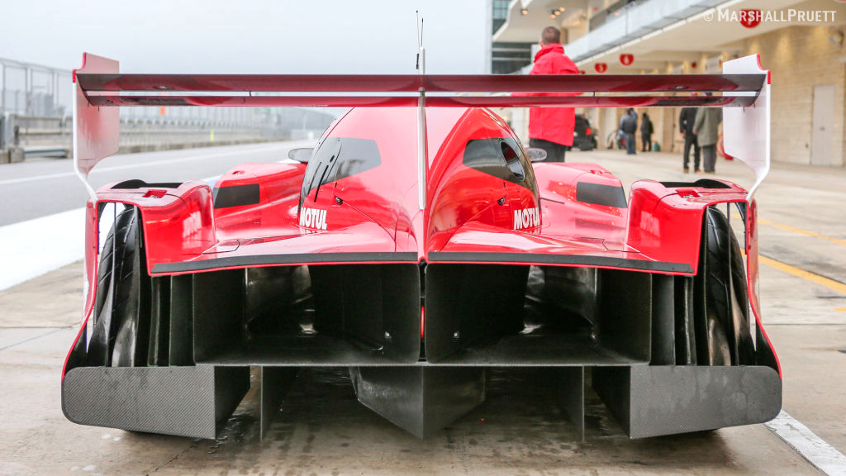 The
technical specification provided confirms smaller than the norm wheel
diameters front and rear, 16" compared to 18" for the Audi. The
16" wheels in lieu of the small diameter brakes, from what I can
understand. However the overall tire diameter is the same as the
Audi, 31/71. And while the rear tire is a completely different
beast, 20/71-16, it still has the same overall tire diameter, 71 cm, as
the Audi. So that means with 16" wheels, and 71 cm (28") diameter
tires, you have a tall sidewall. The
technical specification provided confirms smaller than the norm wheel
diameters front and rear, 16" compared to 18" for the Audi. The
16" wheels in lieu of the small diameter brakes, from what I can
understand. However the overall tire diameter is the same as the
Audi, 31/71. And while the rear tire is a completely different
beast, 20/71-16, it still has the same overall tire diameter, 71 cm, as
the Audi. So that means with 16" wheels, and 71 cm (28") diameter
tires, you have a tall sidewall.
Looking at tire
widths, the front tires are 13" wide (31 cm according to Michelin
nomenclature) and only 9" wide (20 cm according to Michelin) at
the rear. The tire dimensions are completely driven by
aerodynamic and weight distribution desires. With more weight
forward they'll be less weight transfer front to rear. The
preliminary front/rear weight distribution guesstimate is 61/39.
This is calculated by generating the total contact area for a
front (31 * 71= 2201) and a rear (20 * 71= 1420), calculating the total
area combined (2201 + 1401= 3621) and then generating a ratio of tire
area to total area for each (2201/3601 = 61%, 1420/3601 = 39%).
The idea being the contact patch % of the total is in a similar
relationship to the weight distribution. It isn't perfect, but
it's a good starting point. So with only 39% of the weight in the
rear there's less need for rear contact patch, and the narrow tire is a
aerodynamicist dream as bonus, reducing the tire-to-underfloor
interaction. Nothing in the tech spec confirms the narrowed rear
chassis, and the drawing provided seems to blow that idea out of the
water mostly.
Yes, the Nissan has a rear wing. Again, this
idea, the rear wing delete, was, in my mind, a Le Mans test item given
all we know about the the concept, reduced drag, weight forward
reducing need for rear downforce, etc., etc. Nothing in the press
literature addresses this, though informed sources state, “We will run
Le Mans spec aero, etc., even at Silverstone.” Regardless, it
appears integrated into the car design and in the end I was completely
out to lunch on this. But with a 61/39 weight distribution, aero
balance will trail around 58/42. 42% is about 10% less than a
mid-engined car, so rear downforce will have to be reduced, thus the
rear wing, while much more substantial than "vestigial", is reduced.
Interestingly enough the 58/42 aero balance guess is dead on
though low-side, and back to front, of what a mid engined car typically
runs (typically run between 45-42% front). In the end this was my
unintended contribution to the "wild rumors," the rear wing delete
idea. Though it would certainly have been interesting!
Nothing
has been said about what MJ energy class the GT-R LMP1 will run in,
that is still a bit of a moving target at the moment. Total
system power output has been addressed and Nissan has backed away from
the 2000 number, admitting it was a target, and perhaps one that isn't
currently achievable. They are admitting to 1250-1500 for the time being.
The
new Nissan prototype is a continuation, and execution to the
regulations I might add, of the concepts started with the DeltaWing,
continuing to the ZEOD, now culminating in the GT-R LMP1. It's a
connect-dots car, much like the DeltaWing. Starting with a desire
to drastically reduce drag, leading to a front engine to move weight
forward in order to reduce rearwards weight transfer, and to shift aero
balance forward in chase of weight distribution, it all makes elegant
sense in the end. | Mulsanne's Corner Book Store
A selection of sports car related DVDs and books, with a technical slant. |  1.31.15 1.31.15
>>So
roughly 5 hours after I wrote the below, Nissan releases this (left)
via @Nismo. Soooo, I guess that means tune in on Monday?
Now it turns out, Monday morning 10:00 (AM) Yokohama, Japan time.
So just barely Monday morning in London, UK, 01:00 (AM),
and 20:00 (8:00 PM) on the East coast U.S., thus Sunday evening.
I nearly screwed that one up!
Oh yeah, note the pretty clear lack of a rear wing in that image...
Just say'in... | Mulsanne's Corner Paddock
Motorsports and other interesting merchandise. Or, cleaning out my house. |  Images courtesy and copyright Nissan and Jalopnik Images courtesy and copyright Nissan and Jalopnik
>>Godzilla
has gone a bit quiet ahead of the official debut tomorrow, though this
is understandable. But if you listen closely, you can hear her
thumping around off in the distance and the discussion is taking a
somewhat more realistic tone. Tempered expectations? No,
nothing officially at least.
One of the items I'm hearing is
that there seems to be troubles with the flywheel KERS, such that up
until recently the Nissan GT-R LMP1 struggled to do multi-consecutive
laps without the system overheating. And while I'm told that the
KERS is working “perfectly” on the dyno, I also understand that's not exactly the case. And of course there's still the issue of getting it to work in the chassis.
I now also have a clearer description of the KER system; it's actually a two
flywheel system with each placed next to one another, either side of
car center line, underneath the driver's feet. Harvesting power
input for the system are the front wheels. I don't have a
description of how the twin flywheel system work, but it is my
understanding that there are issues with getting both to work
“together”, and as such it has “half” the power expected. The
rest of the accompanying hybrid components are underneath the driver's
leg, with a single prop shaft projecting rearwards, on car center line,
powering the rear wheels. My best guess is that the GT-R LMP1
will be running in the 8MJ energy class. Anything less suggests
significant issues with the KERS given the usable time vs power drops
dramatically the lower MJ class you're in. So if Nissan does
indeed have 2000 total system hp, and they opt for the 2MJ class for
example, it means they will have a mere 2 seconds to expel that 2000 hp (~1400-1500 from the flywheel) at max power.
In contrast, the 8MJ class would give you roughly 7 seconds of
release at max power. So bigger potential power release means
you'd migrate towards the larger MJ class in order to maximize the time
across which to release max power (or even partial power).
Another issue is interesting in what it reveals.
I'm told that the Nissan is utilizing much smaller diameter than
conventional brakes (smaller than even P2 brake diameters apparently),
with the idea the KERS provides the braking difference upon harvesting,
as is being done in F1. The issue seems to be that the KERS isn't
providing enough mechanical drag/braking force, though I'm told the
setup will be OK for Le Mans. There's also been a suggestion that
both the front and
rear wheel diameters are smaller than conventional, as well as a
confirmation the rear diameters are smaller than the fronts. With
the smaller diameter wheels come tall side wall tires and I understand
there have been issues with the vehicle dynamics and a suggestion of a
reconsideration of the small tire concept. I can imagine what
that would take, and affecting a major redesign such as that could be
detrimental at this stage of the program.
About that rear
wing...the car concept was developed without it though it has become a
necessity as total downforce levels have increased, as I mentioned in
my last update. However, it has been reiterated to me that it is
little more than vestigial as the elimination/reduction of the rear
wing is central to the entire theme. And it's expected the GT-R
LMP1 will run Le Mans spec aero at testing, and the races, ahead of Le
Mans. With or without rear wing? Watch this space as well...
|  What's
this about Nissan having only done 100 kilometers of testing? I hear
that's completely rubbish. However, I do wonder how constructive their
testing has been. The impression I have is that there's a steep
learning curve with this car, and perhaps certain systems, the KERS for
example, are in need of further development. And as such I'm
personally not expecting much for reliability up front. And if they're
lacking in reliability at the moment, you can be sure that testing has
been frustrating. Some are saying, “Give it a year of development.” I
hope a year is enough to reveal the correct road taken from a concept
standpoint and to shake any bugs out. What's
this about Nissan having only done 100 kilometers of testing? I hear
that's completely rubbish. However, I do wonder how constructive their
testing has been. The impression I have is that there's a steep
learning curve with this car, and perhaps certain systems, the KERS for
example, are in need of further development. And as such I'm
personally not expecting much for reliability up front. And if they're
lacking in reliability at the moment, you can be sure that testing has
been frustrating. Some are saying, “Give it a year of development.” I
hope a year is enough to reveal the correct road taken from a concept
standpoint and to shake any bugs out.
I'm still planning on
tuning into the Super Bowl though I'm not really sure how that will
help me report post. As of now there have been no official Nissan
press releases even informing media of the Super Bowl event. While I
don't expect Nissan to chatter about their car ahead of the debut, I do
expect them to give a heads up. So for some reason they haven't, and as
a result I have no idea what I'm even expecting other than a 90 second
commercial. I have set the DVR to record in HD, for whatever that's
worth. I suggest everyone should tune in. You're welcome Nissan!
Oh
course there's the distinct possibility the commercial is just a
commercial with the official debut at some other time entirely.
Here's a Technical specification recap of what I've been speculating on
since December:
Nissan GT-R LMP1
- Cosworth developed twin-turbo V6, 550-600 hp, going out on a limb I'll say its 1.6L considering the F1 origin.
- Front engined, front wheel internal combustion engine drive
- Torotrak
developed twin flywheel KERS located in front of chassis, harvesting
via front wheels, power transmission to rear wheels
- 8MJ energy class, anything less than 6MJ= issues?
- Total system power, “2000”
- 1900 mm overall car width at front, ~1800 mm overall width at rear
- Smaller diameter front and rear tires than conventional with the rears smaller than the fronts
- Smaller rear tire width than conventional, is it as simple as a front to rear swap as far as tire width concerned? Maybe.
- Smaller diameter front and rear brakes, utilization of KERS braking during energy harvesting
- No rear wing for Le Mans, low drag wing elsewhere
- 200+ mm high rear deck above diffuser TE to accommodate “flow through” cooling/front diffuser activator
- Obvious things I've missed, many. Not so obvious things I've missed, many. Things I'm plain wrong about, many.
In
the end it all sounds pretty wild and is certainly many, many tacks
away from what's been considered the norm. Is all of the information
correct? Probably not, I'm sure the pedants will inform me.
There is a little more than 24 hours away before we all know (hopefully, maybe?). |
| All images courtesy and copyright Jalopnik
1.21.15
>>When
it rains it pours, about 24 hours after our little amoeba friend
appeared on the Net showing the Nissan GT-R LM LMP1 going through it's
testing cycle at the Circuit Of The Americas, thanks to diligence on
Jalopnik's behalf, more images, vastly more descriptive ones at that,
pop up. It's an information bonanza!
So I've been reporting on the Nissan for over a month now with my first articles going on mid-December.
No other outlets are writing about the program at the moment, instead
they are presumably waiting for the official launch. Thus it puts
me in the tight spot of being the only one willing to stick my neck
out, and as has been seen, I've had to rely on a fair bit of
speculation. That's nothing new to those who frequent my site.
This process is about homing towards the truth so at times, to some, it
seems as though I'm grasping at straws. The reality is the information
is evolving and I'm adjusting my viewpoint with those updates. I'm
augmenting source information with speculation as I don't have a clear
picture; it's very obscured. But have I been so wrong? I'll argue
the speculation has simply become more nuanced. And while I'll never
talk about who my sources are, I will say this: Nissan's NDAs have been
pretty effective and frustrating. That I've been able to dig up as much
information as I have speaks to connecting the dots, from Delta Wing
and ZEOD, to scraps of information here and there, to my always
reliable cadre of sounding boards (you all know who you are) .
And once you piece all that information and references together, at the
end of the day the car begins to draw itself and it actually makes
quite a lot of sense. Yes, I might miss on some of the specific
details, but I feel I've been providing a pretty clear picture into the
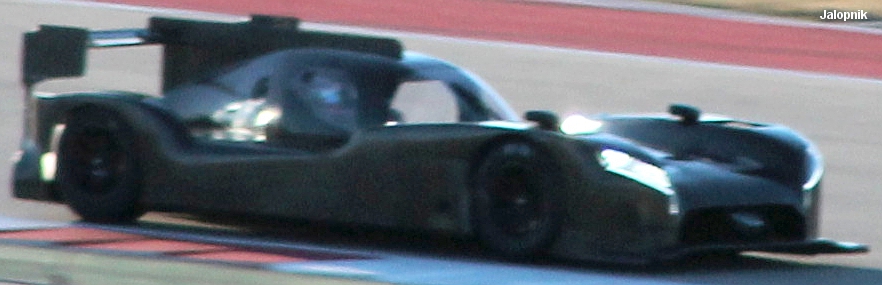
concept phase. |  A
rear wing has appeared! For starters, I've always felt that the
rear wing delete would be a Le Mans-only configuration, if I didn't
make that clear. However, note that from the images it doesn't appear
the Nissan is carrying much rear wing angle, and these shots were taken
at COTA; a high downforce circuit. That should tell you something about
design intent regarding the rear wing and it's overall importance. As
to why it appeared, I've been told that the drivers felt the car was
"dangerous" and needed a touch more rear downforce. The rear wing was
then added based on that feedback. However, I still feel very confident
that Nissan will run without the rear wing at Le Mans and that its
addition was only necessary with the increased total downforce demands
of higher downforce tracks. A
rear wing has appeared! For starters, I've always felt that the
rear wing delete would be a Le Mans-only configuration, if I didn't
make that clear. However, note that from the images it doesn't appear
the Nissan is carrying much rear wing angle, and these shots were taken
at COTA; a high downforce circuit. That should tell you something about
design intent regarding the rear wing and it's overall importance. As
to why it appeared, I've been told that the drivers felt the car was
"dangerous" and needed a touch more rear downforce. The rear wing was
then added based on that feedback. However, I still feel very confident
that Nissan will run without the rear wing at Le Mans and that its
addition was only necessary with the increased total downforce demands
of higher downforce tracks.
Very early on in this process I
was informed of the detail regarding the drop gear on the upright and
raised half-shafts that I mentioned back on January 7. I was told
this was because the Nissan had "huge tunnels" at the rear. I
really didn't know if I should take that literally or not, and after
confirming Nissan hadn't been given any dispensation regarding the
underfloor from the ACO I tucked the “huge tunnels” thought away.
Though I still didn't know what to make of the raised half shafts. So I
came to the conclusion of the diameter discrepancy front to rear and
that Nissan must be compensating for extreme halfshaft angles. It
fit the rumor narrative at the time coming from AutoHebdo about smaller
rear tires. But seeing the tires now, the front to rear diameter
difference is small. So I don't think Nissan is compensating for
halfshaft angle at the rear. But why the raised halfshaft? Back
to the "huge tunnels" comment. Upon seeing the rear end of the
car I'm struck by the very tall rear deck height and the complete lack
of any sort of obvious front diffuser exit. The rear deck height
is monstrous; for 2015 the ACO has mandated a minimum rear body
trailing edge height of 50 mm above the diffuser. So one would expect
to see the minimum (50mm), or thereabouts, given the trend towards zero
heights the past couple of seasons. 50mm is 2”, and as a
reference the diffuser exit height is a maximum of 200 mm tall.
It's pretty obvious that the rear deck height is greater than 200 mm
above the rear diffuser trailing edge. | 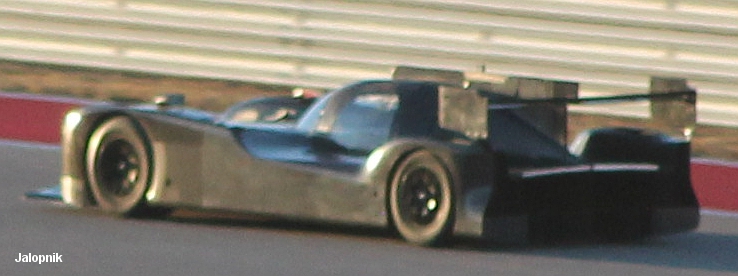 So
clearly something is going on there. Now at the rear of the
car, in the base area, is a very nice source of low pressure.
Could there be some sort of tunnel, or ducting, projecting rearwards
from the front of the car, through the side pods and along side the
tub, and out the back? But what could the low pressure feed from
the car's base area be activating? Regardless, this starts to
perhaps better explain the raised rear halfshaft. Recall the Audi R15
ran into issues with their flow-through concept when it came to the
rear suspension and half shaft, these elements increased the induced
drag and made the overall concept a very tough argument in Le Mans
spec. Thus I think Bowlby has raised the half shaft and
incorporated a drop gear on the upright not to compensate for reducing
tire diameter, but to pick that element up out of the air flowing
through the duct, allowing for more effective flow-through.
Presumably the upper A-arm is out of the flow to begin with and
the lower A-arm intrudes into the diffuser tunnel more than likely. So
clearly something is going on there. Now at the rear of the
car, in the base area, is a very nice source of low pressure.
Could there be some sort of tunnel, or ducting, projecting rearwards
from the front of the car, through the side pods and along side the
tub, and out the back? But what could the low pressure feed from
the car's base area be activating? Regardless, this starts to
perhaps better explain the raised rear halfshaft. Recall the Audi R15
ran into issues with their flow-through concept when it came to the
rear suspension and half shaft, these elements increased the induced
drag and made the overall concept a very tough argument in Le Mans
spec. Thus I think Bowlby has raised the half shaft and
incorporated a drop gear on the upright not to compensate for reducing
tire diameter, but to pick that element up out of the air flowing
through the duct, allowing for more effective flow-through.
Presumably the upper A-arm is out of the flow to begin with and
the lower A-arm intrudes into the diffuser tunnel more than likely.
But
what is the purpose? Could the low pressure wake behind the car lend a
hoovering effect to the front diffuser? This would explain the lack of
any exits at all past the front wheel centerline as any interruptions,
changes in direction, in the ducting would reduce pressure recovery.
But is the trailing edge exit too far away to have any influence on the
front diffuser? So is it only for cooling? Surely the two
exit ducts towards the leading edge of the nose (the only two that can
be seen on the entire car) are related to that. Though that
doesn't seem to be enough for the presumed cooling needs of the car
(water, oil, intercoolers). But there are also no obvious means
of generating front downforce. No diveplanes even (remember these
images are shot at COTA), and only a prominent splitter as a means to
prduce front grip. And there are certainly no exit ducts
of any kind related to obvious downforce generation. This car
will need front downforce and the mandatory cutouts (Big Honking Holes,
note Nissan has gone for the top
location option) in the front wheel arches certainly aren't enough to
draw the front diffuser, creating the necessary front downforce.
We've seen similar details in the past, recall the boundary layer suction developed for the Nissan P35's large side pod oil cooler inlets. Utilizing the large area of low pressure situated behind the car, a slit in the leading edge of the duct drew
off the thickened boundary layer ahead of the main intake. It was
a simple and small detail on a mid-rear engined car which utilized the
rear wake to also draw out the heated oil cooler air through the engine
bay, past the engine, gearbox, and suspension, and out the back of the
car. And it worked, even in that comparatively dirty
environment. How much more effective would the low pressure draw
of the base area be if the car design was optimized for this purpose
and the rear end didn't have all the complications of a engine being in
the way? So with that, what do you do with it? The answer
could be very interesting. Watch this space. |  Looking
at the side view and focusing on the wheels, it seems pretty clear the
rear tire diameter is smaller than the front but that the wheel
diameter is the same or very similar. Therefore I think there's less of
a need to compensate for half shaft angle and the real reason for the
upright drop gear is what I mentioned above and simply for aero
reasons; to clear the full length ducts/tunnels that provide front
diffuser activation. The front view affords a look at rear tire
widths, based on the width of the rear fenders, and it does appear that
the rear tires are narrower than the fronts. Looking
at the side view and focusing on the wheels, it seems pretty clear the
rear tire diameter is smaller than the front but that the wheel
diameter is the same or very similar. Therefore I think there's less of
a need to compensate for half shaft angle and the real reason for the
upright drop gear is what I mentioned above and simply for aero
reasons; to clear the full length ducts/tunnels that provide front
diffuser activation. The front view affords a look at rear tire
widths, based on the width of the rear fenders, and it does appear that
the rear tires are narrower than the fronts.
At the front we can
see what looks like the crash structure protruding forward out of the
primary radiator inlet. It seems a bit awkward looking and I
can't think of any reason why it wasn't better integrated into the
design, assuming I'm right that it is indeed the crash structure.
These
images unfortunately don't provide any corresponding visual evidence to
the location of the engine exhaust exit. I was told they poked
out the engine cover ahead of the windscreen, but the limited views
available don't reveal that, or much of anything really, just lots of
reflections in that area.
The side view mirrors are positioned
just aft of the mandatory fender holes, presumably riding in part of
the low pressure wake created by those holes.
At this point all
there is left to do is to but wait for the official launch as these
images certainly have satisfied a portion of my curiosity until then. |
|  1.18.15 1.18.15
>>Nissan has choreographed the
release of two extraordinarily poor 1995 cell phone images of the GT-R
LM testing at the Circuit Of The Americas (they can be seen in various
forum and on Facebook). Taken with a pinhole camera (or etched on
a rock, I can't decide), we can see what can only be described as a
blob, or an amoeba, as seen
from 2 miles away. However, the image seems to confirm that the
blob is red, and perhaps white, and probably front engined. If
you squint that is. Furthermore, given the much higher downforce
nature of COTA than Le Mans, a rear wing blob can be seen (no surprise
there, ultra low-drag only has a chance at LM) at the rear of the main
blob. Maybe. Identifying any more details beyond that would
be a supreme leap of faith, though I'm pretty sure that's Winston
Churhill's profile there in the middle. Yes Darren Cox, I wrote
150 words about an indescribably shitty photo (no offense meant to the
photographer of course). You're welcome. | Mulsanne's Corner Book Store
A selection of sports car related DVDs and books, with a technical slant. |  1.7.15 1.7.15
>>A couple of weeks further since Part 2
and more information is coming forward. I'm told that the
flywheel KERS on the Nissan is actually in the front of the chassis,
with a prop shaft running to the rear to drive the rear wheels.
Furthermore, said sources have confirmed, without a doubt, that the
combustion engine does indeed power the fronts tires, KERS the
rears. My best guess about placement of radiators seems correct,
mostly ahead of front wheel CL. And all of this,
radiators/intercoolers, KERS, is purely for weight distribution.
While the GT-R LM has nothing like the extreme weight distribution of
the Delta Wing (30/70), like I mentioned last month, I do believe it is
closer to 55-58% (or even slightly more) on the front, which ultimately
means it has similar weight distribution numbers to a mid-engined car,
but back to front.
I'm told that the Cosworth engine is a
conventional twin turbo arrangement, conventional in this case meaning
that the turbos aren't located in the 'V' of the engine and aren't
being used for energy recovery. They also aren't being utilized
for any aerodynamic benefit as they apparently exit out the top of the
engine cover, ahead of the windscreen. So this leads me to
believe that the exhaust flow from a turbo perhaps isn't that useful
aerodynamically. I also understand that the driver is much
further back in the chassis than I would have guessed, very close to
the rear wheel.
A lot of people doubt the rear wing
delete. I get it, we're so used to the current paradigm as it's
what, 45 years old? But remember that aero balance follows weight
distribution, I can't stress this more; this is pure physics and car
setup basics. So by piling the front with weight there becomes
less of a need for rear aero balance, and therefore you can begin to
consider new options regarding the rear wing. But the removal of
the rear wing is more about eliminating unneeded drag. Yes, the
rear wing is the most efficient aero device on the car, something on
the order of better than 10:1 (compared to a total car L/D of
approaching 6:1 at Le Mans). And yes, the rear wing also produces
on the order of 20% of the car's total downforce. But the list is
precious short for items that can reduce drag so dramatically, around
8% of total drag. And hence eliminating the rear wing is not
nearly as counter intuitive as it might seem. And there's been a
bit of back and forth about the legality; frankly I've looked at the
regulations myself and see nothing that makes a rear wing
mandatory. However, in the event it is deemed a necessity, it's
easy to imagine a very short chord vestigial rear wing, aerodynamically
invisible, being added simply as a rules work around.
And
drag reduction isn't limited to the removal of the rear wing. At
the rear we can surmise with some confidence that the rear is narrower
than the front, 1800 mm vs. 1900 mm. As mentioned previously, it
makes sense. But in reducing the rear overall width it becomes
apparent that Nissan will not be able to utilize the maximum allowed
14” wide rear tires if they want to maintain the maximum allowed tunnel
width of 1100 mm. When you reduce the rear car width from 1900 mm
to 1800 mm, you're left with a space that a 12” tire will fit while
maintaining the same relationship between the inboard face of the tire
and the outer wall of the underfloor as a 14” wide tire (the regulated
maximum) out to the 1900 mm max car width. A 13” wide tire will go into
this space too, but it begins to encroach heavily on the outer wall of
the underfloor, with negative implications via tire wake and underfloor
interactions. But if 12” or 13” wide, that's another small
chipping away of total drag. However other factors (see below)
might indeed see Nissan retain 14” wide rears in lieu of traction
desires and in that case they would have to opt for less than the 1100
mm max tunnel exit (the regulation is 1100 mm max tunnel exit width,
1000 mm minimum).
But wait, there's more! I understand
that the GT-R LM has a unique rear half shaft arrangement, in that the
half shaft is not on-center to the upright, and drop gears, located in
the uprights, are utilized for final power transmission to the rear
tires. I've never been 100% sure on whether or not the rumor of
smaller sized tires at the rear meant narrower width or smaller
diameter. I've somewhat moved away from thinking narrower
width. And the details regarding the drop gears and half-shafts
leads me to smaller diameter. Because as wheel diameter gets
smaller, the center point of the hub begins to lower to a point where,
combined with a narrower rear end, the half shaft angle starts to get
sketchy. The drop gears are used in order to actually reduce what
the drive shaft angle might have been, all with the idea of letting the
CV joints actually survive. But why all this hoop jumping for
smaller diameter tires? Well the rear wheel arches are
responsible for between 5 and 8% of total car drag. If you can
reduce rear tire height, you can surmise you can chip away at some of
that 5-8%.
Further evidence of extreme drag reduction as being a
primary design principle is that I was told the top speed projections
Nissan are using in their lap simulations are "mental." It would
seem Nissan is concentrating on the extreme end of a fast lap time at
Le Mans (approaching it from pure drag reduction), and have forged into
an area that no one has gone in 60 years. The question remains
whether they've strayed too far off the curve that defines lap times at
Le Mans.
I've finally been able to confirm that total system
horsepower figure. Ready for this? I've been told, from
reliable sources, that the Nissan GT-R LM's total system horsepower is
a conservative 2000. Yes, that's what you read. However,
while these numbers certainly grab your attention, they really are
relative to the storage capacity and the harvesting and release
strategy, of which we know nothing about at the moment. I can't
even assume which Release Energy class Nissan are running in. So
while this number is quite fantastic, ultimately it's a little
meaningless without context. | Mulsanne's Corner Book Store
A selection of sports car related DVDs and books, with a technical slant.
|
|
|

