|

|
Pete
Lyons' fantastic Can-Am Cars in Detail:
 |
July/August 2012
Reload
to see the latest news
All news content copyright Michael J. Fuller, unless
otherwise noted |
 |  8.25.12*with updates 8.26.12 8.25.12*with updates 8.26.12
>>So
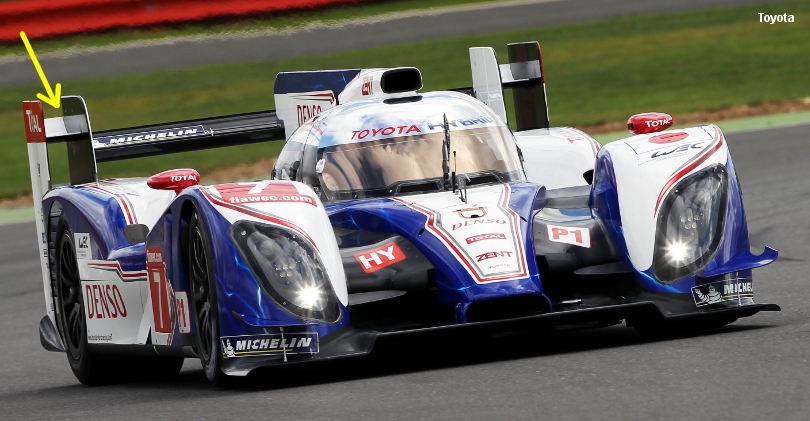
given a very long gap between Le Mans and Silverstone you'd
certainly expect some developments. And with the TS030 back on
scene, we're seeing some new bits. The most interesting item is
a second endplate that mounts to the bodywork at maximum car width.
And sprouting from the top of that outboard endplate and
projecting inboards towards the rear wing endplate proper, and closing
the gap in the 200 mm "no man's land" either side of the 1600 mm wide
rear wing, is a cambered aero surface. A winglet. Further
inspection verifies that these winglets are simply
parallel-section (constant section) cambered elements, not true wings
(as that would be verboten as true wings are more stringently
regulated).
Article 3.6.2 governs what is and is not considered
an aerodynamic elements (elements capable of generating aerodynamic
effect, i.e., downforce). It states, "No aerodynamic element can
be added on the bodywork, being an integral part or not of it, apart
from:"
3.6.2 then state that diveplanes, front diffuser strakes,
the rear wing, and a single bodywork trailing edge gurney are the
approved set of "aerodynamic elements."
Additional language
then goes on to explain what the ACO considers to be aerodynamic
elements that are outside of the approved set mentioned and thus
illegal. This includes "angle brackets" (essentially winglets
disguised as various bracketry outside the permitted diveplanes),
engine exhaust chimneys, bodywork elements with more than one possible
position (adjustable), and the catch all, "Any aerodynamic element the
function of which is only to generate down force and is not permitted
by the regulations."
Thanks to L'endurance's interview with Toyota's Pascal Vasselon,
we have insight into Toyota's interpretation. Mr. Vasselon
indicates that the winglet perched atop the outboard shadow endplate is
actually an offset of the fender surface below it. That's no
winglet, it's merely the extension of the fender surface below but
offset upwards (substantially). The winglet is the fender.
He states, "We must have openings on the wheels, so we have
designed a wheel arch that means, when the hole is open, it looks like
that. Simple. It is just doing things differently. When you open the
wheel arch, it has the shape you see. The ‘winglets’ you see are the
rearward part of the wheel arch." Naturally Toyota can say whatever they want to here as the onus of legality is on the ACO.
And in 2008 Audi used similar language in regards to the Spa Wings on the Audi R10.
Audi called their Spa Wings "covering panels" for the large holes
they had opened up in the bodywork just above the exhausts. But the ACO's 2008 ruling
was made in a slightly different regulatory environment as the, "Any aerodynamic element the function of which is only to generate down force and is not permitted by the regulations," phrase wasn't
in the regulations then. That only appeared in the 2009 rules
(the full regulation per the '09 rule book is: "Any bodywork
element the function of which is only to generate down force and is not
permitted by the Regulation (at the ACO discretion)." The "at the
ACO discretion" disappeared in the 2012 rules) Seemingly this
2009 amendment to Art 3.6.2 was in response to Audi's Spa Wings.
Thus it appeared that the ACO took an ill view of add on winglets
and subsequently no more appeared.
 But interestingly enough, there also is ACO precedent for clamping down on aerodynamic
elements that are outside the prescribed set and whose singular
function is the generation of downforce. In early 2009 Audi
proposed a double set of diveplanes attached outboard and just ahead of
the rear wheels on the R15. These were bonded/integrated into the local bodywork and were not considered separate or add on elements. The rear diveplanes were
good for, "a bit of rear downforce, not much," according to insiders at Audi. But
the ACO took issue and they were banned on the spot. Though you
have to ask, how were Audi's rear diveplanes any different in ultimate intent than Toyota's winglets? But interestingly enough, there also is ACO precedent for clamping down on aerodynamic
elements that are outside the prescribed set and whose singular
function is the generation of downforce. In early 2009 Audi
proposed a double set of diveplanes attached outboard and just ahead of
the rear wheels on the R15. These were bonded/integrated into the local bodywork and were not considered separate or add on elements. The rear diveplanes were
good for, "a bit of rear downforce, not much," according to insiders at Audi. But
the ACO took issue and they were banned on the spot. Though you
have to ask, how were Audi's rear diveplanes any different in ultimate intent than Toyota's winglets?
Let's
be honest, everyone in the paddock knows that the singular purpose of
Toyota's winglets is to generate downforce. This is where the
outrage comes from. And in cases like these it's up to the ACO to
take the high road. And therein lies the issue. Toyota
hasn't found a clever loop hole, they've simply exploited the ACO's
lack of consistency regarding their own regulations.
If the ACO
is going to insist on using wording such as that which is in Art 3.6.2,
then they should be prepared to defend it and not allow everyone
who shows up with "clever" wording and a smile and a wink an immediate
pat on the back.
The solution? The ACO should simply remove the final dash-point wording within Art 3.6.2.
| 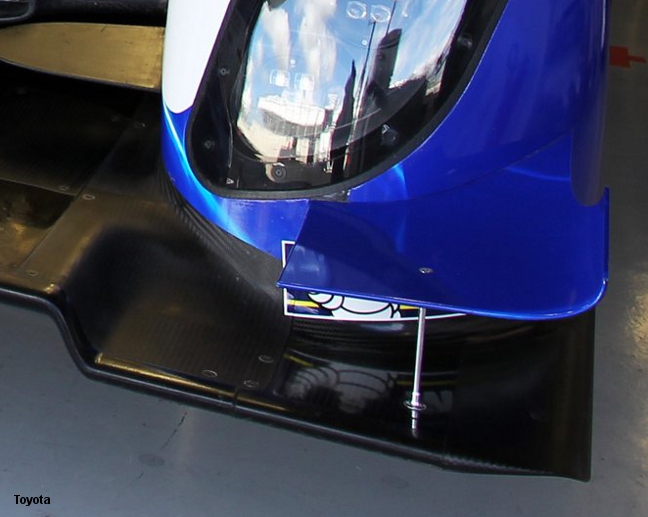 The TS030 is also sporting a new front diveplane. It reminds us a bit of the P38 GI can opener... The TS030 is also sporting a new front diveplane. It reminds us a bit of the P38 GI can opener... | 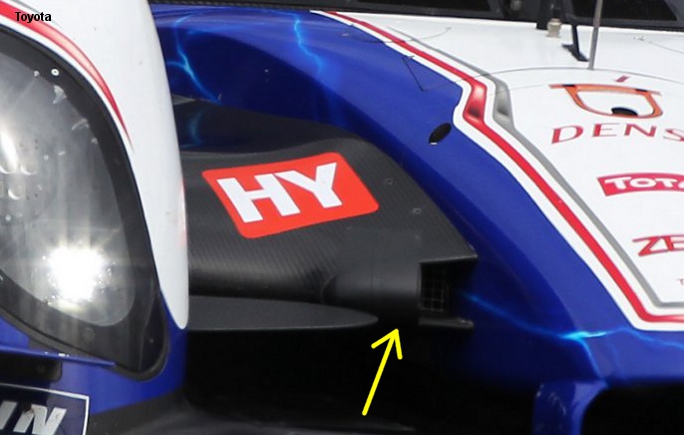 Brake inlet blanking panels. Brake inlet blanking panels. | 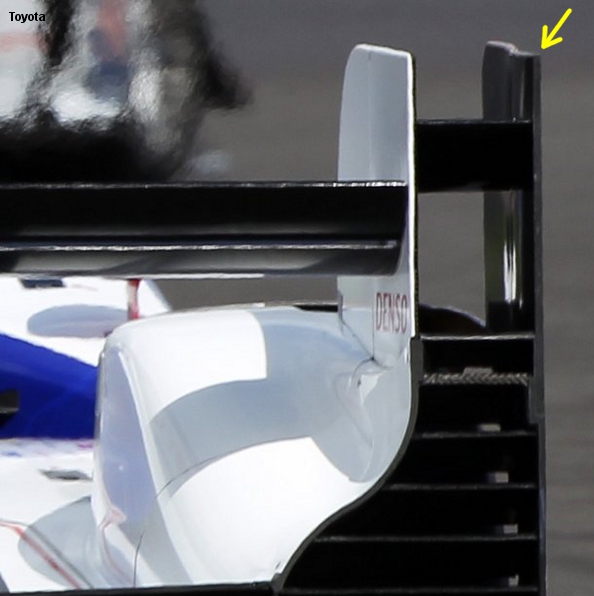 The TS030's shadow endplate is 'S' curved in plan view. The TS030's shadow endplate is 'S' curved in plan view. | 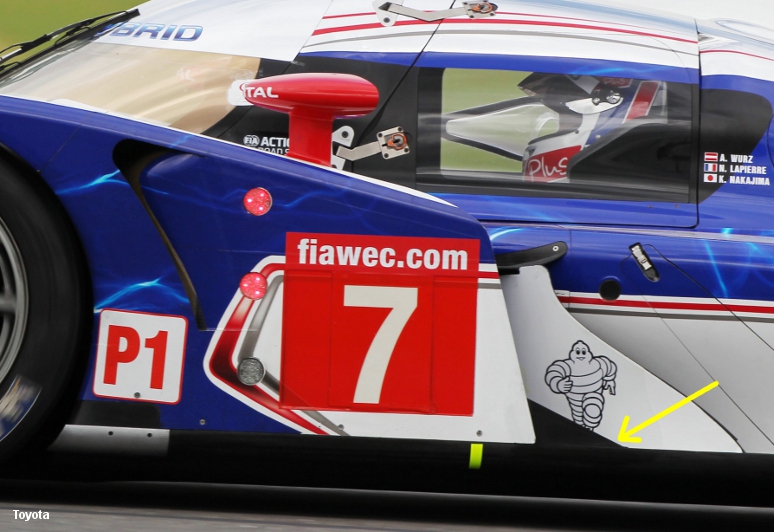 Pontoon fender trailing edge extension. Pontoon fender trailing edge extension. | TS030 front fender development:
 | Silverstone 2012. Much shorter fender leading edge, allowing more splitter area ahead of the fender. |
| Le
Mans test 2012. Longer leading edge, subsequently shorter
splitter area ahead of the fender. Leading edge shape is also
blunter. |  |
| 
|
| |
|

