March/April 2009
Reload to see the latest news
All news content copyright Michael J. Fuller, unless otherwise noted |

|
 4.9.09, updated 4.14.09 4.9.09, updated 4.14.09
>>It's with some irony we post this link to an article on Autosport regarding rival teams questioning the legality of the Audi R15.
Summarized, the article indicates that both Aston Martin Racing
and Peugeot have begun to question the legality of design details on
the Audi R15.
As written, the challenge posed seems
to indicate a general lack of understanding of the regulations as they are written, namely this paragraph from the article:
The LMP1 regulations state that "with the exception of the rear wing...
no bodywork or underbody element having a wing profile is permitted".
Audi's rival believe that the splitter element contravenes this
regulation.
Careful
reading of the LMP regulations will lead one to Article 3.6.1
(Aerodynamic devices) and the
symmetrical "wing" exemptions within that Article (frequent readers to
Mulsanne's Corner will be very familiar with Art 3.6.1). And
there is pretty clear evidence that the main plane and flap on the R15
are of symmetrical profiles and thus governed by those bullet points.
Ultimately the Audi R15's design execution, post-2007 3.6.1
clarification, was the
inevitable direction, wasn't it? To protest 3.6.1 now,
well, isn't it a bit too late (consider the Porsche RS Spyder's valance panels)?
At this point it seems the Audi has simply out-drawn its rivals.
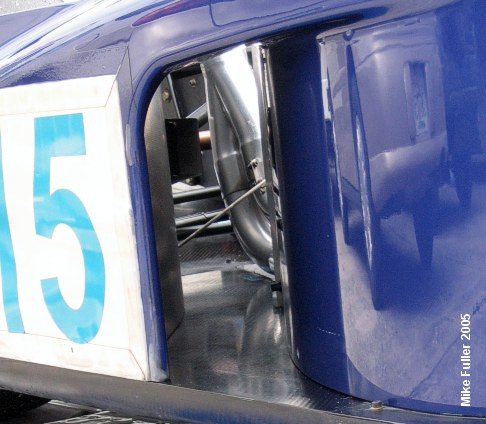 Looking
at the details of the complaint as laid out in the Autosport article,
the front wing has been called out (as mentioned above), but so too has
the coke-bottle duct/channel at the rear of the car. According to Aston Martin's George Howard-Chappell ,
"The question is what constitutes an aerodynamic opening and what
constitutes a radiator duct?" It's very interesting to note that
this detail has been on every Lola (with the exception of the LMP1
Lola) since the B2K/40 (B05/40 at left): Looking
at the details of the complaint as laid out in the Autosport article,
the front wing has been called out (as mentioned above), but so too has
the coke-bottle duct/channel at the rear of the car. According to Aston Martin's George Howard-Chappell ,
"The question is what constitutes an aerodynamic opening and what
constitutes a radiator duct?" It's very interesting to note that
this detail has been on every Lola (with the exception of the LMP1
Lola) since the B2K/40 (B05/40 at left):
B2K/40
B01/60
B05/40 LMP2 Series
So
this interpretation is nothing new for sure, precedent has been set,
and for quite some time. Having seen the Audi execution first
hand I really couldn't say it was any different than the Lola's.
And while historically the regulations always had wording
limiting "ducts to no where", here's the text from the 2001 ACO LMP900
regulations, Art 3.4.5 a/:
The
air intakes the purpose of which is to feed the engine, cool mechanical
components (radiators, brakes, gearbox, etc.), and to provide
ventilation for the driver and engine compartment shall not induce
aerodynamic effects;
...the
wording, "shall not induce
aerodynamic effects," fell out years ago (with the 2004 LMP1/2
introduction) as the cars became more intricate and what instituted
"aerodynamic effect" anyway? A conventional radiator
intake induces such an effect; the regulations never stated
"positive" aerodynamic effect... So without that wording within the
current rules, it becomes difficult to point a finger at any opening
whose clear purpose was aerodynamic. And then the waters
certainly get cloudy if you innocently place your brake cooling ducts in such a
channel (as on the Audi...and the Lola). Then you get into
arguments about the primary
purpose of the intake, yada, yada, yada, it
becomes endless. So in a sense it's good that the terminology is
gone from the regulations as that then eliminates a lot of the
contention about ducts/channels within the bodywork. And as long
as they meet the bodywork regulations, then they are legal, right?
But
even with all of this, one only needs to take a look at the Lola Aston
Martin to find cloudy areas as well. Purusing over to Art 3.4.5
that governs air intakes, and then scrolling down to section d.2
concerning closed top cars:
d.2 - (Air intakes must...) Be integrated into the
curved line of the roof.
Even
the briefest of glances at the Lola Aston and it is clear the roof
mounted engine intake is of questionable nature in that it
doesn't integrate to the profile of the roof; it is a separate
surface and shape and is offset (though connected to) from the roof
line. Basically it all hinges on the word "integrated" and comes
down to interpretation. Perhaps the point is that there are potential contentions on every car?
So is there a fight brewing? The ACO was noncommittal
when asked if they would request Audi to make changes to the car
should, upon reexamination, details be deemed, well I don't know what,
"illegal" I guess (Audi responded saying that as the car had been homologated they weren't changing jack). Interestingly, at
Sebring Audi's Wolfgang Appel confirmed that the ACO did request
changes to the design to be made to the R15 prior to its homologation
being accepted (see our 3.13.09 news segment). So
the ACO has already
tread this path with Audi and scrutinized the car's design and found
elements
that they weren't in favor of. If they had any further questions,
wouldn't that have been the appropriate time to address them?
Yes, you'd like to think so and you can bet everything was
brought onto the carpet then and there.
As we're constantly dealing with the word "interpretation", you'd
like to think once the ACO signed off on a design, that was that;
precedent was therefore set (see Lola engine intake for an example).
They are, after all, the dictator of the regulations.
The ACO says they will soon issue a rules clarification.
But will that mean Audi has to make changes to their car, i.e.,
which side of the decision will Audi fall? We shall see.
|
 4.3.09 4.3.09
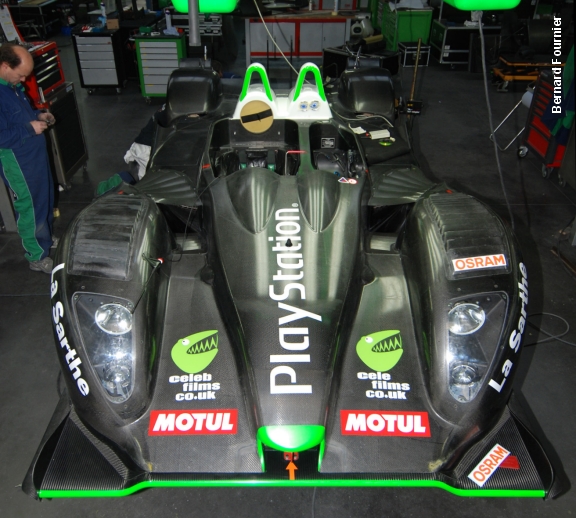
Considering that images of the car are now readily available, we're reposting the Pescarolo shots.
>>Bernard
Fournier has been gracious enough to share these images of the updated
2009 Pescarolo. We see the familiar shape but with some new and
interesting details. The bodywork between the fenders and the
nose comes further forward than on previous Pescarolo LMPs and ends
just shy of the leading edge of the splitter. |
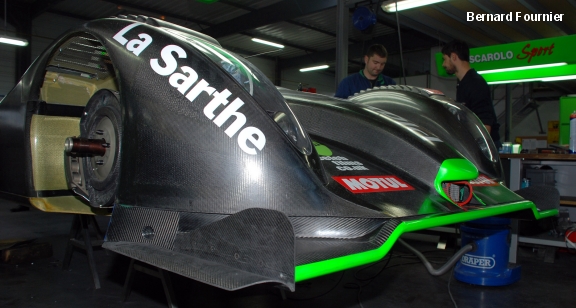 The
outer edge of the splitter takes on a shape familar to the Acura
ARX-01a/b. The vertical endplate, just inboard of the outer edge
of the splitter this year, is a familiar Pescarolo item. The
outer edge of the splitter takes on a shape familar to the Acura
ARX-01a/b. The vertical endplate, just inboard of the outer edge
of the splitter this year, is a familiar Pescarolo item. |
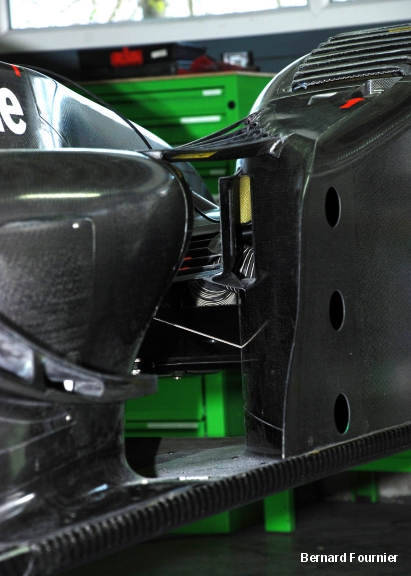 The
deep sculpting of the side pod is evident. Legality louvers
sticth the sidepod to the trailing edge of the front fender. Note
the vent on the inboard face of the front fender pontton. The
deep sculpting of the side pod is evident. Legality louvers
sticth the sidepod to the trailing edge of the front fender. Note
the vent on the inboard face of the front fender pontton. |
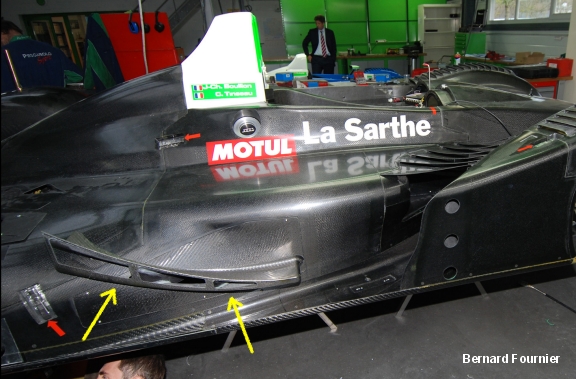 The
arrowed item is of interest. Clearly it seems to be oriented to
produce downforce, but is it also being used as a radiator exhaust
chimney given the slots in the outboard edge? The
arrowed item is of interest. Clearly it seems to be oriented to
produce downforce, but is it also being used as a radiator exhaust
chimney given the slots in the outboard edge?
There's
discussions from Barcelona that items on the car have been deemed
non-compliant with the attention being drawn to the chimneys here.
Endurance-Info has published an image that shows the chimney having been removed. |
3.31.09
>>Audi
has released an image of the livery of Team Kolles Audi R10 set to race
this year in the Le Mans Endurance Series and at Le Mans. Worthy
of
note is the rear wing. It would appear to effectively be the
R15's wing assembly but for different endplates and possibly mounting
pylons (bottom portion).
 |
 |
|
|
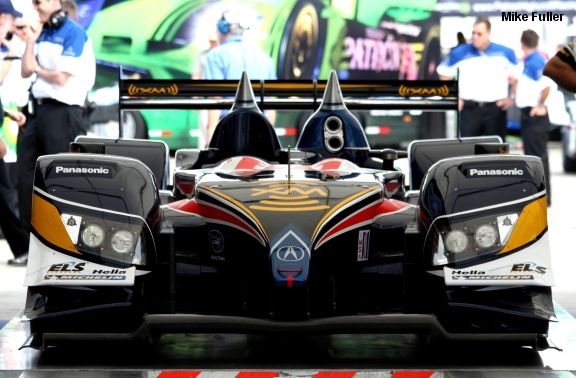 3.29.09 3.29.09
Well another 12 Hours is
done and dusted, they say this one was epic.
I’ll leave the color to others because, let’s face it, you don’t come
here for that...
>>Following
their pole win, Acura seemingly faded from the weekend when they took up shadow
position to the two primary race protagonists.
There's already a skeptical drum beat sounding throughout the media and
forums that perhaps the Acura program wasn't "ready for prime time." Certainly the effort is in its literal
infancy, especially compared to the very well honed Audi and (somewhat less so)
Peugeot effort. But that seems to overlook the obvious. So neither car finished
due to various component failures (gearbox on the #9 Highcroft car and
suspension failure on the #66 de Ferran car).
It is our understanding that this issue came down to "poor lifing
control" of the components in question.
The positive here is that there's an obvious solution to that issue and
we can imagine it's in place as we speak. Looking at their on track
performance, in the race the Acuras appeared to be about 2 seconds off the
absolute race speed of either the Audi or the Peugeot, take your pick. And
while on a single lap, or a string of laps, the Acura can keep pace with the
front runners (see qualifying), when traffic was brought into the equation the
Acura suffered even more so not having back marker dusting uber-torque.
Maintaining the car's momentum is paramount to laps times in this car. But in
order to merely keep that pace, albeit slowly drifting through race length
stints, the Acura drivers had to drive their hearts out and then some. The
Acura makes up the power deficit to the diesels through higher cornering speed,
which means higher G-loadings on the driver, lap after lap. We understand that
the performance deficit to the diesels could be bridged by running even higher
downforce levels or custom tires, but the car is currently at, or very near the
upper levels of human performance. That is, chances are the drivers simply
would not be able to corner the car at that speed for any given race length.
This poses something of a quandary to the regulations makers. If a factory
effort takes the page of the regulations that deals with gasoline powered LMPs,
designs their car to those regulations, and yet finds itself in effectively the
same position as anyone else would be in if they came to the table without a
diesel ("knife to a gunfight" as one has described it even now in light of the
changes the ACO
has made to diesel regulations for this season), what then? |
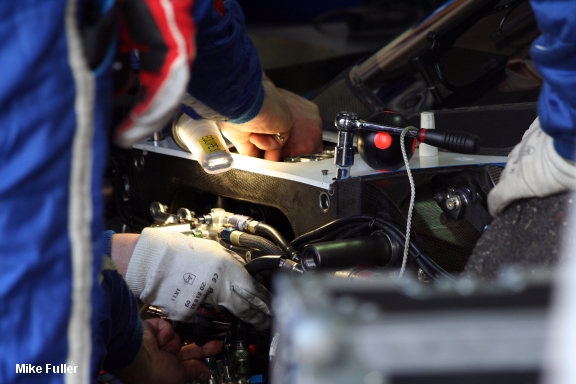 >>Peugeot had a bit of a scare when it was
discovered Tuesday evening, during a routine inspection, that a previously
repaired section of the monocoque had begun to crack again. The damage was located at the front of the
tub in the critical area of the suspension pickup points. Discussions surrounded how to solve the
problem; repair the tub on site or fly in a new one from France by
Friday with the result of having to skip qualifying and start from the back of
the grid. But in order to initiate the
repair Peugeot needed a critical repair jig manufactured. This is where Dennis Spencer’s Fabworks steps
in. Fabworks put their Buford, Georgia
facility at Peugeot’s disposal and by 1:45
pm on Wednesday CAD drawings and photos had been
transferred and work commenced on the part.
Peugeot was then able to virtually look over the shoulder of Fabworks' CNC
operator, as their part was cranked out, using Fabworks’ IP camera. In the mean time, Spencer moved one of his
airplanes from the Atlanta
area to the Gainesville
airport (15 minutes from the Buford shop) in anticipation of flying the item
directly to Sebring International Airport. And at 5:13
pm, the plane lifted off and headed south. Everyone involved was then able to track the
plane’s progress through Flight Aware.
Touchdown occurred 2 hours and 43 minutes later and the repair jig was
handed off directly to Peugeot at the airport.
Peugeot declared the jig perfect and initiated the repair finally
finishing up at 3 am
Thursday morning and in time for the after noon
qualifying session. >>Peugeot had a bit of a scare when it was
discovered Tuesday evening, during a routine inspection, that a previously
repaired section of the monocoque had begun to crack again. The damage was located at the front of the
tub in the critical area of the suspension pickup points. Discussions surrounded how to solve the
problem; repair the tub on site or fly in a new one from France by
Friday with the result of having to skip qualifying and start from the back of
the grid. But in order to initiate the
repair Peugeot needed a critical repair jig manufactured. This is where Dennis Spencer’s Fabworks steps
in. Fabworks put their Buford, Georgia
facility at Peugeot’s disposal and by 1:45
pm on Wednesday CAD drawings and photos had been
transferred and work commenced on the part.
Peugeot was then able to virtually look over the shoulder of Fabworks' CNC
operator, as their part was cranked out, using Fabworks’ IP camera. In the mean time, Spencer moved one of his
airplanes from the Atlanta
area to the Gainesville
airport (15 minutes from the Buford shop) in anticipation of flying the item
directly to Sebring International Airport. And at 5:13
pm, the plane lifted off and headed south. Everyone involved was then able to track the
plane’s progress through Flight Aware.
Touchdown occurred 2 hours and 43 minutes later and the repair jig was
handed off directly to Peugeot at the airport.
Peugeot declared the jig perfect and initiated the repair finally
finishing up at 3 am
Thursday morning and in time for the after noon
qualifying session.
>>We understand the Peugeots routinely ran
through the tech line posting weights a good deal above the 900 kgs minimum. Peugeot has admitted that they have stopped
development on the 908, instead concentrating on the 909 HY. But given the obvious pace of the 908 in
spite the cessation of development coupled with it not even being at fighting
weight, a couple of things come to mind.
Clearly the car is all engine.
Sure, the aero is competent, but you really have to think Peugeot has
put most of their concentration on engine side and in getting that power to the
track. Another thought also creeps into
the picture. How fast was Audi really
trying to go? I have suspicions that
Audi didn’t even come close to showing their entire hand and thus the Peugeot
was closer than it would have been. It
is a three year old design after all, frankly it wouldn’t have much business
being quicker than the R15, would it? |
>>Speaking of weight and late nights, it is our
understanding the Acura ARX-02 is designed to be several hundred pounds under
the minimum weight in order to be ballasted to the minimum of 900 kgs.
This is done primarily through a several inches
thick piece of steel or similar thick and heavy metallic ballast
located on or
near the front wheel centerline. We also hear the Acura teams had
a number of late nights, some of this is due the car's less than user
friendliness: 6-7 hours for an engine swap and 2 hours for a power
steering change.
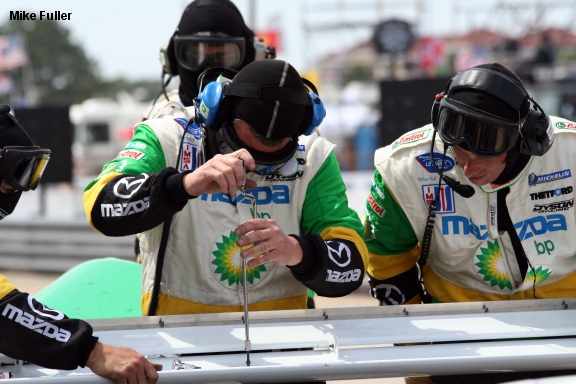 >>The #16 Dyson Lola-Mazda had a bit of a
fright when the wing departed rather unceremoniously during the race. The #16 continued on to the pits and the wing
landed between turns 3 and 4 where it stayed until being retrieved later in the race, perfectly
intact. According
to
Lola’s Julian Cope, upon inspection, it appeared the failure was
related to
rubber build up causing a vibration that simply rattled the wing loose.
Ultimately the wing's bolt through holes were undamaged and the
threads in the pylons intact. >>The #16 Dyson Lola-Mazda had a bit of a
fright when the wing departed rather unceremoniously during the race. The #16 continued on to the pits and the wing
landed between turns 3 and 4 where it stayed until being retrieved later in the race, perfectly
intact. According
to
Lola’s Julian Cope, upon inspection, it appeared the failure was
related to
rubber build up causing a vibration that simply rattled the wing loose.
Ultimately the wing's bolt through holes were undamaged and the
threads in the pylons intact.
>>There are still persistent thoughts
within the ALMS paddock that the ACO
regulations are not equitable between diesels and gas powered LMPs. I suspect you’ll hear the chorus of “sour
grapes” about now, but lets get everything on the table here and now—there are
still talks of being upwards of a 100 hp deficit between the top gasoline
powered cars and the diesels, this even after the ACO’s
10% restrictor diameter decrease for diesels. So we're not talking small reachable-thorugh-development offsets. With Henri Pescarolo having been appeased by Peugeot, who then takes
up the challenge to the ACO regarding the regulations?
>>And the biggest waste of money? It has to be the ACO’s
rear wing regulations. For all the cost
and effort, the rear wing regulations changes have effectively resulted in cars
that are as fast as last year (once the track was rubbered in we saw true
speeds—qualifying wasn’t representative of what the cars are capable of given
the support series action and the rubber put down by them). We’ll suggest that a much cheaper alternative
would have been a simple large inlet restrictor cut across the board aimed at
100+ hp. Sure, there would have then
been the temptation to optimize the package to that restrictor and thus regain performance, but at that
point costs would be optional.
What’s the ’09 rear wing update package cost (mandatory mind you),
$50,000-$100,000? For about $1000 the ACO
could have actually achieved the desired effect with an across the board power
reduction. |
|
 3.17.09 3.17.09
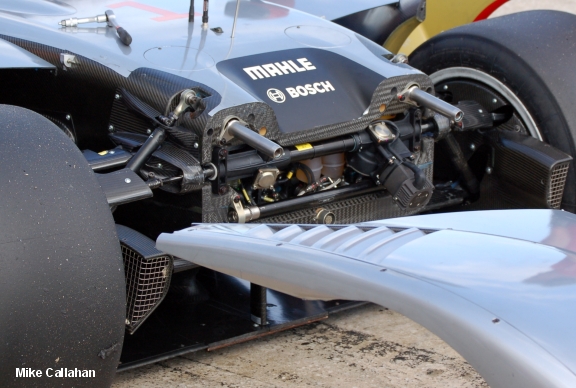
>>Mike Callahan, of the ALMS spotter's guide, gives us a first
look at the R15's front end. We can see horizontally mounted
torsion bars and the electronic power steering unit. Front
suspension members are individually shrouded as they are at the rear
(see Pruett image below). Brake ducting is as on the R10 in that it's via upright mounted backing plates with ducts mounted to the backing plates. |
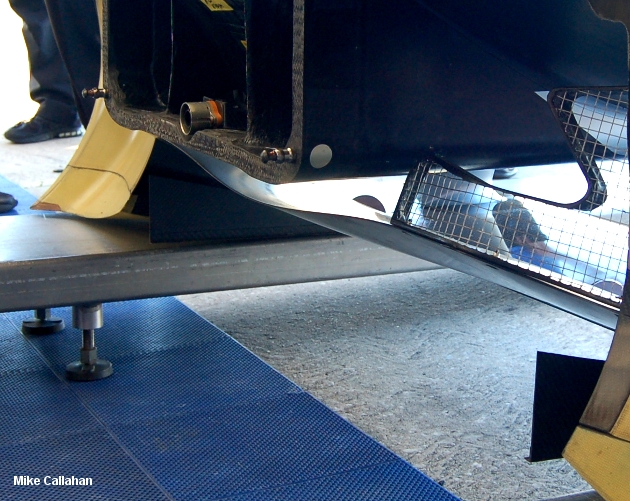 Here's
a look underneath the R15's front diffuser. What I've cropped and
focused on here is the trailing edge of the flap. We can see that
it comes to a point. Here's
a look underneath the R15's front diffuser. What I've cropped and
focused on here is the trailing edge of the flap. We can see that
it comes to a point.
The rhetorical question,
ultimately, is how has this been deemed legal? Let's refresh our
memory of Art 3.6.1, this is the full text:
3.6.1 -
With the exception of the rear wing defined in article 3.6.3, no bodywork
or underbody element having a wing profile (*) is permitted :
(*) "Wing profile"
: section generated by two arcs with different curves and/or centres joining
a leading edge at the front to a trailing edge at the rear, the purpose
being to exert an aerodynamic effect, lift or down force. Are not considered
as a wing profiles, the bodywork elements that:
•have a constant
thickness,
• have an absolutely
symmetrical profile,
• are vertical. |
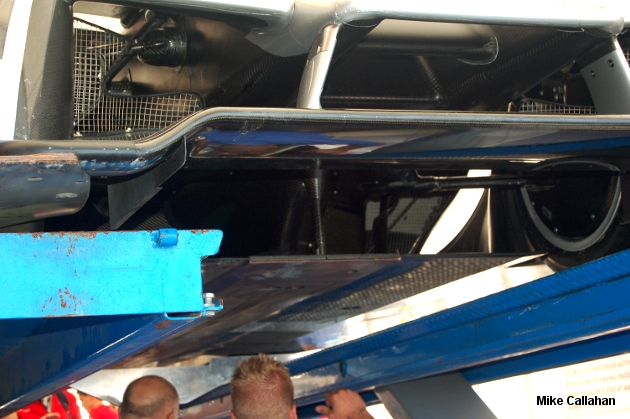 With that in mind, we can only
surmise one thing: the Audi's splitter wings must be of the symmetrical
variety. Run in ground effect and at an angle of attack, symmetric
wing profiles are rather efficient generators of downforce. Sure,
they'd be better served with purpose racing wing profiles, but you go
with what you can. The recent addition (2007) of the wording,"have an
absolute symmetrical profile," to Art 3.6.1 certainly benefits the
Audi's designers in this case. Ultimately it's no secret the main
desire is to create a wing in this area as that's the most efficient
shape. Audi has merely taken advantage of what's on the rule book. It
was our opinion back two years ago
that the revisions to Art 3.6.1 came about after discussions the ACO
had in regards to the updated '07 Porsche RS Spyder. With the
liberalization of the regulations in regards to what was allowed as a
"non-wing", the ACO opened the flood gates to all sorts of new and
interesting wing interpretations. With that in mind, we can only
surmise one thing: the Audi's splitter wings must be of the symmetrical
variety. Run in ground effect and at an angle of attack, symmetric
wing profiles are rather efficient generators of downforce. Sure,
they'd be better served with purpose racing wing profiles, but you go
with what you can. The recent addition (2007) of the wording,"have an
absolute symmetrical profile," to Art 3.6.1 certainly benefits the
Audi's designers in this case. Ultimately it's no secret the main
desire is to create a wing in this area as that's the most efficient
shape. Audi has merely taken advantage of what's on the rule book. It
was our opinion back two years ago
that the revisions to Art 3.6.1 came about after discussions the ACO
had in regards to the updated '07 Porsche RS Spyder. With the
liberalization of the regulations in regards to what was allowed as a
"non-wing", the ACO opened the flood gates to all sorts of new and
interesting wing interpretations. |
 |  | Aerodynamicist
and automotive enthusiast Paul T. Glessner presents "The Secrets
&
Basics of Vehicle Aerodynamics" Seminars. See why more cars
are going
faster and doing it more safely and in style. Paul has been
asked
to speak at venues like Bob Bondurant School of High Performance
Driving,
Society of Automotive Engineers (SAE), Specialty Equipment Marketing
Assoc.
(SEMA), and Performance Racing Industry (PRI). Paul's
seminars both
educate and entertain. The day long seminar can be held at
your club,
organization and/or company location with the organizer paying only
$100.
(click event date in site) to read
about Paul's
extensive background and testimonials from enthusiasts like Jay
Leno.
Schedule your seminar at www.aeroseminars.com! | |
"While
I am not an engineer or a major technical type, I enjoy the discipline
of aerodynamics and was pleased at how Paul was able to explain its
intricacies
to individuals like me." - Jay Leno, Tonight Show Host |
|
 >>Festivities
are kicking off today at Sebring and SpeedTV's Marshall Pruett is
already out of the box with a gallery of images of the Audi R15. >>Festivities
are kicking off today at Sebring and SpeedTV's Marshall Pruett is
already out of the box with a gallery of images of the Audi R15.
The R15 has shown to be very quick out of the box setting the fastest times (1:43.596 )
in today's test session. At that rate the track record looks sure to be
broken, and this with less downforce and power than last year. Well, at least that was the supposed goal of the 2009 regulations. |
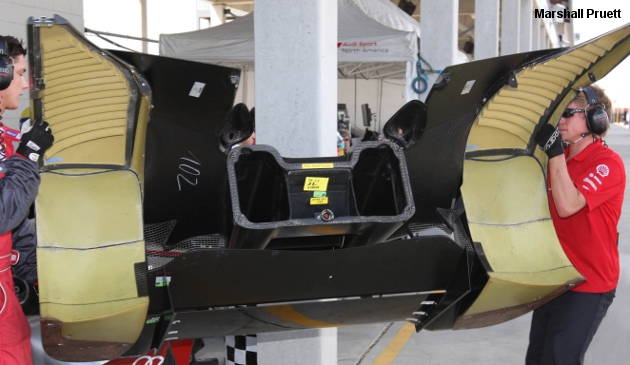 There's
little doubt the concept behind the R15's front diffuser is that of a
formula car with a mainplane and flap. It's our understanding the
flap isn't adjustable as that would require homologation of each
adjusted position. We're also wondering what the cross section of
the mainplane and flap are like as the LMP regulations strictly
regulate wings and their location. There's
little doubt the concept behind the R15's front diffuser is that of a
formula car with a mainplane and flap. It's our understanding the
flap isn't adjustable as that would require homologation of each
adjusted position. We're also wondering what the cross section of
the mainplane and flap are like as the LMP regulations strictly
regulate wings and their location. |
 The R15's rear suspension appears somewhat similar in general layout to the R10's.
We can see the (now) near vertical torsion bars (1) as well as
the through-shaft "3rd-spring" damper on top (2). All the rear
suspension members are covered in carbon fiber shrouds. The duct
ahead of the rear wheel draws air into this area of the car and out the
back to reduce base drag. The shrouded suspension members helps
to streamline the air's route through the duct. It also appears
that the sides of the gearbox are shrouded as well. The R15's rear suspension appears somewhat similar in general layout to the R10's.
We can see the (now) near vertical torsion bars (1) as well as
the through-shaft "3rd-spring" damper on top (2). All the rear
suspension members are covered in carbon fiber shrouds. The duct
ahead of the rear wheel draws air into this area of the car and out the
back to reduce base drag. The shrouded suspension members helps
to streamline the air's route through the duct. It also appears
that the sides of the gearbox are shrouded as well. |
 On
the Ferrari F2008 F1 car a similar vent appeared. It's important
to note that given the location of the vent on the Ferrari F1 car, the
vent was working in conjunction with the front wing and the airflow
that shed off the trailing edge. On the R15, the vent is far
enough forward to not to appear to have any interaction with the flap
and thus is working aerodynamically on its own. On
the Ferrari F2008 F1 car a similar vent appeared. It's important
to note that given the location of the vent on the Ferrari F1 car, the
vent was working in conjunction with the front wing and the airflow
that shed off the trailing edge. On the R15, the vent is far
enough forward to not to appear to have any interaction with the flap
and thus is working aerodynamically on its own.
Go to SpeedTV.com to see Pruett's full gallery. |
|
3.13.09
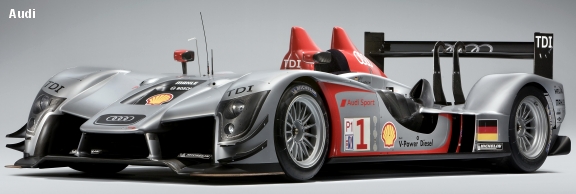 >>Audi
is simply bombarding us with images. Today they released yet
another series of images, these containing the first views of the rear
end of the car. >>Audi
is simply bombarding us with images. Today they released yet
another series of images, these containing the first views of the rear
end of the car. |
 | What's
interesting to note here is that the R15 has clearly undergone an
extensive revision to the rear bodywork since the first images were
released.
 |
|
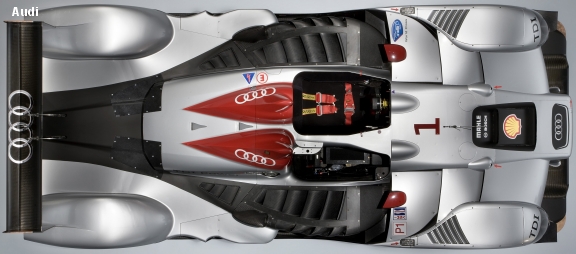 From the top we
can better see the continuos, unbroken surface that now covers the rear
suspension and how it differs from the test car. It is our
understanding that the ACO had something to do with the modification to
the bodywork. From the top we
can better see the continuos, unbroken surface that now covers the rear
suspension and how it differs from the test car. It is our
understanding that the ACO had something to do with the modification to
the bodywork. |
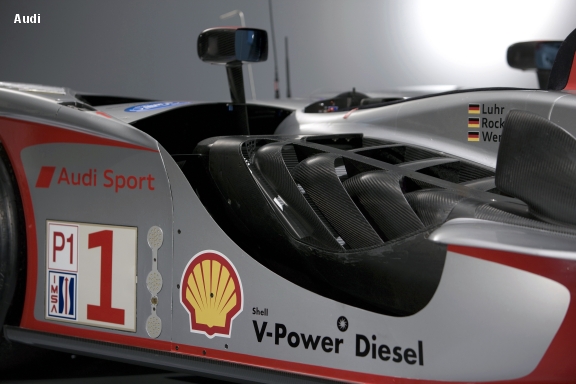 Unusually,
the front fender trailing edge transitions to a endplate which channels
the airlflow exiting out of the front diffuser area around the
radiators (area defined by the carbon louvers) and down the side of the
car. Traditionally this airflow exits the car just aft of the
front fender Unusually,
the front fender trailing edge transitions to a endplate which channels
the airlflow exiting out of the front diffuser area around the
radiators (area defined by the carbon louvers) and down the side of the
car. Traditionally this airflow exits the car just aft of the
front fender |
3.9.09
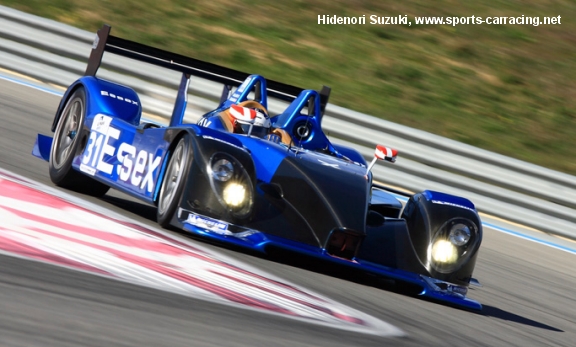 >>The Paul Ricard Le Mans Series test is ongoing and Hidenori Suzuki of the Japanese based website Sportscar-Racing
sends us these shots of the 2009 aero kit for the Porsche RS Spyder.
It has been reported that Team Essex is not running the direct
injection Porsche RS Spyder engine at the test. >>The Paul Ricard Le Mans Series test is ongoing and Hidenori Suzuki of the Japanese based website Sportscar-Racing
sends us these shots of the 2009 aero kit for the Porsche RS Spyder.
It has been reported that Team Essex is not running the direct
injection Porsche RS Spyder engine at the test.
|
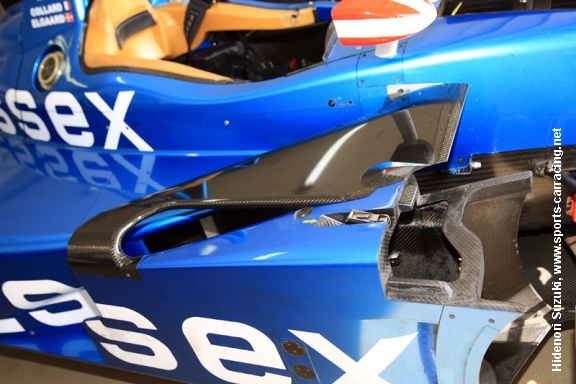 We believe this
is the 2008 Le Mans valence panel (as opposed to developed specifically
for the '09 aero regulations). Compare to the "high downforce" version. We believe this
is the 2008 Le Mans valence panel (as opposed to developed specifically
for the '09 aero regulations). Compare to the "high downforce" version. |
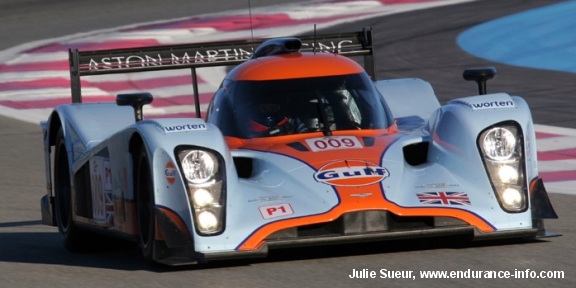 Aston
Martin unveiled their massaged Lola chassis at the Paul Ricard test.
Essentially Aston has tweaked the car here and there, but the
Lola core certainly is evident. The side pod now connects
directly to the front fender instead of being "stitched" together
through a valence panel as on both the Lola LMP1 and LMP2 coupes and
open toppers. The entire nose has been redesigned to impart Aston
Martin styling hints and thus the brake ducts are now either side of
centerline and framed by the traditional Aston Martin "grill" shape. Aston
Martin unveiled their massaged Lola chassis at the Paul Ricard test.
Essentially Aston has tweaked the car here and there, but the
Lola core certainly is evident. The side pod now connects
directly to the front fender instead of being "stitched" together
through a valence panel as on both the Lola LMP1 and LMP2 coupes and
open toppers. The entire nose has been redesigned to impart Aston
Martin styling hints and thus the brake ducts are now either side of
centerline and framed by the traditional Aston Martin "grill" shape. |
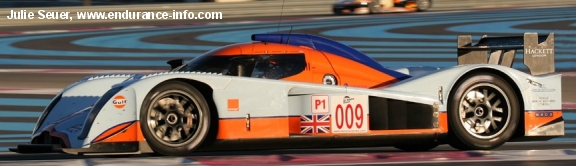 The
rear end has also been detailed with the rear bodywork varying slightly
over the standard 2009 Lola update. The rear wing endplate also
seems to be unique to the Lola Aston. The
rear end has also been detailed with the rear bodywork varying slightly
over the standard 2009 Lola update. The rear wing endplate also
seems to be unique to the Lola Aston.
Earlier in the week the
car's naming rights became an issue when Prodrive's David Richards was
quoted as saying the Lola Aston Martin was a "radical
redesign," in one stroke diminishing Lola's involvement in the
car's design (original concept and ongoing with Aston). Lola
issued a statement pointing out, "Lola has spent over two and a half
years in the research and development of this state of the art car
costing several millions of pounds." Ultimately the release from
Lola hit upon the real reason for Lola's forceful words..."When Aston
first mooted rehomologation of the Lola car and was given the cost of
their contribution to IPR and R&D the negotiations broke down. It
is completely inappropriate that Aston Martin should now attempt to
achieve 'ownership' through misrepresentation in the media." In
summation, if you don't want to pay for rehomologation then don't go
around hinting it's an Aston Martin anyway...
Thomas Enge did the unthinkable and, according to an interview with David Richards on Autosport, promptly wrote the #007 car off on the first day of testing at Paul Ricard.
Images provided courtesy Julie Sueur from Endurnace-info. |
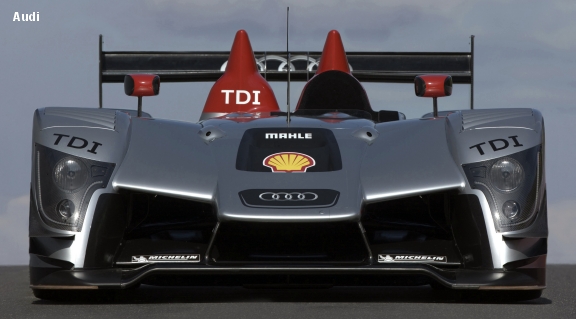 >>Audi
chose to release detailed images of the Audi R15 LMP1 today.
Perhpas they felt left out of all the action at Paul Ricard? >>Audi
chose to release detailed images of the Audi R15 LMP1 today.
Perhpas they felt left out of all the action at Paul Ricard? |
 The
R15's engine is a 5.5 liter turbo diesel V10 that is, according to
Audi, rated at better than 600 hp and more than 775 lb-ft of torque.
With two fewer cylinder, the R15's engine is naturally shorter
than the R10's V12 engine. But in addition to that, Audi has been previously quoted as
stating that this new TDI powerplant is lighter for the same swept
volume. All of this works towards improving weight distribution,
one of the weaker areas of the R10. The
R15's engine is a 5.5 liter turbo diesel V10 that is, according to
Audi, rated at better than 600 hp and more than 775 lb-ft of torque.
With two fewer cylinder, the R15's engine is naturally shorter
than the R10's V12 engine. But in addition to that, Audi has been previously quoted as
stating that this new TDI powerplant is lighter for the same swept
volume. All of this works towards improving weight distribution,
one of the weaker areas of the R10.
And as further evidence of
the weight distribution optimization, Audi has announced that the
on-board car battery is a Lithium-ion type similar to what is found in
hybrid gas-electric road cars. The use here is for weight savings
benefits with Lithium-ion batteries weighing less than the standard
lead-acid variety. |
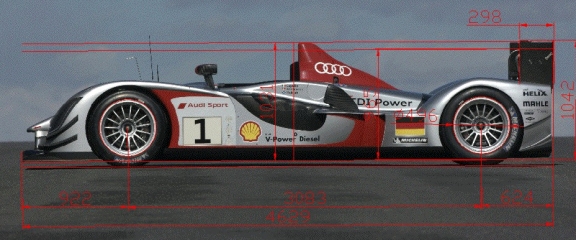 Preliminary
dimensioning shows a very long wheelbase of approximately 3083 mm which
is tangentially confirmed by the press release text which states, "Thanks to a longer wheelbase and the optimized vehicle
weight the R15 TDI is significantly more agile than its predecessor."
The Audi R10 was on a 2980 mm wheelbase. The overall length
of the Audi R15 appears to be about 30 mm short of the maximum.
Front and rear overhangs are approximately 922 and 624 mm
respectively. For now we can't resolve the apparent 1042 mm
height to the top of the rear wing endplate (regulations state max rear
wing height is 965 mm). Preliminary
dimensioning shows a very long wheelbase of approximately 3083 mm which
is tangentially confirmed by the press release text which states, "Thanks to a longer wheelbase and the optimized vehicle
weight the R15 TDI is significantly more agile than its predecessor."
The Audi R10 was on a 2980 mm wheelbase. The overall length
of the Audi R15 appears to be about 30 mm short of the maximum.
Front and rear overhangs are approximately 922 and 624 mm
respectively. For now we can't resolve the apparent 1042 mm
height to the top of the rear wing endplate (regulations state max rear
wing height is 965 mm). |
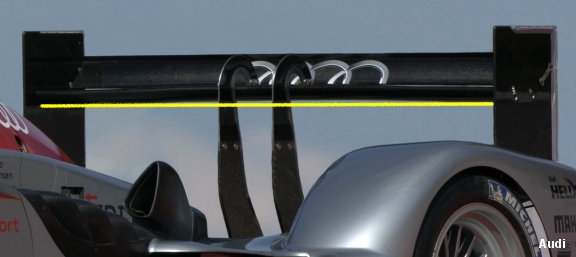 The
R15's rear wing is slightly anhederal. Connecting a straight line
between the two outer profiles and you can see that center section is
raised. Note the swan necks. The
R15's rear wing is slightly anhederal. Connecting a straight line
between the two outer profiles and you can see that center section is
raised. Note the swan necks. |
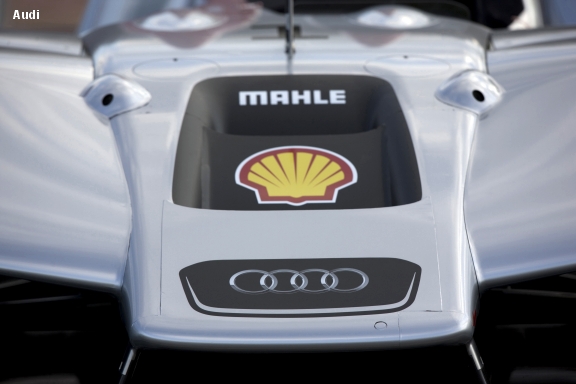 The
vents in the roof of the nose helps the wide nose pay for its
ride. The wide nose is related to another, for now undisclosed,
purpose. The
vents in the roof of the nose helps the wide nose pay for its
ride. The wide nose is related to another, for now undisclosed,
purpose. |
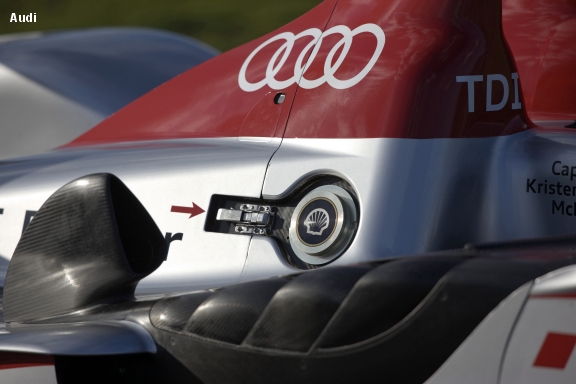 While appearing as though a mechanic has leaned on them, there's little doubt about the deliberate placement of the turbo inlets. While appearing as though a mechanic has leaned on them, there's little doubt about the deliberate placement of the turbo inlets. |
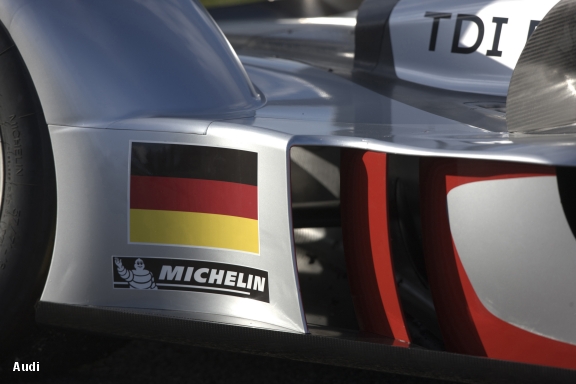 One
of the more interesting details...what do the ducts feed? And is
this an element related to the "raised rear suspension"? We think
so inamsuch as there wouldn't be a radiator located this far back
in the chassis. In essence we're suspecting that the ducts are
simply drawing in air to fill in the base area at the rear of the car
in order to reduce drag and the rear suspension is perhaps raised and
shrouded to augment this. One
of the more interesting details...what do the ducts feed? And is
this an element related to the "raised rear suspension"? We think
so inamsuch as there wouldn't be a radiator located this far back
in the chassis. In essence we're suspecting that the ducts are
simply drawing in air to fill in the base area at the rear of the car
in order to reduce drag and the rear suspension is perhaps raised and
shrouded to augment this. |
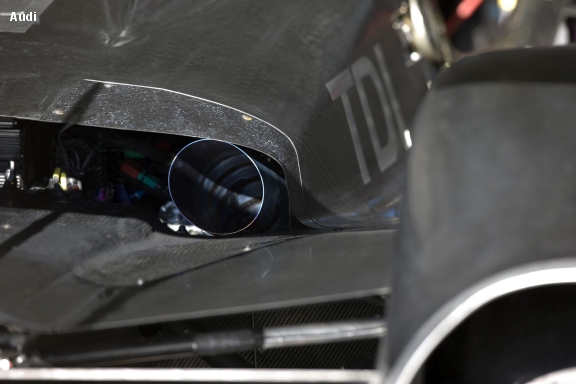 The
turbo's exhaust exits out the car just aft of the engine. This
allows for shorter exhaust headers and ultimately less weight. The
turbo's exhaust exits out the car just aft of the engine. This
allows for shorter exhaust headers and ultimately less weight. |
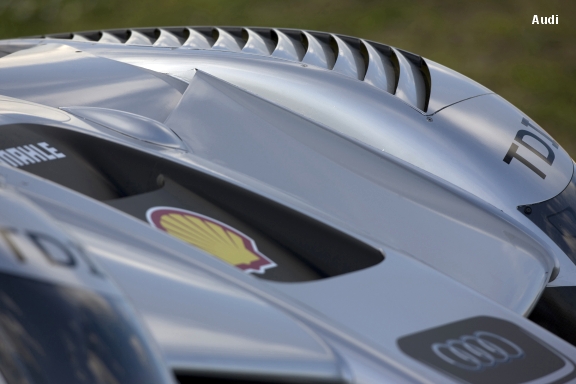 Some say platypus, we say manta ray... Some say platypus, we say manta ray... |
 |
|


